

Fresh murals are painted on the walls as you enter northern Syria. One reads, “Brotherhood knows no borders.” On another, a painted Statue of Liberty raises the Free Syrian Army flag — the green, white and black emblem of the rebels and their unrecognized proto-state that stands against the black, white and red banner of the Iranian-backed and Russian-armed Assad regime.
We crossed into Syria as a three-man team comprising myself — a Syrian-American — our field producer, a Syrian of Turkmen origin who was a long-time media activist-turned-journalist, and our Turkish cameraman/driver of Kurdish descent, who knew enough Arabic to be able to ward off the various militia checkpoints by repeating the phrase “hukumet Turkiye” (Turkish government) in Arabic to avoid unwarranted searches.
We entered a stretch of roughly 3,500 km in northern Syria that is dotted by burnt-out wreckage of the war and beautiful long stretches of wheat fields and gently rolling hills that could easily pass for parts of the American Midwest.
The distance from the active front lines has even allowed some towns to establish a semblance of normalcy; though the scars of war were there to make sure to remind us where we were. The seemingly endless rows of refugee tents and the hundreds of little children running around aimlessly under the hot sun are among the first things you see when you enter this Syrian purgatory, sandwiched between competing world and regional powers, each vying for a slice of what was once a nation state.
I was born in the Syrian capital of Damascus. My family and I emigrated to the US when I was eight years old. I last saw Damascus in 1999, during a summer visit to my grandparents’ house that remains in the Mezzeh district of the city. This time around, my return — “awda” in Arabic — to Syria was unsettling. I could not enter Damascus because I am wanted by the Syrian Military Intelligence Directorate (being a former US government employee and supporting the Syrian uprising are the likeliest reasons for my arrest warrant). I settled for the next best thing: The part of Syria free of Assad’s rule.
Our first stop was the city of Azaz in the northern Aleppo countryside, where a major battle ousted the Assad regime in 2012. There, we lunched at a popular roasted chicken restaurant that served the Syrian mezze and delicious garlic paste I remembered from my Damascus childhood. If only Anthony Bourdain had lived long enough to come here and taste it. Tragically, two days after our departure from Azaz, a double suicide bombing not far from the restaurant tore the entire neighborhood apart. What had been a fleeting happy memory is now erased forever.
The brief re-acclimation with the sounds and sights of Syria was a humbling reminder that this could have been my life. That the pain and daily struggle of the Syrian people we attempted to capture as part of a documentary I am producing could have just as easily been mine. I am, after all, a product of this land.
The nearly 40 degrees Celsius heat of the northern Aleppo countryside was brutal; doubly so with our chain-smoking driver, who never let up on the three-hour drive from the southern Turkish border town of Urfa into Syria. Syrian children (and the streets are often filled with kids running around aimlessly with not much else to do) immediately crowded our 4x4 vehicle as we attempted to make our way through narrow, potholed streets packed with tractor trailer trucks, motorcycles, and pickup trucks with heavy machine guns mounted on the back. The kids would beseech us, “para, para” (“money” in Turkish). They knew well enough how to play the game of survival.
We had entered Syria at a time when yet another Kremlin-brokered cease-fire had given way to a renewed assault by the Assad regime and its forces, backed by the full might of the Russian Air Force. The city of Khan Sheikhoun in the northwest province of Idlib had been pulverized into nothing but rubble. In 2017, Khan Sheikhoun was the site of a chemical weapon slaughter. By August of this year, the city had fallen — its resistance was no more.
What happened in Khan Sheikhoun was a bellwether for worse to come. Over 600,000 civilians have been displaced since April, according to the latest estimates. We saw many of those families living in tents under trees hugging the wall-lined border with Turkey — the last meters of safety afforded to them. Yet world powers continue to look the other way.
Syria is on the verge of being wiped off the face of the map — supplanted and replaced by an Iranian statelet. Policymakers need to redouble efforts to weaken the Assad regime’s war machine and Iran’s ability to resupply it.
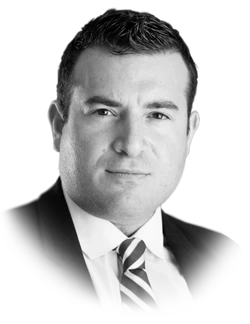
Oubai Shahbandar
But this humanitarian catastrophe is not one simply localized to Syria. The likelihood that more than a million refugees may stream into the EU — in a repeat of the 2015 mass migration — is very near to becoming reality. The despair one hears with the Syrians we spoke with on the ground was telling. They want to give their children a chance, just that, for a better life. So many of them have had to relocate time and time again; forced nomads fleeing further north as the Russian war machine and its Assad auxiliaries advance.
And the tent rows keep multiplying. Near the Bab Al-Salameh (gate of peace) border crossing, the only real prospects for Syrian boys are to either join a militia (recruitment can begin as early as 14 or 15 years old) or leave school and begin working at a very young age. Across the dirt path that essentially served as a “highway” connecting the city of Azaz to Al-Bab, kids were lined up on the sides of the road under the scorching sun begging for food and money.
Though the Assad regime no longer has dominion here and Daesh was forced out of the countryside by a combined Sunni Arab opposition force and the Turkish military, the lack of hope is palpable. Many of the children we saw were fatherless, and almost all had had a close family member killed or imprisoned by the Assad regime.
Even if the war were to end tomorrow, the fear of retribution by one of the dozens of various security services under Bashar Assad is enough to ensure that the displaced families could never live in peace again under the regime that sought to exterminate them.
It is a regime of boundless cruelty. And it is a cruelty that came to life as we heard the stories of women detainees held for years in the notorious Adra Prison. We spoke with engineers who are constantly having to come up with new ways to keep hospitals functioning underground. Incidentally, though not widely covered, it is also a cruelty that encompasses the entirety of Syria’s ethno-sectarian spectrum. Christians alongside Muslims have been victimized, forcibly conscripted, and arrested en masse by the regime.
The geopolitical implications of all this are huge. That is because, behind the scenes, Iran — Assad’s principal benefactor — is busy cementing its long-term occupation of Syrian land. Tehran is actively constructing massive bases of operation, like its Imam Ali base along the strategic Abu Kamal-Al-Qaim border corridor.
Make no mistake, the mullahs are paving a highway from Tehran through a Syrian corridor into the Beqaa Valley of Lebanon. They will ruthlessly bury any Syrian who gets in the way of their grand ambitions. And, from there, the launching pad for attacks and infiltration into Israel and the surrounding Arab states becomes even more of a threat.
But all is not lost. The wide swaths of northern Syria that are still outside the control of the tripartite Ali Khamenei-Vladimir Putin-Assad axis need not be served as a human sacrifice in hopes of satiating the monster. The people we interacted with, ate with, laughed with and promised to see again are worthy of the international community’s protection.
Shortly before my return to Syria, I had the chance to visit the US Holocaust Memorial Museum and the haunting Syria exhibit recently installed there. The words of Elie Wiesel, the museum’s founder, were etched on the walls as you entered the exhibit: “Our remembering aims at saving as many men and women as possible from apathy to evil, if not evil itself.”
I will never forget those words. And we should not wait until hundreds of thousands more Syrian lives become a distant memory. Syria is on the verge of being wiped off the face of the map — supplanted and replaced by an Iranian statelet. Policymakers need to redouble efforts to weaken the Assad regime’s war machine and Iran’s ability to resupply it. Otherwise, apathy to this evil of our time will surely come back to haunt us all. And then, there will be nothing to return to.
- Oubai Shahbandar is a Syrian-American who served for nine years as a Pentagon analyst and defense intelligence officer in Iraq and Afghanistan. He is currently working on a documentary on Syria.


