Security is a major issue in network and data centers especially in the workplace and the lack of awareness about device security is a matter of concern for organizations in Saudi Arabia, according to a Cisco expert.
Speaking at a press conference on Wednesday, the expert warned that there are two types of organizations: those which have been hacked and they know about it and those which are being hacked but are unaware of it.
However, according to him, major brand handset mobiles which can download free apps are protected from being hacked by the firms which manufacture them as they are conscious of preserving their own image and reputation.
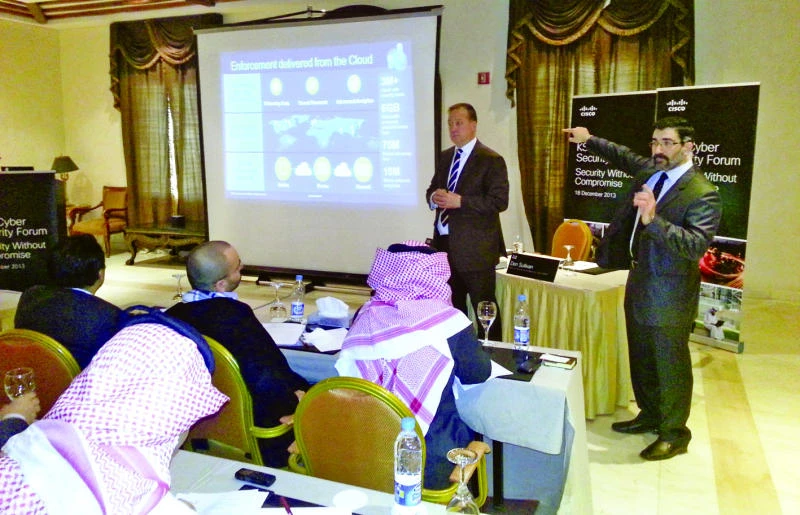
In his presentation at Marriot Hotel, Den Sullivan, head of architectures and enterprise, Cisco Europe, Middle East & Africa and Russia, said:
“Saudi Arabia’s business needs are changing the face of network security today.” Enterprises are being driven to enable more types of users with greater access to applications, devices and resources.
But these enterprises need to make sure that only the right users get access to specific applications, data and service functionality, he added. “Changing demands like BOYD have broken legacy security models, which force IT to choose between enabling greater productivity or greater security.”
Sullivan, who is here to address 200 various Saudi companies and government agencies on the gravity and rapid increase of cyber attacks and the huge loss and damage they cause to these organizations, said earlier hackers were not so sophisticated and mainly did it for fun. But now they use advanced technology, are more organized and are often run by a group or gang in pursuit of financial gains or have a political agenda. Their targets are high-profile firms in the country, the expert added.
During a panel session, Cisco executives highlighted some of the key security challenges faced by organizations in Saudi Arabia and unveiled new solutions the company is introducing to help address these challenges.
Cisco also released findings from its Middle East ICT Security study1 conducted among next generation executives in Saudi Arabia and the UAE, which revealed that 65 percent of employees are placing their companies at risk by not understanding the security implications of using personal devices in the workplace.
Cisco research done earlier this year indicated that enterprise security within organizations in Saudi Arabia and the UAE is being put under increasing pressure by the proliferation of devices brought into the workplace.
It highlighted that almost half (46 percent) of all employees in the region are bringing at least one unsecured device to work. A more worrying factor, however, is that only 55 percent of the companies surveyed have a plan in place to manage the use of these devices when used for work purposes.
The survey, in which more than 200 young executives from the two countries participated, was conducted to understand better the attitudes young management-track professionals have about security within their organizations.
‘Businesses need to tighten cyber security’