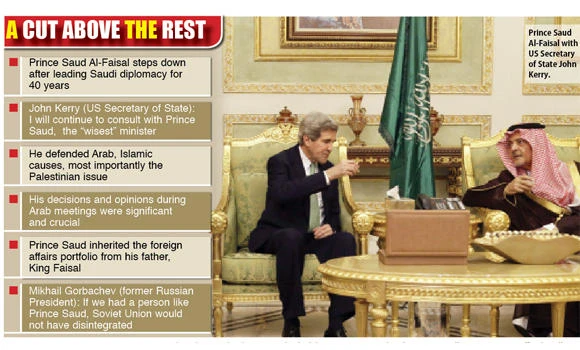
Prince Saud Al-Faisal, who served as Saudi Arabia’s foreign minister for 40 years, has stepped down. His name will be written in golden letters on the walls of international diplomacy. His colleagues and friends say they cannot believe Prince Saud leaving the Foreign Ministry after four decades of continuous service, taking important decisions on various national, regional and global events and developments. People call him the Kissinger of the Arab world.
Prince Saud’s diplomatic journey started during the Cold War between the US and the Soviet Union and continued until the formation of the first Saudi-led Arab and Islamic coalition to restore legitimacy in Yemen. He served King Khaled, King Fahd, King Abdullah and Custodian of the Two Holy Mosques King Salman, and during Cabinet reshuffles his name remained unchanged.
King Salman relieved the country’s chief diplomat of his duties upon his request due to health reasons, but appointed him as state minister and Cabinet member, king’s adviser and special envoy, and supervisor of foreign affairs.
Foreign ministers in the Gulf Cooperation Council and other Arab countries have commended Prince Saud’s contributions toward the success of Arab causes, defending the rights of Arabs and Muslims at international forums. His voice was highly effective in the message reaching home.
US Secretary of State John Kerry said Prince Saud had associated with 12 US secretaries of state and impressed all of them. Former Soviet President Michael Gorbachev had said: “If we had a man like Prince Saud Al-Faisal the Soviet Union would not have disintegrated.”
Prince Saud has been a skillful captain of the Foreign Ministry as he inherited the portfolio from his erudite father on March 25, 1975. He steered the ministry through the waves of crises, taking bold and intelligent decisions. He has been a strong advocate of Arab and Islamic causes, most importantly the Palestinian issue. He established strong Saudi relations with other countries on the basis of mutual respect and political independence. Saudi Arabia has never reacted emotionally to events and situations but dealt with them intelligently.
One of the major tests faced by Prince Saud in his career was the Gulf crisis or Operation Desert Storm that was launched during King Fahd’s era. Saudi Arabia was successful in mobilizing support of 34 countries to liberate Kuwait from Iraqi occupation. Protection of Saudi embassies and missions around the world following the Sept. 11, 2001, attacks in the US was another big challenge for the minister.
Bahraini Foreign Minister Sheikh Khaled bin Ahmad Al-Khalifa says: “Prince Saud has played a successful diplomatic role when Bahrain passed through a major crisis in 2011 … The people of Bahrain will never forget Prince Saud and hold him in high esteem. Prince Saud is a school of diplomacy and has played a big role in enhancing Saudi Arabia’s international reputation.”
Prince Saud, he said, spoke vividly about Bahrain and defended the country by providing facts. “He used to contact me even at late hours to know the latest developments in Bahrain during the crisis. He has also visited Bahrain several times during those difficult days,” the minister said.
“I have been working with Prince Saud for the last 10 years and we used to meet now and then at different events and occasions. I have learned many things from the prince, especially how to deal with difficult situations. Some of them have taken place at Arab meetings when Prince Saud came up with solutions acceptable to all,” he said while praising Prince Saud’s readiness to respect the views of others.
US Secretary of State Kerry says: “I will continue to consult with Prince Saud Al-Faisal and I appreciate his friendship based on the many hours we spent discussing the challenges facing our nations.”
He said Prince Saud had helped steer the Kingdom at a time when the world had become more complex than ever before. He was not only the longest-serving foreign minister in the world “but also among the wisest. He has worked with 12 of my secretary of state predecessors in the United States, and has been admired by all.”
US State Department acting spokeswoman Marie Harf also paid tribute to Prince Saud. “The alliance, as we all know, between Saudi Arabia and the US is historic and enduring, and we will continue to maintain our close, productive relationship as we work together to address a number of serious challenges,” she said.
Amr Moussa, former Egyptian foreign minister and secretary-general of the Arab League, described Prince Saud as a top-class diplomat. “His bold stances have benefited the Arab world. His was the voice of reason and sobriety. Rulers as well as government officials will miss him.”
Moussa added: “If the Arab world had 100 people like Prince Saud Al-Faisal, its situation would have been much better. I wish him better health to continue his contributions to safeguard Arab interests.” He said Prince Saud has taken several courageous decisions, especially to protect the rights of Palestinians and strengthen Arab unity.”
Fayez Tarawneh, chief of the Royal Court in Jordan, also spoke highly of Prince Saud, describing him “a giant diplomat in the world.” He said Prince Saud has become a well-known diplomat not because of his long-term service as foreign minister but because of his effective contributions. He gave instances of Prince Saud taking bold and decisive decisions at Arab and OIC conferences of foreign ministers.
Diplomat par excellence