RIYADH: Deputy Crown Prince Mohammed bin Salman, second deputy premier, minister of defense and chairman of the Council of Economic and Development Affairs, stressed that the Kingdom’s Vision 2030, approved by the Cabinet on Monday, constitutes a road map for the country’s overall development in the next
15 years.
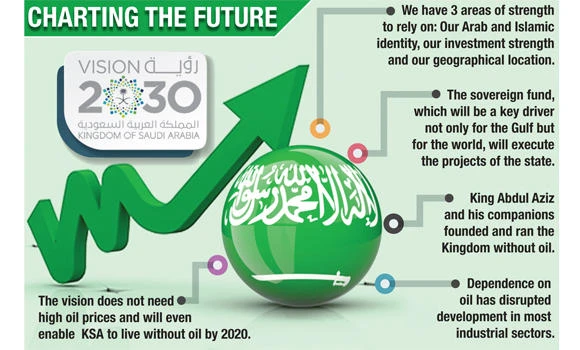
In an exclusive interview with Al Arabiya News Channel by Turki Al-Dakhil, Deputy Crown Prince Mohammed bin Salman said that the Kingdom of Saudi Arabia was founded by late King Abdul Aziz and his companions without the need for oil, pointing out that it is very dangerous to deal with Aramco company as our constitution. He said that Aramco’s reverence by some is a very big problem and we have a state of oil addiction in the Kingdom, which disrupted the development. He added “we will turn Aramco into a holding company and move its operations to companies owned by it.”
The deputy crown prince explained that high risks would have occurred if there had not been a move to offer Aramco for public subscription, saying that the investment fund will not manage Aramco and there will be a board of directors to manage it. He pointed out that we have three strong points on which nobody competes with us: They are our Arab and Islamic depth, our investment strength and our geographical location.
The following are excerpts from the interview:
Q: You have declared more than once that you will offer part of the shares of the world largest oil company, the Saudi Aramco company, for public subscription both in the Kingdom of Saudi Arabia and abroad. Everyone is talking about that Aramco is a public property; how did you manage to give up Aramco by this offering?
A: First of all, we are talking today about a vision. The vision is a road map for our goals of development and economy and other aspects for the next 15 years; Aramco has a very small part of this vision in which there are so many contents. We should not reduce them to Aramco. No doubt that Aramco is part of the main keys of this vision, and for the renaissance of the economy and the renaissance of the Kingdom of Saudi Arabia. The IPO of Aramco has several benefits. The first and most important of these benefits is transparency. People in the past used to be upset that Aramco’s files and data are not announced, unclear and not transparent. Today, it will become transparent. If Aramco is listed in the market, this means it must announce its statements and declare every quarter. It will come under the supervision of Saudi banks, Saudi analysts and thinkers. All world banks and all research and planning centers in the world will intensively monitor Aramco. Aramco today works as a facilitating limited company. This is a very dangerous matter: A giant company of this size is managed and treated as a facilitating limited company. I see the portion that will be offered for public subscription as very small, less than five percent.
Q: On what basis this percentage (less than 5 percent) has been set?
A: First, Aramco’s size is very huge. To date, there is no final valuation and we expect Aramco to be valued at more than $2 trillion. We talk about more than SR7 trillion. If only one percent of Aramco’s shares was offered for public subscription, it will be the largest IPO in the history of the world.
Aramco’s IPO will be in the Saudi market and there are ideas about finding outlets for Aramco shares outside the Saudi market. Today, you can buy gold from the US market, or oil through funds in the US market and we have something similar. For example, in the Saudi market there is the Falcom Fund which buys in several companies. Ideas include establishing a fund in the US market only for buying Aramco’s shares. This is one of the outlets that will be very important in bringing liquidity for Aramco trade or other companies in the Saudi market. The Aramco company is a part of the keys of the Kingdom of Saudi Arabia’s Vision 2030 and Aramco’s IPO will make it transparent and under the supervision of banks and everyone else.
Q: This means that you will not violate, as some say, any sacred thing when you offer Aramco or part of it for public subscription?
A: This is a very big problem.
Q: Aramco’s reverence?
A: Yes. King Abdulaziz and all men who worked with him all over the Kingdom, when they established the Kingdom, there was no oil. They founded and ran the country without oil and they lived in this country without oil ... Today, oil has become our constitution; the Qur’an and Sunnah and then petroleum. This is a very dangerous thing. We have a situation of oil addiction in the kingdom, which disrupted the development in many sectors in the past years.
Q: Is oil the main item on which the economy of the Kingdom of Saudi Arabia depends?
A: Yes. Oil comes from your work in investment no less, no more. Investment is a company that has value and should be owned as an investment, not owned as a main commodity or a main source of income.
Q: So you are seeking to diversify the sources of income?.
A: Yes. Aramco’s IPO has many benefits other than the transparency, its benefits for the Saudi market. When you offer a company of more than SR7 trillion in the Saudi market, then you have doubled the size of the Saudi market. There is also a second phase of the offering. Aramco’s parent company and then its affiliated companies will be offered in the market, it would give the Saudi market a larger size, this the second benefit for the market. The third benefit and the most technically important after Aramco’s IPO is shifting Saudi Arabia’s income from oil to investment. What remains is how to diversify your investments. Most assets of your investment portfolio are in energy companies, we must diversify the investment by borrowing and entering in other opportunities in order to balance your portfolio, and this is what will be done in the coming years, which will help to increase the size of your portfolio.
Q: So, you will offer initially five percent of Aramco’s parent company or of some of its affiliated companies?
A: Less than five percent of the Aramco’s parent company and most of Aramco’s affiliated companies. We are trying to turn Aramco into a holding company and the operating sector will only belong to the companies owned by Aramco.
On the Public Investment Fund’s extent of risk in relation to Aramco, that lack of action is much riskier and that the Public Investment Fund will not manage Aramco in the future. Aramco will be run by a Board of Directors. The Board of Directors will be elected by a general assembly, which represents Aramco’s owners. The owners may be the fund or other citizens, or investment entities at home and abroad, who will buy Aramco’s shares. This will make a very huge leap. Preliminary data points out that the fund will be in control of more than ten percent of the world’s investment capacity. The fund’s size of assets will be more than 3 percent of the global assets. We believe that it will exceed these estimates.
Question on lands:
A: Lands, we believe that their development will solve part of the problems and crises that we have in the cities, whether in commercial, financial, business or housing complexes . There are very large assets, which are areas that have not been developed so far in this field, especially the tourism field or others. I expect that these assets will amount to one trillion Saudi riyals. Investment Fund will not manage Aramco Company. There will be a Board of Directors for Investment Fund that will control 10% of the investment capacity in the world. The Investment Fund was restructured last year. With little studies, the investment fund gained profits which amounted to SR30 billion in 2015.
Q: Are these lands owned by the state?
A: Yes, these lands are owned by the state. And now we have finished the procedures regarding the transferring of their ownership to the Public Investment Fund.
Q: Thus, will they be offered or invested through the construction of malls and commercial centers?
A: No, the Fund does not enter into malls; and its size is very large. The Fund enters into huge opportunities, mostly lands and great opportunities. The lands will be transformed into projects, transformed into a company and offered at whole in the market.
Q: So, don’t you consider that you will manage, in your capacity as you are responsible for the Public Investment Fund and chairman of the Council of Economic and Development Affairs, these funds with a policy having some risks?
A: No, we have worked in the Public Investment Fund which was restructured last year. Small details have remained, and the full program of Public Investment Fund will been announced; and how to manage the resources and make the decision. The Fund’s transparency will be clear to everyone. I am the chairman of Board of Directors of Public Investment Fund. I do not have the decision. The decision is taken by the Board, according to the mechanism and governance that will be released and announced to everyone. I can not take a decision without accordance with this governance.
Q: This means that a chairman or board of directors can not dictate opinions.
A: No, the board can not dictate its viewpoints.
Q: Why?
A: Because the board of directors can not vote except based on the mechanism announced by public investment fund governance or it will be announced.
Q: What have you done after the restructuring of the Fund?
A: The introduction of new assets to the Fund; Aramco and other assets, and re-solving the problems of current assets owned by the Public Investment Fund, whether companies or other projects. There were stalled projects and restructuring some of them. Some of the problems facing some other companies owned by the Fund were solved, and this will support and increase the profitability of these companies and lead to more profits for the Fund.
Q: Some believe that the Fund was managed with a conservative investment policy, do you overpass this conservative investment policy?
A: The word conservatism and risk is sensitive. The Fund’s decision is based on a clear study, a clear analysis and a clear vision. The decision became studied and procedures have not changed. The Fund in the past was not working well, and not achieving high profits. In 2015 we were able to realize a profit from the fund amounting to approximately SR30 billion, which led and contributed to raising non-oil revenues by 35 percent in 2015. This is in one year, is this conservative? Or did it earn additional profits for the government?
Q: You stressed on three main axes in the vision released today, on what basis have you built this vision? Is it only on these elements?
A: Of course, there was a very big debate, like entering human development into it, or other elements . What is the vision? It is to put your strength areas which you can operate on them in the date of this vision.
Q: Will it be in the time that you have set?
A: In the time that we have set, we have three areas of strength that we have not exploited them and no one competed with us regarding them. The Arab and Islamic depth, we have Muslims’ Qibla and we have Madinah and very huge Islamic heritage. Our Arab depth is strong. Arabism was launched from the Arabian Peninsula and the Kingdom constitutes the large part of it. This is not being fully exploited, and we have the world’s leading investment force. Today we will launch the largest Sovereign Fund in the globe, and this will be a key driver of the globe, not only for the region, there will not be any investment or movement or development in any region of the world, without the voice of the Saudi Sovereign Fund which executes the projects of this state, if they do not succeed or we do not invest in them that will affect directly, and vice versa. The Kingdom of Saudi Arabia will be a strong investment force through its Sovereign Fund, and through other funds owned by the government, and through the most important profession; Saudi businessmen. Yes, we have many businessmen in different industries, but most businessmen are in investment companies. The Saudi mentality is an investment one, we must use it, and push the Sovereign Fund and other funds, and all Saudi companies, so as to be an investment force to move the Saudi market and the global market.
The third aspect is the geographical location. We are in a very special geographical location, we have three most important marine straits in the world and almost 30 percent of global trade passes by sea through the Kingdom and now we will have King Salman causeway between the Kingdom of Saudi Arabia and Egypt, which will be the most important land border crossing in the world and the major part of trade between Asia and Africa and a major part of trade from Europe to Asia pass through the Kingdom.
We have a huge opportunity to create logistical services, both in aviation or ports or industrial complexes or in the economic centers that will be developed or in linking the Gulf countries, Egypt, Jordan and other countries to find a very large movement by exploiting the geographical location centers. This will make many goods pass through the Kingdom of Saudi Arabia that worth hundreds of billions.
Q: From Asia to Europe?
A: Yes, this will make many commodities amounting to billions of dollars pass by. This will create very huge economic opportunities and new industries, and jobs, and at the same time, they will help in the growth of the global economy. These are the three main pillars of the vision which are your strength that must be exploited. We must not focus on other pillars in which we are weak, and we can not strongly grow them up. We want to exploit the strength areas that we have and then move on to another stage.
Q: Let me ask you about oil again, did you launch this vision due to low oil prices?
A: Never, this vision was about to be launched, whether oil price is high or low.
Q: If oil prices return and stabilize above $70, how the vision would be affected?
A: The vision will not be affected in general. If oil price rises, no doubt it will be a strong supporter and incentive, because too many procedures will be easier for us, but the vision does not need high oil prices, but it deals with less oil prices.
Q: What is the date in which you will not need oil income and therefore other income would be relied on?
A: I think that if oil stops in the year 2020, we will be able to live without it.
Q: You focused in the vision to preserve the high living standards and raising citizens’ living standards?
A: Yes, this is part of the vision. This requires the cooperation being exerted by citizens in order to maintain a better standard of living and improve it.
Q: What do you expect from citizens to do?
A: Everyone must work in it. Today we are making more effort to convince everyone, whether in the government agency or in executive, legislative or judiciary authorities, whether citizens or businessmen. This is our fate we all as Saudis must do their turns in this vision.
Q: You referred within the vision to the vital society; you talked about the development of Haj and Umrah, and providing more welfare services for pilgrims and Umrah performers?
A: Of course.
Economic objectives outlined