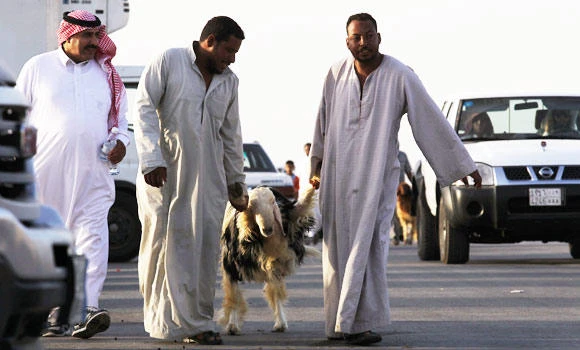
Meat parcels are a common gift exchanged among neighbors and relatives across the Muslim world and in Makkah in particular.
In fact, the Eid Al-Adha festivity has always been synonymous with giving sacrificial livestock in keeping with the example of the Prophet Muhammad (peace be upon him).
Umm Saad Al-Sharhri says many people view Eid Al-Adha as an occasion to exchange tokens of gratitude, such as flowers, perfumes or chocolates, in addition to exchanging meat parcels.
During Eid, families gather together to cut and distribute the sacrificial meat among one other.
Relatives and neighbors often gather to have a traditional fatty breakfast on the first day.
Amal Al-Saleh said many women get creative in packaging the meat to make gift parcels attractive.
Nora Al-Widahi spoke of Asir customs during Eid.
“We buy the lamb well before Eid, and some people, especially those who live in the Badia, raise their own lamb. On the first day of Eid, family members get together and each family head slaughters a lamb in front of his wife and children to teach his sons how to slaughter. Women then cook parts of the meat for breakfast,” she said.
She added some families gather at the head of the family’s house and men help each other with the slaughter.
Women save some meat to give to neighbors after breakfast. The lamb is divided into a third for the family, a third for friends and a third for the needy.
Nora said when there is extra meat, women and men take part in salting and drying it, especially since Asir is known for its cool climate, which helps to preserve meat produce.
Lamb is often kept aside for pilgrims who come to visit on the second day.
“Sacrificial lamb has become very expensive and that is why many families have given up buying the pricey commodity,” said Madiyah Al-Hakami.
“Eid provides an opportunity to offer this meal for those who need it and those who can’t afford to buy meat. I call my children to help with the slaughter and distribution of the lamb. This habit should be instilled in the hearts of our young children.”
Dietician, Balqees Bakhtmah said meat has great nutritional value since it builds the body’s cells.
“The best meat is close to the head because it is lighter on the stomach and has little harmful fats,” she said.
“The body, however, does not need more than 100 to 200 grams of meat, so people are advised to eat little amounts to avoid diseases that could be caused by eating too much meat.”
Roast meat is easiest to digest and white meat is less harmful than red meat because it has a lower fat content, which can raise cholesterol levels in the blood.
Bakhtmah said calories vary according to meat type. For instance, goat meat has less calories than sheep.
Around 100 grams has 150 calories and only 10 percent fat.
Sheep meat only contains 260 calories per 100 grams and fat content does not exceed 20 percent of its weight.
Eid meat makes for perfect gift pack