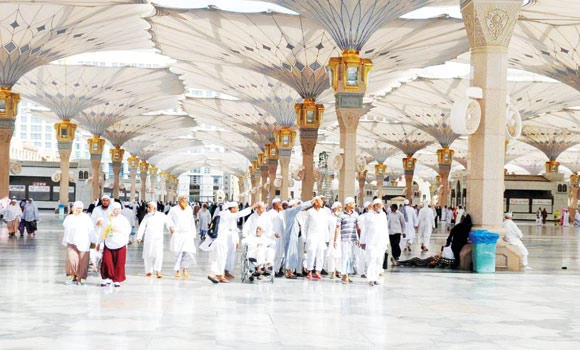
Every year millions of Muslim faithful from different parts of the world assemble in Makkah and other holy sites for Haj, the fifth pillar of Islam, in a unique expression of Islamic unity and brotherhood, chanting “Labbaik Allahumma Labbaik, Labbaik Lasharika Laka Labbaik” (O Allah, here we are answering Your Call, and we reaffirm our faith that You do not have any partners).
They come to the holy places in Saudi Arabia responding to the call made by Allah through His Prophet Ibrahim (Abraham): “And proclaim to mankind the Haj (pilgrimage). They will come to you on foot and on very lean camel. They will come from every deep and distant (wide) mountain highway (to perform Haj), that they may witness things that are of benefit to them. Let them complete their prescribed duties and perform their vows and circumambulate the ancient House.” (Qur’an 22:27-29).
Haj brings together the faithful from across the world, irrespective of their race, color, language, culture and position, in a marvelous manifestation of human unity and equality.
Allah has stated in the Qur’an: “O mankind! We have created you from a male and a female, and made you into nations and tribes, that you may know one another. Verily, the most honorable of you with Allah are those (believers) who are the most pious. Verily, Allah is All-Knowing, All-Aware. (49:13)
Retracing Prophets’ lives
During Haj, pilgrims retrace the unforgettable instances from the lives of Prophet Ibrahim, his wife Hajarah (Hager) and their son Prophet Ismail (Ishmael) may Allah be pleased with them, thus receiving the gratification of following the path of great prophets.
They circumambulate the Holy Kaaba, in the center of the Grand Mosque in Makkah, which was rebuilt by Ibrahim and Ismail.
They run between Safa and Marwa mountains in commemoration of the run done by Hajarah in search of water for her son Ismail when he was a little child, which ultimately resulted in the sprouting of Zamzam, an amazing source of water that continues to quell the thirst of the millions of pilgrims and worshippers until today.
A great symbolic act
The whole practice of Haj is a very symbolic act.
The two pieces of white cloth a Haji wears reminds the believer of the simplicity of the way in which he came into the world.
It also reminds him of his final resting place, where he would lie within another white cloth, separated from the world, similar to the way in which he is separated during Haj.
The circumambulation (tawaf) around the Holy Kaaba denotes how we as believers should be living our lives, circling around Allah, following His teachings.
The faithful spend the night in Mina on Dul Hijjah 8 at the start of the pilgrimage for Yaum Al-Tarwiya in preparation for their important journey to Arafat, about 20 km southeast of Makkah, where they spend the whole day in prayer at the climax of the annual pilgrimage.
They seek Allah’s forgiveness to cleanse their minds from sins and bequeath His blessings in order to lead a better life in future for the benefit of not only himself, his family and the community but the whole mankind. Prophet Muhammad (peace be upon him) has said: “There is no day on which Allah frees His servants from Hell fire more than the Day of Arafat. And, verily, He draws near and then proudly speaks about them (pilgrims) in front of angels, saying, ‘What do they seek?’”
In another Hadith, the Prophet says: “Whoever performs Haj and does not commit any obscenity or transgression shall return as he/she was on the day his/her mother gave birth to him/her.”
Another Hadith says: “The reward for a rightful Haj is nothing but Paradise.” (Bukhari and Muslim).
Haj is Arafat
The day of Arafat holds great importance in Islam since this is the day when Allah completed His revelation on the Prophet.
According to one Hadith, a Jewish man said to Caliph Omar bin Al-Khattab: “O Ameer Al-Mumineen! There is a verse in the Qur’an, which if it was revealed on us, the Jews, we would have taken that day as a festival.”
Omar asked: “Which verse?”
He said: “This day I have completed your religion for you, fulfilled My blessing upon you, and have chosen for you Islam as your religion.” (Qur’an 5: 3).
Omar said: “We know on which day and in which place was this verse revealed to Allah’s Messenger (peace be upon him). It was when he was standing in Arafat on a Friday.”
Prophet Muhammad has said “Haj is Arafat” considering the significance of Arafat Day.
After spending a full-day in prayers and meditation, seeking Allah’s forgiveness and bounties, Hajis move from Arafat to Muzdalifah after sunset.
Spending part of that night in Muzdalifah, they return to Mina to stone at Jamrat Al-Aqaba in commemoration of Prophet Ibrahim’s rejection of Satanic inducement to dissuade him from sacrificing his son Ismail.
The Qur’an explains: “So We gave him the good news of a forbearing son. And when (his son) was old enough to help in his daily affairs, he (Ibrahim) said: O my dear son, I have seen in a dream that I must sacrifice you. So what do you think? He said: O my father! Do that which you are commanded. God willing, you shall find me of the patient.” (Qur’an 37:101-102)
Ibrahim took his son to a place in Mina to sacrifice him. “And when they both submitted (to the command of God), and he (Ibrahim) laid him (Ismail) face down upon his forehead; We called to him: O Ibrahim: You have indeed fulfilled the vision. Lo! Thus do We reward the good. Lo! That verily was a clear test.” (Qur’an 37:103-106) Then Allah instructed Ibrahim to sacrifice a sheep instead of Ismail. Not only Hajis but Muslims all over the world remember this incident on Eid Al-Adha and sacrifice animals to get the reward of Allah.
It was reported that Prophet Muhammad slaughtered on the day of sacrifice two horned white and black castrated rams.
When he placed them facing the Qiblah, he said: “Verily I turned my face toward the One who created the heavens and the earth, upon the religion of Ibrahim, being upright, and I am not one of the polytheists. Verily, my prayer, my sacrifice and my death are all for Allah, the Lord of the worlds. There is no partner for Him and I have been ordered with that, and I am one of the Muslims. O Allah, it is Thine and for Thee, from Muhammad and his people: In the Name of Allah. Allah is the Greatest.” (Ahmad, Ibn Majah and Abu Dawud).
Allah is not asking for the flesh and blood of the slaughtered animal, but he looks into the believer’s heart, intention and sincerity and his/her readiness to sacrifice. After sacrifice the Haji goes to shorten or cut off his hairs of head in utmost simplicity and sense of submission and avoidance of any pomp and style. He is ready to remove his beautiful hair for obtaining the pleasure of God. After performing Tawaf Al-Ifadha at the Grand Mosque in Makkah, they spend three more days in Mina on the 11th, 12th and 13th Dul Hijjah. This gives them a golden opportunity for Muslims from different parts of the world to acquaint with one another and discuss matters for the uplift of the community.
During these three days, they stone at the three Jamrat, showing their rejection of Satan and its hateful thoughts and advices.
Haj rituals are completed with Tawaf Al-Wida (farewell circumambulation of the Kaaba) on Dul Hijjah 13 and the pilgrims return to their countries as new individuals spiritually energized to make positive and constructive contributions in their societies.
Hassan bin Ali Al-Ahdal, secretary-general of the International Islamic Media Organization, highlights the significance of Haj, saying it brings together Muslims from all over the world.
“People in different parts of the world are keen to perform Haj. They save money for this once-in-a-lifetime spiritual journey, to seek Allah’s forgiveness and enjoy praying at the Grand Mosque, circumambulating the Holy Kaaba and meeting with their brethren from other parts of the world,” he told Arab News.
Safeguarding Haj sanctity
He advised all Muslims to perform their religious rituals peacefully without causing any harm to their fellow pilgrims.
“They should avoid disputes and quarrels that affect the peace and tranquility of Haj,” Al-Ahdal said while commending the Saudi government’s efforts to enhance facilities for pilgrims by implementing gigantic projects in Makkah, Madinah and other holy sites.
“So, pilgrims should avoid all gossips, political propaganda and evil acts that affect the spirituality and sacredness of Haj.”
Haj also sends a great message to the world that Muslims are a peaceful nation that abides by the teachings of their divine religion, Al-Ahdal said.
“They come to the holy places to strengthen their spirituality and cleanse themselves from sins,” he adds.
Haj also highlights the unity of humanity as people with different backgrounds come to the holy places.
“This shows that we Muslims look for unity, rather than differences and work for the progress and prosperity of the whole mankind.”
He stressed Muslims readiness to cooperate with other communities for the development of the world.
Many organizations in Saudi Arabia, including the Haj Ministry, Muslim World League and the World Assembly of Muslim Youth hold seminars and conferences with the participation of scholars from different parts of the world to discuss various issues facing Muslims and exchange ideas and experiences for the betterment of the Ummah.
The Islamic Development Bank holds workshops after Haj for Muslim NGOs from different countries.
“The participants of these programs will be able to implement the best practices and ideas they have learned from these seminars and workshops in their societies,” said Al-Ahdal while wishing a rewarding Haj for the more than two million faithful who have come for the annual pilgrimage this year.
Haj: An unforgettable spiritual journey