RIYADH: Say the name Joshua Van Alstine and the response is likely a blank stare.
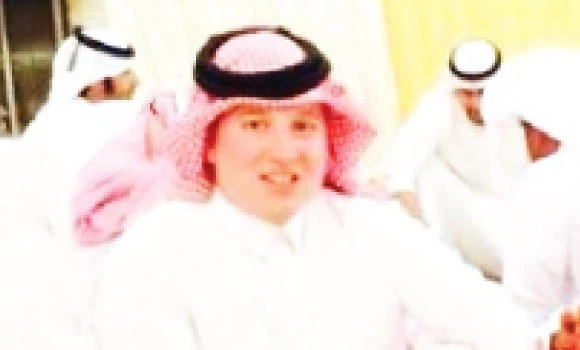
But mention his Web-born persona, Abu Muteb, and chances are good you’ll get a knowing nod or wry smile for the baby-faced American military brat. He slings Saudi-accented Arabic, wears traditional Gulf robes, mixes comedy and commentary and may be one of the Arab world’s most improbable celebrities.
Van Alstine is a niche within a niche. He rode a wave of YouTube videos that were not even a blip at the college he attended near Dallas but were monster hits in Saudi Arabia and eventually caught the attention of VIPs. Then an e-mail arrived in May 2013 asking whether he would consider moving to Riyadh. He accepted.
“This whole thing has been wild. Really crazy,” said Van Alstine, whose videos — some with 1 million-plus views — also landed him on one of the Middle East’s most widely watched television channels. Last week, he was recruited by Qatar state television to help cover the country’s national day celebrations.
To get the full measure of Van Alstine’s journey, it’s important to know what the 25-year-old is not. He’s not a native Arabic speaker. He’s not of Arab descent. He had never set foot in an Arab country until he was in his early 20s.
But he is Muslim, raised in the religion of his Turkish-born mother as the family bounced between Turkey and the US with deployments of his father, an Air Force enlisted airman who rose to the rank of chief master sergeant.
One stop was in San Antonio shortly after 9/11 when he was in grade school.
“For the first time I felt I wasn’t accepted,” he said. “Here I was, a white Muslim in America. Many Americans rejected me because I was Muslim. The Muslims in America — Arabs, Pakistanis and others — rejected me because they saw me as just American. I felt really isolated.”
That was until he fell into a clique of Saudi students at the University of North Texas. He started picking up Arabic and the distinctive Saudi dialect. One day in late 2011, from his parents’ basement, he decided to make a video challenging Westerners to seek a better understanding of Islam. He posted it on YouTube.
Then he made another one with a lighter touch about hanging with the Saudis. And another.
No one noticed on campus except the Saudi students. They tweeted it. And, back in the Kingdom, the posts went into the meme-osphere in one of the region’s most vibrant social media landscapes. Here was something entirely new: A blond American winging it in Arabic with a Saudi flavor. Americans are well used to foreigners expropriating US culture and slang. But for Saudis, it was a hoot.
“I was anonymous at home and like some kind of star in Saudi Arabia,” he said.
How a blond US kid became a star in Kingdom