India’s relationship with Saudi Arabia has expanded more rapidly and more satisfyingly both in absolute terms and when compared with India’s relations with any other region or nation in the world.
In fact, close interaction between the people of India and of the Kingdom began with the dawn of history millennia ago and has continued on an uninterrupted basis since then.
Few countries can match this historical connection.
Factors such as bilateral trade, gas and oil interdependency, remittances and the huge Indian passport-holding diaspora living and working in Saudi Arabia, make the Kingdom India’s leading socio-economic partner in the world.
For many Indians today, the Kingdom is the second home, as political, diplomatic and commercial relations between New Delhi and Riyadh are becoming stronger and stronger day by day.
Overall, it is a relationship of increasing mutual symbiotic advantage and synergy, that will go a long way in promoting and safeguarding the interests of these two great nations — India and Saudi Arabia.
In an environment where economic growth is modest, India today stands as a bright spot among the global economies with Saudi Arabia.
Both countries are members of the G-20, and they have been closely working under the mandate of this major bloc of nations.
In fact, India and Saudi Arabia enjoy cordial and friendly relations reflecting the centuries old economic and socio-cultural ties.
The establishment of diplomatic relations in 1947 was followed by high-level visits from both sides. King Saud visited India in 1955 and Indian Prime Minister Jawaharlal Nehru visited the Kingdom in 1956.
The visit of the Prime Minister Indira Gandhi to Saudi Arabia in 1982 further boosted the bilateral relations.
In the recent times, the historic visit of King Abdullah to India in 2006 resulted in signing of ‘Delhi Declaration’ imparting a fresh momentum to the bilateral relationship.
The visit provided the framework for cooperation in all fields of mutual interest.
The reciprocal visit by the then Prime Minister, Manmohan Singh, to Saudi Arabia in 2010 raised the level of bilateral engagement to ‘Strategic Partnership’ and the ‘Riyadh Declaration’ signed during the visit captured the spirit of enhanced cooperation in political, economic, security and defense realms.
Custodian of the Two Holy Mosques King Salman visited India in Feb. 2014, when he was crown prince, deputy prime minister and minister of defense. A joint statement was issued and the defense pact was endorsed during the visit.
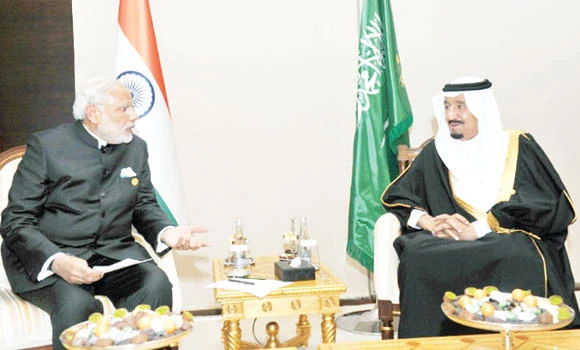
In Nov. 2015, on the sidelines of G-20 meeting in Antalya, Turkey, Indian Prime Minister Narendra Modi met with King Salman and discussed areas of bilateral interest.
These visits and political interactions have already placed the two countries on a sound footing from where an era of new bilateral relations has already been heralded.
This has resulted into the signing of a number of agreements between the Kingdom and India. Besides signing the ‘Delhi Declaration’ in 2006 during the visit of King Abdullah, the ‘Riyadh Declaration’ was signed in 2010 during Manmohan Singh’s visit to Riyadh.
It raised the level of interaction to ‘strategic partnership’ in the political, economy, security and defense realms.
Besides these declarations, several accords and MoUs including an MoU for foreign office consultations; an MoU for joint business council; an accord for avoidance of double taxation; an MoU on combating crime; an agreement in the field of youth and sports; an agreement on transfer of sentenced persons; an MoU for cooperation in peaceful use of outer space; an agreement on scientific cooperation; an MoU on cultural cooperation, an MoU on labor cooperation and another MoU on defense cooperation are currently in place.
On commercial front, the Kingdom and India have forged closer cooperation.
“Saudi Arabia today is our fourth largest trade partner and is a major source of energy as India imports around 19 percent of its crude oil requirement,” said a report released by the Indian Embassy.
During 2014-15, the bilateral trade reached $39.3 billion registering a decrease of 19.2 percent compared to a year before.
In terms of imports by Saudi Arabia, India ranks 7th and is source of around 3.61 percent of Saudi Arabia’s total imports.
“The import of crude oil by India forms a major component of bilateral trade with Saudi Arabia being India’s largest supplier of crude oil, accounting for almost one-fifth of its needs,” said the report.
To this end, the embassy reported noted the visit of Indian Minister of State for Petroleum and Natural Gas Dharmendra Pradhan to the Kingdom in Oct. 2014.
The two countries have also seen progressively growing investment relations. According to Saudi Arabian General Investment Authority (SAGIA), it has issued 426 licenses to Indian companies for joint ventures and for 100 percent owned entities till April 2015, which are expected to bring total investment of $1.6 billion in Saudi Arabia.
These licenses are for projects in diverse sectors such as management and consultancy services, construction, telecommunications, IT, pharmaceuticals, etc.
Moreover, several Indian companies have established collaborations with Saudi companies and are working in the Kingdom in the areas of designing, consultancy, financial services and software development.
On the other hand, Saudi Arabia is the 47th biggest investor in India with investments from April 2000 to September 2015 amounting to $58.83 million.
In addition, Saudi petrochemical giant SABIC had set up its R&D Center in Bangalore with an investment of over $100 million in November 2013.
In fact, India and Saudi Arabia have great potential for cooperation in various sectors keeping in view the growing economies of the two countries.
In the case of India, the International Monetary Fund (IMF) in its report has projected India’s growth for 7.5 percent in 2016.
In its report dated Nov. 12 2015, the IMF said that while growth in emerging economies remains fragile and could be derailed in an environment of declining commodity prices, reduced capital flows, and higher financial market volatility, India’s growth will benefit from recent policy reforms.
Also, Moody’s ratings revised India’s sovereign rating outlook to “positive” from “stable”.
Foreign direct investment flows to India during the 2014-2015 reached $44 billion including the capital flows from the Gulf states and Saudi Arabia.
The Indian government’s continued push toward FDI liberalization will continue to aid FDI flows.
The Financial Times of London in its ranking of the top destinations for green field investment (measured by estimated capital expenditure) in the first half of 2015 shows India at number one, having attracted roughly $31 billion, $3 billion more than China and $4 billion more than the US.
A total of $130 billion has been proposed spending on railways over five years on schemes including high-speed trains in India.
In Nov. 2015, the Indian government awarded contracts to set up two locomotive plants.
The contracts are two of the first and the largest to be awarded to foreign firms since India last year allowed 100 percent FDI in the railway sector.
According to reports, the General Electric Co. (GE) will build a diesel locomotive factory and Alstom will set up an electric locomotive in the state of Bihar.
To boost the investment environment in the country, the India government has further eased FDI norms across 15 sectors.
As a result of the above measures, India has moved up 16 positions to rank 55th on a global index of the world’s most competitive economies compiled by the World Economic Forum.
The jump in India’s position underlines the country’s recent economic recovery, improvement in the competitiveness of the country’s institutions and its macroeconomic environment.
All these statistics and indicators also support the growing commercial relations between India and Saudi Arabia on the one hand and between India and GCC as a bloc on the other.
Not only this, Riyadh and New Delhi have also cemented their relations in cultural domain also. A cultural troupe from ICCR consisting of a Shehnai and a Qawwali group, performed in Jeddah and Riyadh a couple of years back, coinciding with the republic day celebrations.
Also, a 54-member cultural delegation visited the Kingdom to participate in the ‘Indian Cultural Week’, organized in Riyadh in collaboration with the Saudi Ministry of Culture from November 3-7, 2012. On the other hand, the Indian diaspora is the largest foreign community living and working in the Kingdom.
“The 2.9 million plus strong Indian community in Saudi Arabia is the largest expatriate community in the Kingdom and is the ‘most preferred community’ due to their expertise, sense of discipline, law abiding and peace loving nature,” said the report.
The contribution made by Indian community to the development of Saudi Arabia is well acknowledged and appreciated by Saudi officials as well as by entrepreneurs of this country.
This is in addition to a large number of Indian Muslims, who visit the Kingdom for religious purposes including Haj and Umrah every year.
During Haj 2015, around 136,000 Indians visited the Kingdom to perform Haj. Around 300,000 Indian pilgrims visit the Kingdom to perform Umrah every year.
India: Charting a new reform path