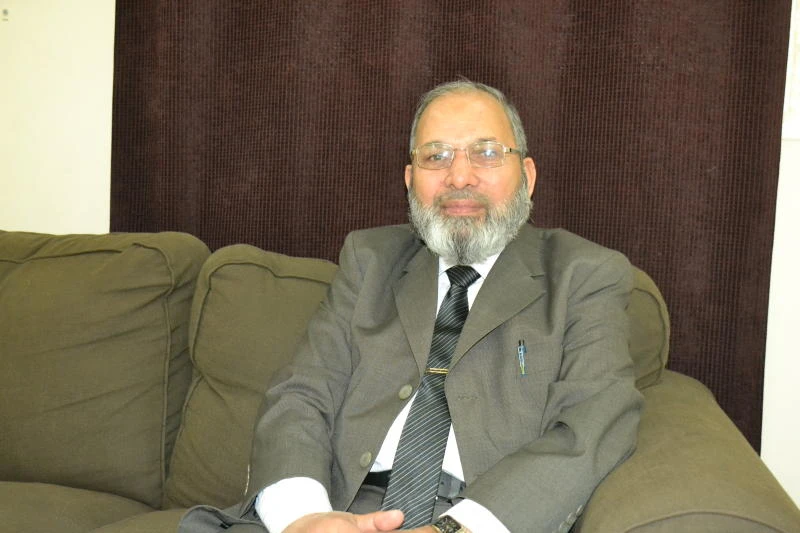
The Kashmir issue is not a bilateral issue between India and Pakistan but an issue of the Kashmiri people which should be resolved according to their wishes, according to Ghulam Mohammad Safi, chairman of the All Parties Hurriyat and convener of Tehreek-e-Hurriyat of Jammu & Kashmir.
Safi was in Jeddah on the occasion of the Kashmiri Black Day held at the Organization of Islamic Cooperation (OIC) headquarters and at the residence of the Pakistani consul general.
In an exclusive interview with Arab News, Safi said that he has been working on finding a solution to the Kashmir issue for the past 67 years. “The Kashmiri people have been suffering for decades and are still facing restrictions and human rights violations in Jammu and Kashmir,” he said.
He pointed out that the superpowers are failing to pay the Kashmiris their due attention. “They only talk about reducing the human rights violations in Kashmir, not about forcing India to stop the gross injustice in Kashmir.”
“We want freedom from India and are determined to succeed according to the wishes of the people of Kashmir,” he said.
He called on the international community to intervene and exert pressure on India to implement the relevant UN resolutions on Kashmir to resolve the dispute. “The Kashmiris’ peaceful struggle for their right to self-determination is inalienable and non-negotiable,” he said.
Elaborating on the Kashmiri issue, Safi said: “There is no consistency among the successive governments in Pakistan while India’s stand is that Kashmir is an integral part of India.”
He said that recently the issue of Kashmir was raised at the United Nations General Assembly as an international issue once again but it was stalled with India repeating that it was a part of India and that it is a bilateral issue between Pakistan and India.
“We are asking for the UN to come forward and withdraw the troops from Jammu & Kashmir. There has to be a referendum according to the wishes of the Kashmiri people. Although human rights organizations have been publishing reports and raising their voice against human rights violations in Jammu & Kashmir, the Indian government is paying no attention,” he said.
The OIC secretary general, Iyad Madani, also made it clear that the issue of Jammu & Kashmir is basically an international issue and that there is a need to engage people who raise their voice in favor of the issue.
Safi stressed that the human rights situation in Kashmir has only gotten worse over the years. He said that the Muslim Personal Law based on the Islamic Shariah had been replaced by a unified civil law while Azad Kashmir would officially be declared as Pakistan-occupied Jammu & Kashmir as opposed to Indian-occupied Jammu & Kashmir.
“By doing this, they hope to end the Kashmiri movement,” Safi said.
Commenting on the recent floods in Kashmir, he said: “Srinagar, our capital city was badly affected but there were no rescue operations from India. Instead, it was the Kashmiri youth who volunteered to rescue and provide assistance in this calamity.”
“Our message to the international community is to give us our right to self-determination,” Safi said, adding that the Saudi government can influence India to make decisions in favor of the Kashmiri people.
Kashmir ‘not merely a bilateral issue between regional powers’