RIYADH: The government has embarked on key reforms of the economy in the wake of falling oil prices, which would include an emphasis on diversifying sources of income so that it can continue ensuring quality jobs, health care, housing, education, transport and infrastructure for citizens, said Custodian of the Two Holy Mosques King Salman at the Shoura Council on Wednesday.
The king outlined the government’s domestic and foreign policy plans during an address to the Shoura Council, the country’s legislative advisory body, which has now been in operation for four years and held six sessions.
The king said the Kingdom carried out several mega infrastructure projects and boosted its fiscal reserves when oil prices were high. This enabled it to overcome the consequences of the sharp decline in oil revenues. Current development projects have not been affected by the drop, he said.
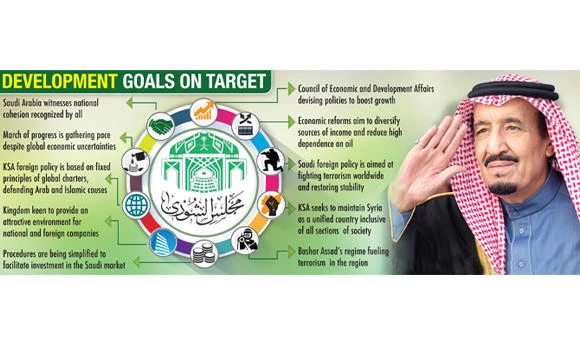
King Salman said he has ordered several key economic reforms to diversify sources of income and reduce the country’s high dependence on oil, which would include efficient public spending and use of economic resources, and boosting returns from state investment.
“I have directed the Council of Economic and Development Affairs to devise the necessary plans, policies and programs to achieve that,” he told the council members.
King Salman said fiscal policy was based on “preserving stability and balance between revenue and spending on big development projects.” The reforms would create a conducive environment for increased investment by Saudi and foreign companies, simplify procedures and boost employment, he said.
He said the Kingdom was committed to a stable oil market, which would protect the interests of current and future generations. There would also be continued oil and gas exploration, he said.
The monarch said the 10th development plan had kicked off this year on a solid economic base, and aims to grow the country’s Gross Domestic Product, develop the skills of citizens and increase spending on infrastructure.
He said improving services in the health sector was a key priority with massive budgetary allocations to continue, including the employment of more citizens, opening more medical colleges, and providing more scholarships for medical specializations.
There would be a similar focus in education, which would include ensuring quality tuition to improve the skills of students. The Custodian of the Two Holy Mosques’ Foreign Scholarship Program would be aligned to the needs of the labor market, particularly scientific and other technical professions.
He said everyone was aware of the massive developments underway to provide affordable and quality housing for citizens, including huge budgetary allocations, measures to achieve balance between supply and demand, and the tax on unused land.
The king said jobs and training remain a major priority, with measures including the modernization of administrative and financial programs, and the formation of the Commission for Job Creation, which would coordinate the work of all government and private sector agencies.
He said there has also been an emphasis on boosting entrepreneurship in the Kingdom with the formation of the General Authority for Small and Medium Enterprises.
King Salman said the government has also been placing a great deal of attention on the participation of women, to help boost the economy, in line with the teachings of Islam. “Saudi women have proven their efficiency and ability to fulfill roles in various fields, including their active participation in the recently held municipal elections,” he said.
Those in attendance included members of the royal family, ministers, senior government officials and diplomats. The welcome address was delivered by Shoura Council Chairman Abdullah Al-Asheikh who said the Kingdom has witnessed rapid development under the reign of King Salman. Earlier, the king also outlined the country’s foreign policy initiatives, which includes measures to protect Arab and Islamic states and peoples, fight terror and achieve security and stability in the world.
He repeated his call for a political settlement in Syria, and said Riyadh wanted to ensure Syria becomes a unified nation incorporating all religious sects. A political solution would have to involve all foreign forces leaving the country, he said.
KSA to diversify income; security top priority