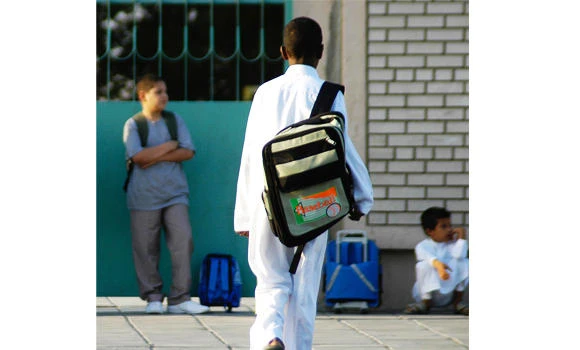
JEDDAH: There appears to be many students bunking classes and heading to cafes and the corniche here, according to a report in a local publication on Wednesday.
Officials from the Ministry of Education and schools have admitted there is a problem that they have been trying to address with various measures, the report said.
Abdulaziz Al-Refaie, assistant director of the Jeddah education department, said: “We monitor the attendance of students every day. If a student leaves or is absent without a valid reason, the student advisers deal with the problem and parents are notified.” “We cannot only depend on the cameras and surveillance systems at schools. This is not a radical solution so we monitor each individual class and classroom during the school day.”
Abdul Majeed Al-Ghamdi, spokesman of the Jeddah Education Department, said the problem is being addressed with specialized guidance programs and cooperation and communication with parents and guardians.
However, Mohammad Al-Sulami, the principal of an elementary school in Alsamer neighborhood in Jeddah, has rejected the notion that absenteeism is a major problem.
“The number of students who bunk classes is limited, at no more than 2 percent. If it is widespread at some schools, there must be a good reason for this happening.
Most probably, this has to do with the intense daily study schedule, which makes students very bored. Families may also have a role to play.”
Ibrahim Almesbahi, a student adviser at Saad bin Abi Waqas School, said some schools have cameras installed to monitor the students, but said there should be “stricter monitoring.” “However, some schools have this problem but it appears this year that absentee levels are much lower than last year. As educators we are seeking to get to the root of the problem,” he said.
Zaher Al-Hukair, a psychotherapist, said families and the community have an important role to play. In addition, schools must make their learning environment more attractive for students. “We need to develop studies on the needs of our children at schools, their behavior and how they spend their time before the problem gets out of control,” he said.
Many ‘bored students’ bunk classes in Jeddah