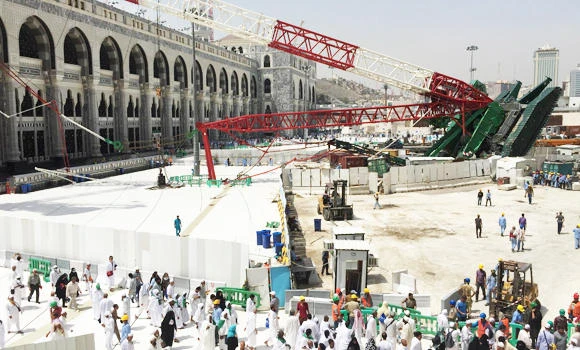
JEDDAH: While the Sept. 11 disaster at the Grand Mosque shook the Ummah, there is no denying the martyrs of the crane collapse received the most honorable end, something every Muslim considers fortunate.
The 111 people who lost their lives were in the highest degree of ibadah (worship) and at the strongest point of Eemaan.
Most of them must be in the state of Ihram, either going to begin Umrah or Tawaf or returning home after spending a dhikr-packed day to please Almighty God.
What better way could there be to return to the Creator than embracing death in the holiest city’s most sacred spot in the state of Ibadah and being buried in the birthplace of Islam?
There are numerous ahadith that attest to the blessed death that the martyrs received in the Grand Mosque.
Ibn Abbas (Allah be pleased with them) reported: While a man was riding (his mount) in Arafat, he fell and broke his neck (and died). Allah’s messenger Prophet Muhammad, peace be upon him, said, “Wash him with water and Sidr and shroud him in two pieces of cloth, and neither perfume him, nor cover his head, for he will be resurrected on the Day of Resurrection saying, ‘Labbaik,’ (i.e. like a pilgrim).” (Volume 2, Book 23, Number 356)
Another hadith says “Whoever goes out to perform Haj, and he dies, then Allah will write for him the reward of a person who performs Haj until the Day of Resurrection.
The Prophet (pbuh) also said: “The one who dies beneath a collapsed building is a martyr .” [Ahmad (23804), Abu Dawood (3111) and Al-Nasaa’i (1846) and graded as “Saheeh” by Shaikh Al-Albaani]
The kin of the dead are understandably grief-stricken but there must also be relief in their hearts that their loved ones couldn’t have got a better deal.
The tragedy that struck Makkah in the form of a ferocious tempest has again emphasized that man is helpless before nature and the Almighty’s will and that one’s fate takes him to the exact spot where his journey of life has to end. The day of death is fixed and no man has control over his Qadr, so one cannot afford to be lax in the matters of Deen.
After much of the dust has settled following the accident, there is a need to look at human weaknesses that find expression at such moments.
One of them is the craze to take photos and make clips as many and as fast as one can and post them on social media forums. The gorier the better as they attract more eyeballs.
Videos showing the crane’s fall and the subsequent loss of lives and limbs would not have served any purpose.
And what good can one possibly imagine by showing helplessness and gloom?
Spreading photos of crushed bodies can only send a chill down the spines of viewers.
Such attempts unnecessarily magnify horror and also give avoidable opportunities to detractors of Islam who love to draw ludicrous parallels.
It goes without saying people need to act and behave responsibly, online and offline.
While the role of social media in Haj is a matter of debate among many, there is no doubt that it can add an element of ease and comfort for pilgrims. There are numerous informative mobile apps about Haj that guide pilgrims.
One such app, developed in Dubai, is Haj Salam which provides a step-by-step guide for pilgrims covering all religious rites. Need to withdraw money to buy an animal for slaughter? Haj Salam will guide you to the nearest ATM. If you forgot how many times you have circled the Ka’aba, Haj Salam uses your phone’s GPS to count it for you. Since its launch, Haj Salam has been downloaded over 40,000 times.
‘Indian Haji Accommodation Locator’ is another mobile app launched last year by the Indian Consulate in Jeddah.
It helps trace Haj pilgrims. Entering a pilgrim’s cover number or passport number can give details about his/her accommodation, including building number, tent number or office number.
It also offers an easy-to-follow satellite or a regular road map that will lead officials and volunteers to reach desired locations in Makkah, Mina or Madina.
Additionally, there are apps that enable you to read Surahs of your choice with translation on your smartphone.
It comes handy when you are stuck in an unending traffic jam without a copy of the Holy Qur’an and don’t know what to do.
You can put your smartphone to another use by having it translate Arabic signboards and hoardings into your language to find your way around the city. There is more to Whatsapp than forwarding silly jokes and videos.
You can use it to ask urgent Fiqh queries to your teacher or an elder.
Forgot an important dua? Message a friend on Whatsapp who can immediately send you a screenshot of that dua.
Instagram which allows users to share photos globally in a second is the latest buzz. Pilgrims can make best use of it by sharing memorable images of standing in Arafat, sacrifice and camaraderie among Hajis of different creeds and shades.
Any act that promotes coexistence, peace and harmony will be rewarded in the hereafter.
In this technology-fueled age of digital narcissism, whether you let your social media addiction grow by circulating selfies and memes or exploit it for the bigger and better purpose of Ibadah is totally up to you.
Rise above the crane fall