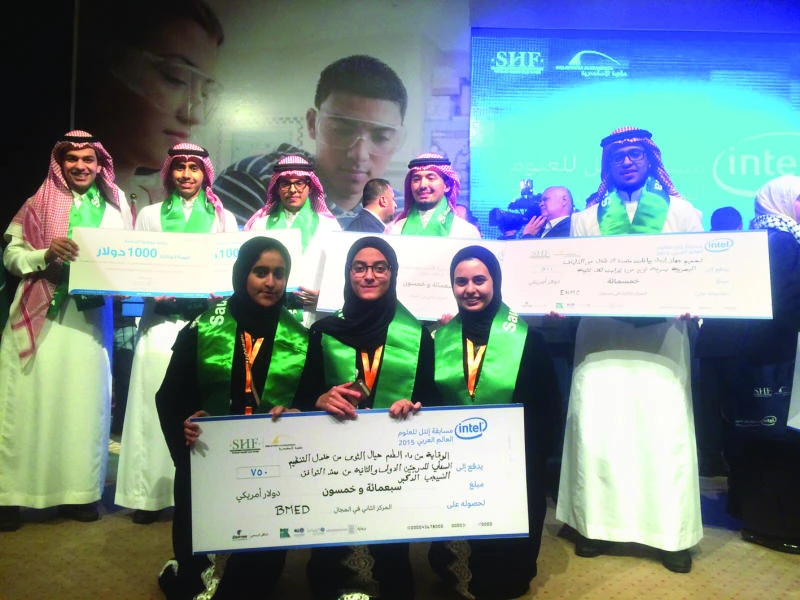
RIYADH: Saudi students have achieved yet another record in Intel Science from the Arab world by winning five medals and cash prizes.
Saudi Arabia was represented by eight students (five boys and three girls) in as many projects at this year's event held in Alexandria, Egypt from Dec. 17 to 19.
The event, in which representatives from 11 Arab countries took part, featured 77 innovative projects.
Walid bin Khalid Ismail Sideeq won the second place in the field of materials and bioengineering for his project (manufacturing bars nano particles of zinc oxide with high purity and organized forms in an ideal time), according to King Abdulaziz and His Companions Foundation for Giftedness and Creativity, or Mawhiba.
Jasmine Zaki Al-Saif also won second place in the field of medical science and health sciences for her project “prevention of bait disease through the lower organization for the first two degrees and the second of a complex larger.”
Khaled Abdel-Alim Al-Zaid received third prize for his project (designing transmitter multiple formats data over fiberoptic speeds in excess of terabit per second) in the electrical and mechanical engineering category.
Both Hassan Ali Al-Shammari and Mohammed Khaled Al-Tauyan received special awards presented by government agencies and private firms in the field of cellular and molecular biology and in the field of biomedical and health.
Saudi Arabia also took part this year in arbitration committees represented by Aminah Rees from Umm Al Qura University and Hatem Abu Haimad of King Abdulaziz City for Science and Technology.
This year a total of 20,000 Saudi students (boys and girls) have registered online for the 2016 scientific innovation selection for the country’s National Olympiads Scientific Innovation (Innovation 2016), according to the Ministry of Education represented by Mawhiba.
Saudi students win five Intel awards