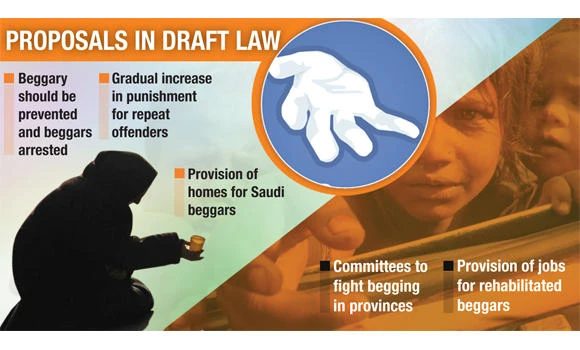
RIYADH: A draft anti-begging law has been drafted by the Committee for Family, Social and Youth Affairs at the Shoura Council. The proposal stipulates that anyone who uses children and the disabled as beggars will be subject to two years in prison and a maximum fine of SR30,000.
One article stipulates that first-time offenders must not stay in the welfare home for more than five days from the date of the arrest. Another details the punishments for beggars.
Saudi beggars cannot be held in the welfare home for more than six months or a fine of SR10,000. If arrested a second time, Saudi beggars can be held in the welfare home for one year or a fine of SR20,000 or both.
If they are caught a third time, adult Saudi beggars can be imprisoned for two years and fined SR30,000 or both. If caught a fourth time, punishments will be doubled according to the times of begging, and might include confiscation of money made through begging and given to charitable societies.
The committee recommended the setting up of a system to fight this phenomenon for its serious effects such as exploiting children, women and disabled people, and also because it is a form of human trafficking.
The law has 15 articles, with the first identifying beggars as people who do not make a living, or pretend to suffer from illness, poverty and disability, or use women or any other methods to beg.
The aim is to curb beggary and take the necessary procedures to rehabilitate beggars, and also to devise a regulatory framework to raise social awareness about the dangers of the phenomenon.
Article 3 points out that beggary should be prevented and beggars should be arrested and punished according to the system. Article 4 stipulates that the Ministry of Social Affairs should allocate homes for the care of Saudi beggars, and that the Bureau of Investigation and Public Prosecution should carry out inspections of these homes.
Articles 5 and 6 call for forming committees to fight begging in provinces and governorates that will follow up on beggars and arrest them. In addition there must be coordination with relevant bodies to enhance anti-begging efforts, while studying the circumstances of Saudi beggars as well as preparing a special register that has all their data and identifies their needs.
Article 8 stipulates that the ministry should coordinate with relevant bodies to provide job opportunities for Saudi beggars who have been trained and rehabilitated in welfare home.
The committee completed the anti-begging proposal after reviewing studies that have been conducted in the Kingdom which show the spread of begging in the Kingdom during the past few years.
The committee said that the increased number of infiltrators in the Kingdom because of the sympathy of Saudis for those people has led to a lack of deterrence and increased the dangers of this phenomenon in Saudi society. This is especially disturbing in light of the presence of gangs that control begging.
The committee studied the draft law, presented by former members Saad Mareq and Naser Al-Shahrani after the council approved its recommendation on the study’s suitability. The recommendation was discussed by representatives of a number of relevant bodies and the council approved passing laws and procedures to curb this growing phenomenon.
Stringent punishment in draft anti-beggary law