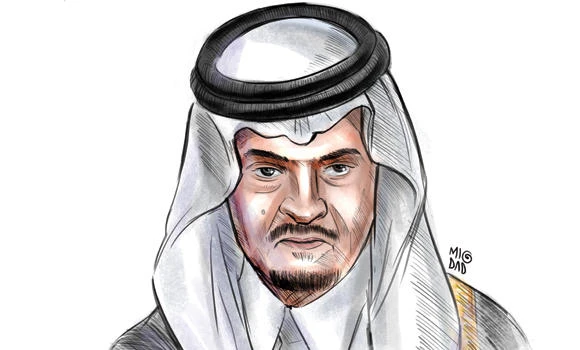
By all yardsticks, Prince Saud Al-Faisal is the archetypal statesman and one of the most accomplished and dignified public servants in the modern history of the Middle East. During his four-decade term as a foreign minister of Saudi Arabia, he was a master tactician and a great strategist who helped pioneer much of Saudi Arabia’s successful diplomacy in a tumultuous region.
Prince Saud’s firm but subtle diplomatic style has earned him the respect of both friends and foes. For this reason, he had helped steer the diplomatic web of relationships in an increasingly complex world. For many observers, Prince Saud is not only the longest-serving foreign minister in the world but also the one who matches means with ends to better serve the interest of his country. In US Secretary of State John Kerry’s word, Prince Saud is “among the wisest.”
His upbringing has for sure set him up for a job that made him the world dean of foreign policy. Born in 1940, he finished his elementary and secondary school in Saudi Arabia. Immediately after that he joined one of the leading American universities (Princeton) and earned his bachelor’s degree in economics. For 10 years, he focused his work on economics where he became the deputy of Petroleum and Mineral Resources Minister Ahmed Zaki Yamani. His education and work in economics would help him later to understand and steer the foreign policy of a country which has been the most important in oil production and a country that has managed to assume the role of a price setter of oil in the world market.
At 35, he became the state minister of foreign affairs and then a foreign minister where he kept his position until he decided to step down this year because of health issues.
Unlike the vast majority of foreign ministers worldwide, Prince Saud’s role was not confined to represent his country’s policy but he also helped shape the Kingdom’s response to crises facing or affecting the Arab region. His tenures started when the region was dominated by Cold War rivalries during which the Arabs were trying to avert the grave consequences of world rivalry in our region. Five years after he assumed the portfolio of Foreign Ministry, the Iraq-Iran war erupted and the whole region was bogged down in an eight-year war.
Driven by his gripping analysis of regional politics and balance of power, Prince Saudi led an assertive foreign policy to push back Iran’s attempt to destabilize the region. Therefore, Riyadh’s support of Saddam Hussein in his bid to check Iran was vital for Iraq’s ultimate victory. This firm position was by no means a blank check for Saddam’s reckless moves in the region. When Saddam invaded Kuwait in August 1990, Prince Saud was among the fiercest opponent of this uncalculated move. It was during this particular crisis that Saudi Arabia led the Arabs to make a clear statement: The invasion of an Arab country by another Arab country is not only not allowed but also immoral.
And yet, the anti-Saddam position was measured. When the United States invaded Iraq in 2003, Prince Saud demonstrated a great vision when he argued against the invasion predicting the unruly repercussion in Iraq which we witness these days. “If change of regime comes with the destruction of Iraq, then you are solving one problem and creating five more problems,” said Prince Saud in a British television interview.
Prince Saud worked meticulously to help the Palestinians realize their right of self-determination. In 2002, he called the bluff of the Israelis and the Americans when he pushed for the adoption of the Arab Peace Initiative. By far, it was the biggest Arab initiative with regard to solving the long-standing Israeli-Palestinians crisis. With a similar gusto, he helped the Palestinians reconcile their internal differences to qualify as a partner in a lasting and fair peace.
Unfortunately, the Israeli society has undergone a shift rightward. Israel failed to live up to the expectations of peace lovers in this part of the world and refused to accept the Saudi-backed peace initiative. It is not as if the Saudi prince was satisfied with that. In fact, he made it perfectly clear that the failure of the peace settlement was the biggest disappointment in his long career.
But working for such a long time had its toll on the health of Prince Saud. Given his age and poor health, he asked Custodian of the Two Holy Mosques King Salman to relieve him of his duties, thus allowing another generation to assume the responsibility of foreign policy.
Undoubtedly, Prince Saud has left huge shoes to be filled. For sure, his wisdom will be missed.
The archetypal statesman