JEDDAH: Covering the Haj is no easy task. Ask any print or broadcast journalist and he or she will tell you that it is the most challenging assignment. I have been part of the Arab News Haj Team for nearly 13 years. I have utilized all kinds of transport: foot, bus, truck, train and bike. But one particular Haj in 2006 was extraordinary in that I had my first look at the holy city of Makkah and the tent city of Mina from above. Thanks to a friendly lift from a Civil Defense helicopter, all the improvements at the holy sites were laid out in panoramic detail before me.
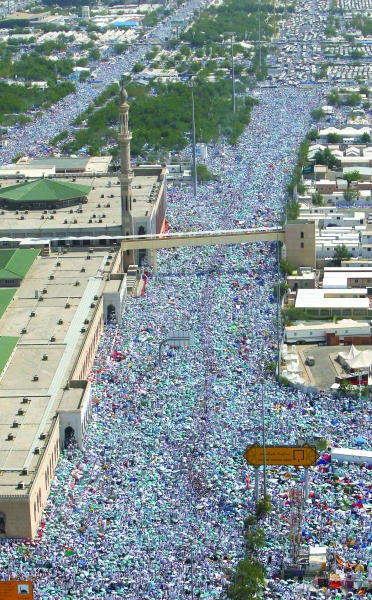
Down in Mina, the streets were packed with pilgrims rushing to and fro. Everywhere one looked, it was a colorful sea of people. Mina is a small city and as far as the eye could see, tents filled every open space. They had been neatly arranged, row after row. The entrances to many of the tents were decorated with banners and garlands. This helped pilgrims identify their temporary residences from among so many that otherwise all looked the same. There were even huge balloons hanging in the sky over certain places to help pilgrims find their tents.
From the pictures appearing in newspapers, magazines and on television, everyone has the impression that the Haj is a sea of white but being on the ground with the pilgrims, it is amazing how colorful it is. Each national group is carrying a flag. Many of the pilgrims have signs or some sort of design pinned to their clothing to help them identify each other. They have prayer rugs over their arms and bags clutched in their hands. Even the pilgrims’ faces are colorful. Every shade of human skin is represented. Among the 2.5 million pilgrims are the tall, majestic Afghans with flowing beards, bushy eyebrows and aquiline noses; the lanky Somalis with their graceful gait; the happy Sudanese with smiles on their faces at all times; the loquacious Egyptians with goatees; the fair-skinned Iranians, always walking in one large group; the young Pakistanis with their trademark mustaches and the ubiquitous Indians chattering away in their regional languages.
The sheer numbers in Mina overwhelm everything. They are an ongoing and virtually unstoppable force on all routes to Mina and Makkah. It is a pity that every pilgrim cannot have a bird’s-eye view of what is happening. If they could, they would have a better sense of the monumental challenges of security and logistics that the authorities have to deal with in order to make the pilgrimage safe and comfortable for every single guest of God. And it is done every year.
On that particular helicopter trip, we were a group of 19 journalists, touring the holy sites. Packed onto the passenger benches of two massive choppers, we clamped earmuffs to our heads to drown out the noise and hung on to overhead straps to steady ourselves. It took just a few minutes for us to realize that the experienced Saudi pilots were taking us on a slow gentle ride designed to allow us to view the area, snap our photos and keep our wits about us. One door of the helicopter was open from the top, enabling everyone to take turns putting cameras out for a clear unobstructed image of the majestic scene below.
From above, the pilgrimage looked very different. The hubbub was gone and the scene below was white, black and shades of gray. At Mina, the tents stretched out in waves with the Al-Kuwaiti Mosque floating in the center of the swells. King Abdul Aziz Bridge is a slash through the tent city.
From above, the pilgrims were mere dots, creeping slowly up, down and around the Jamrat complex. They clustered tightly around the three Jamrat which are walls jutting up from the bridge’s surface. As the pilgrims came forward on the bridge, they passed the first wall, Jamrat Al-Ula, then the second, Jamrat Al-Wusta, and finally Jamrat Al-Aqaba. From there, the pilgrims exited by different lanes and moved away from the complex.
We flew over the hills that surround Mina, with the highway to Makkah a black ribbon, strung through the tunnels in the mountains beneath the helicopter. The road was remarkably unobstructed and traffic was moving easily toward Makkah. Our group included journalists, both men and women, from all over the world.
There was a collective gasp when the Holy Haram came into view. Cameras began snapping and telephoto lenses were set long to get the best shot. “I can’t believe this. It is superb and fantastic,” gushed award-winning Saudi photographer Susan Baaghil. “It is like performing tawaf (circumambulation) from the sky,” she said. “I have taken pictures of many things in the past but the pictures in here are among my most prized possessions,” she said, tapping her high-tech camera.
A young Saudi, Ahmad Al-Ammar, was equally delighted. “Before boarding the helicopter I had no idea what I was going to see but what I saw from above was fascinating. All our lives we have been praying in the direction of the Kaaba and here was the Kaaba in all its glory, shimmering in the glow of a setting sun. It was amazing. I kept clicking as the helicopter circled the holy city,” he said.
Once the requisite images had been made, everyone wanted a photo of himself or herself with the pilgrims performing tawaf in the background. As the earmuffs blocked out all sound, communication was by hand signals with us journalists shifting left and right to enable everyone to have an equal chance to take photographs and get a direct look at the majestically impressive scene below.
That helicopter ride gave us a new appreciation of the great Saudi efforts which are made over and over every year. Hearing or reading that nearly 2.5 million pilgrims come for Haj is one thing. Casting eyes on those millions from above, however, provides a different perspective and on what is required to bring the whole thing to a safe and successful conclusion.
The people of Saudi Arabia and its wise and benevolent leadership, led by Custodian of the Two Holy Mosques King Salman, deserve all praise for what is done to help the pilgrims perform their Haj rituals in ease and comfort.
The breathtaking experience