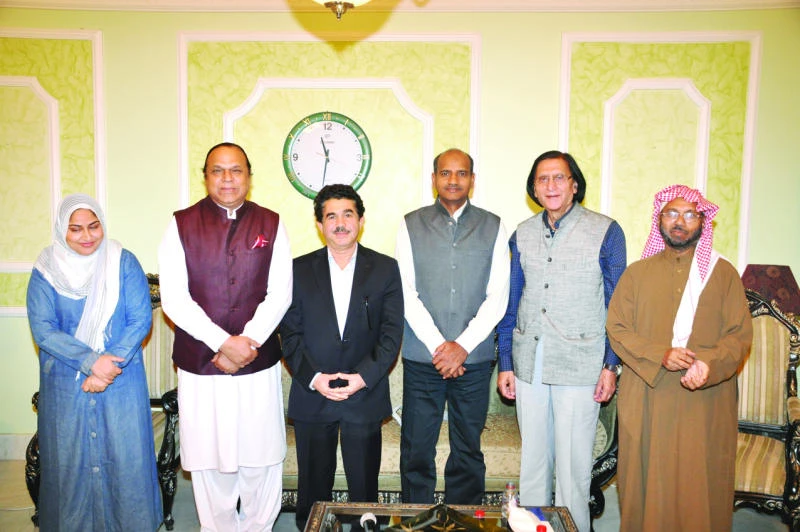
RIYADH: There was a huge turnout here recently for an event to honor the famous Indian poet Waseem Barelvi, who regaled the local expatriate community for three hours with his ghazals.
Barelvi, who has increasingly become known for his innovations around the ancient literary form, had been invited by Nadeem Tarin, the Indian businessman, philanthropist and educationist.
Tarin, lauded for having built a 150-room hostel for students at Aligarh Muslim University, had flown Barelvi from Dammam to Riyadh for the event.
Among those who attended were Hifzur Rahman, second secretary at the Indian Embassy; Delhi Public School-Riyadh Principal Mairaj Mohammad Khan; photo journalist K.N. Wasif and other community members. Barelvi was joined on stage by other poets, including the popular Shafiq Nadwi and the lesser known Asna Badar.
Barelvi entertained the community with his ghazals and couplets that he normally recites only at literary events. He is known as a mushaira poet but had previously been a lecturer in Urdu and a teacher. Earlier, he served as a deputy director for the National Council for the Promotion of Urdu in New Delhi. It was his love of poetry that led him to move out of academic circles.
His demonstrated his poetic personality with recitations of some blank verse inspired by Asna Badar, one of the most prominent poets in India in this genre, following in the footsteps of the late Fatima Shera from Hyderabad.
Asna Badar does not perform often at literary and other forums, but is well known to the dedicated Urdu poetry lovers for her work. Her poems were welcomed with enthusiasm by the audience.
The genre of “ghazal” was originally an Arabic verse form, dealing with loss and romantic love. Medieval Persian poets embraced the ghazal, eventually making it their own. Consisting of syntactically and grammatically complete couplets, the form also has an intricate rhyme scheme.
Each couplet ends on the same word or phrase or the “radeef,” and is preceded by the couplet’s rhyming word, or the “qaafia,” which appears twice in the first couplet. The last couplet includes a proper name, often of the poet’s. In the Persian tradition, each couplet was of the same meter and length, and the subject matter included both erotic longing and religious belief or mysticism.
Top Indian poet regales Urdu lovers