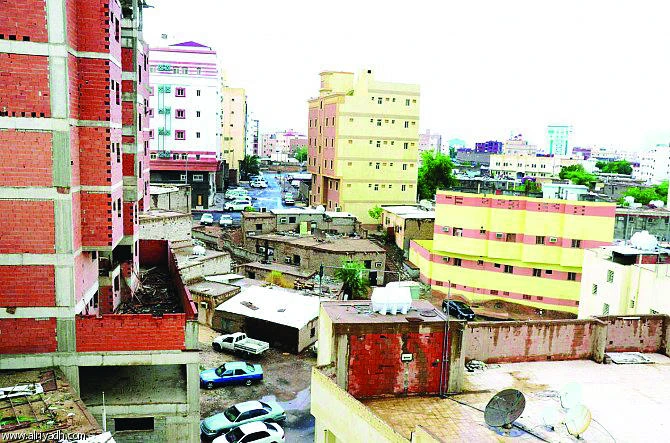
MADINAH: Madinah has a unique housing structure with millions of families moving there from Makkah and other parts of the Kingdom.
Madinah is an open city for all Muslims who want to live and work there. Most of them come with their professions, trade and culture and many of them survive by taking up simple and profitable professions, and buying old houses that surround the Prophet's Mosque, forming small communities from the same country and ethnicity.
Because of the small area surrounding the Prophet's Mosque, buildings are close and sometimes connected, with very little or no space for cars and service vehicles to pass through.
Random buildings (buildings built without licensing) are found in Al-Seeh, Al-Masene, Al-Zahidiya, Al-Meghseela, Al-Jbour, Al-Hurrah, Al-Amida the western Hurrah and Bab Al-Kouma. Houses built without any planning constitute about 45 percent of the current construction with many violations, with derelict houses and waste dumps. In addition, many illegal workers also live in these houses away from the eyes of the law. The majority of these houses are next to the mosque, which makes them difficult and costly to remove.
These areas are awqaf endowments with living or dead owners and have legal deeds issued by courts in Madinah over the centuries, and the Ministry of Housing finds it difficult to develop these locations into residential areas because of the prohibitive cost: one square meter costs SR5 million.
Member of the municipal council and the director of the Ministry of Information branch in Madina Salah Suleiman Al-Raddadi said the issue of reclamation of such areas is at the top of the council's agenda, saying that since the council held its first session it has been following procedures taken by the Madinah municipality to find suitable solutions to the problem.
He added that the council stood behind development projects which have been prepared by the municipality, saying that the council took a number of decisions on random areas, such as total removal of these buildings, especially those close to the Prophet's Mosque. He said that the ratio of such areas in Madinah has reached 50 percent according to statistics from the municipal council.
Al-Raddadi pointed out the importance of studying reasons behind the spread of such areas in recent years, saying one reason is that citizens didn’t get housing units. He added that citizens tend to take over land to build their homes, saying the council looks forward to the issuance of the executive list for the municipality company saying the Madinah municipality is working to complete this list and the council will work to eliminate the problem altogether.
The municipality has prepared a plan under which current streets in such areas will be expanded yards and car parks developed. The plan has been approved by the Ministry of Municipal and Rural Affairs. According to the plan, branch municipalities are to maintain the asphalt, pavements and lighting.
The municipality formed a supervising committee to implement the plan by devising special priorities in the implementation of the development process; overcoming obstacles that come in the way of implementation; devising the necessary mechanisms; arranging priorities; and educating citizens of these areas about the importance of development and its advantages.
Unplanned construction plagues Madinah