DUBAI: The International Cricket Council approved its revised anti-corruption code on Monday but left it up to home boards to allow banned players to return early to domestic competition.
For a player to return to domestic competition before the expiry of his ban would need the agreement of the chairman of the anti-corruption board, Sir Ronnie Flannagan, and the relevant National Cricket Federation, with the approval of the ICC Board, an ICC release explained.
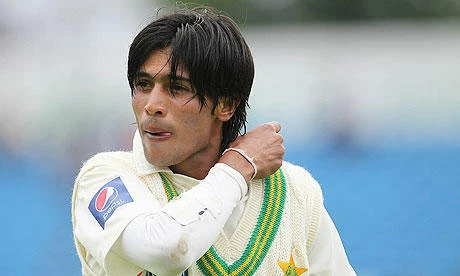
The revised code will specifically help Pakistan seamer Mohammad Aamer’s early return to domestic cricket, likely in February next year.
Last year, the Pakistan Cricket Board had demanded the ICC relax certain conditions of Aamer’s ban after he pleaded guilty to a spot-fixing crime and then completed the rehabilitation process.
Aamer, now 22, was banned along with Salman Butt and Mohammad Asif in a spot-fixing scandal on Pakistan’s tour of England in 2010.
Aamer was banned for five years, Butt for ten (with five suspended) and Asif for seven (two suspended).
The trio, also jailed in Britain, were charged with orchestrating deliberate no-balls during the Lord’s Test against England in return for money.
The ICC said the revised code would close certain loopholes and address the issue of who has jurisdiction in a particular case.
The code would also allow a player charged with an offense but who has not been provisionally suspended, to agree to voluntarily suspend him/herself, the ICC said.
The ICC Board also accepted the PCB’s nomination of its former chairman, Najam Sethi, for the ICC Presidency.
The presidency is now merely an honorific position with all the power in the hands of the chairman, following a reorganization in June.
The Board also reiterated its support for the no-tolerance approach in dealing with suspected illegal bowling actions.
Pakistan’s Saeed Ajmal was one of five bowlers suspended over an illegal action following an ICC crackdown in June.
Raises prize money
ICC announced a 20 percent increase in prize money for next year’s World Cup in Australia and New Zealand.
The winners will take home $3.975 million (3.18 million euros), but if a team remains unbeaten that would rise to more than $4m.
“A total of $10 million, an increase of approximately 20 percent over the ICC Cricket World Cup 2011, will be available,” said the ICC.
The 2011 edition jointly hosted by India, Bangladesh and Sri Lanka had prize money of $8.01 million.
“Should a team at the ICC Cricket World Cup 2015 win the tournament without losing a match, it will receive total prize money of $4,020,000, while a team that loses one match on the way to winning the tournament will receive USD $3,975,000.” The team which loses the March 29 final at Melbourne will pocket $1.75 million while the two losing semifinalists will each get $600,000 each.
The four losing quarter-finalists will receive $300,000 each while the winners of each group matches will get $45,000 per match, the ICC said.
All six teams elimitaed from the first stage will get $35,000 each.
The decision was taken at a two-day ICC Board meeting in Dubai while playing conditions were also finalized for the tenth edition of the World Cup, from February 14 to March 29 The ICC also announced that the Decision Review System (DRS) will be used in all 49 matches and that there would only be reserve days in the knock-out phase.
It also added that there will be no super over in tied matches in the knock-out phase.
In case of a tied quarterfinal and semifinal, the side finishing in the higher position in the group stage would progress.
If the final is tied or if the match is a no-result, then the teams will be declared joint winners.
The ICC Board approved cut-off dates for qualification to the 2017 Champions Trophy and the 2019 World Cup.
The top eight sides on the ICC one-day rankings on 30 September 2015 will qualify for the 2017 Champions Trophy in England.
The cut-off date for the 10-team 2019 World Cup, also in England, was set for 30 September 2017.
The top eight ranked sides on that date will automatically qualify for the World Cup, while the ninth and 10th ranked teams will play in the World Cup qualifying competition in Bangladesh in 2018.
ICC approves revised anti-corruption code