Frankfurt is the fifth largest city in Germany and is also the financial center of Germany. It is known for its futuristic skyline and the busiest German airport, thanks to the famous Lufthansa airlines.
Frankfurt is home of the European Central Bank and the German Stock Exchange. Furthermore, it hosts many significant trade shows, such as the Frankfurt Auto Show and the Frankfurt Book Fair. The best times for visiting Frankfurt are late spring to early autumn.
Many visit this city for work and never get the chance to see its beauty. It is a charming city that offers a lot. On the downside, not all Germans in Frankfurt speak English. It might be the perfect opportunity to learn a little German, no?
Below are the best things for you to see and do in Frankfurt:
Römerberg (Town Hall Square):
It means the Roman mountain, which is the central square in Frankfurt. It got this name from the Roman house that is currently the town hall. How this house got its name was never declared. This is considered as the historic heart of Frankfurt where the Christmas Market as well as some farmer markets are held. During the week it isn’t as congested by tourists. The shops are easy to access. During the weekend, it is really busy but you can enjoy a great meal or just coffee at one of the cafes and restaurants in the area.
This town hall square is known for its half-timbered buildings and comes close to the stereotype of an old German market square. In the western part, there is the Römer building; in the north there is a mix of post World War II architecture and reconstructed medieval buildings. The Eastern part is a reconstruction of the pre-war buildings from the 80s. In the 50s, this space was occupied by a typical post World War II building and later an underground parking area.
The Main River:
One of the most beautiful parts of Frankfurt is the Main River. You can walk across the pedestrianized Eisenbrucke — Iron Bridge, which offers great views over the old town, the cathedral, the church in Sachsenhausen and from the other side some of Frankfurt’s tall buildings.
Just like the love bridge in Paris, people attach padlocks with their names and the names of their partners as a form of love token onto the sides of the bridge and throw the key into the river. Walking along the riverside paths is wonderful; you can watch the boats, bikes and people and when you cross the bridges to explore each side of the bank you can enjoy the view of the river and the scene of the office towers and other sights reflecting in it.
Alte Oper (Old Opera House):
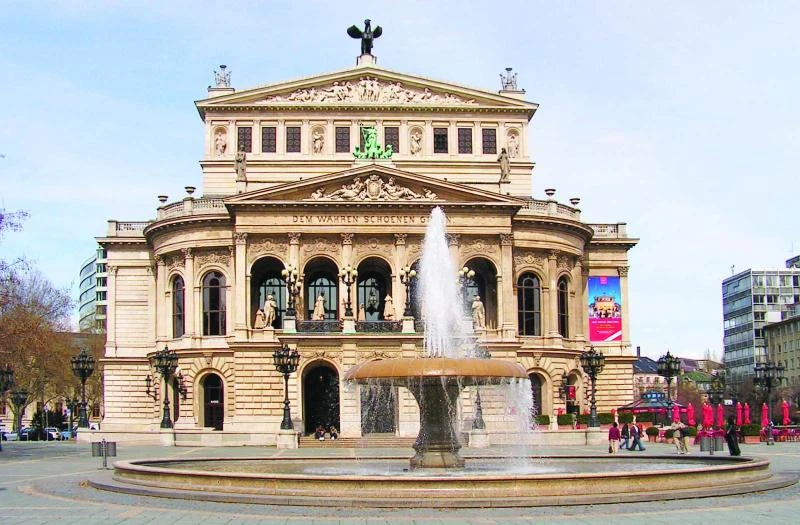
Until World War II, this was the original Opera house, but it was burned down after bombardments. The ruins were reconstructed with the facade and the lobby was rebuilt similar to the original building and it was officially reopened in 1981 and renamed to Alte Oper.
Sadly, this building does not operate as an opera house anymore and the only way for you to see the inside of the building is to attend one of their famous musical concerts or one of their famous orchestras.
Three blocks away from the Alte Oper is the real opera house on Willy-Brandt-Platz, where you can see fully-staged opera productions for about a third of what you would pay for a concert ticket at the Alte Oper.
The area surrounding the old opera house is just beautiful, there are a number of cafes sitting under its towering area. There is also a cafe on the third floor, which offers an amazing view across the park and the office towers. If you want to relax, there’s also a popular fountain just in front where you can enjoy the view and take photos.
Frankfurt Zoological Garden:
It is the second oldest zoo in Germany and it features more than 4,500 animals of over 450 species spread across over 13 hectares. This zoo is famous for breeding rare species like okapis, maned wolfs, black rhinoceroses and Amur leopards, but typical animals like bears, pinnipeds, antelopes and birds of prey are present too.
The establishment is known worldwide for being the first place to raise all four varieties of the monkey in one zoo. Since then, more than 100 offspring have been born there to gorillas, orangutans, chimpanzees and bonobos. In 2008, the Borgori Forest was opened, which is a completely new type of place for monkeys. As the name suggests, nature is brought into the building in the form of many trees, bushes, rocks and natural soil, so both humans and animals feel as if they are in the jungle.
Frankfurt zoo also features many other animal houses aside from the monkeys, such as bird towers with a free-flight arena, a giraffe house with labeling in braille and a giraffe statue for touching and a rhinoceros house. It offers a great option for children to be able to go to their exclusive petting zoo, which is a large playground, equipped with BBQ and pony rides on weekends.
Maerchenbrunnen (The Fairy Tale Fountain):
It is situated in a small green belt alongside the Municipal Theatre near downtown’s Willy-Brand-Platz opera house. The fountain features a statue of a woman sitting on top that was made after the image of a pretty German baker’s daughter. The fountain is illuminated especially during the night, adding to its beauty.
Schloss Johannisburg:
Rent a car and drive to Aschaffenburg city in the district of Lower Franconia of the state of Bavaria where the Schloss Johannisburg castle is located overlooking the Main River. This historic castle is one of the main attractions of the city and its landmarks and it is one of the most important buildings of the Renaissance period in Germany.
It was built in the 17th century in place of the destroyed medieval castle, the keep of which is still in existence. It was later the town’s archives and art collection holding up beautiful sculptures from the time of the construction of the castle, views of the city, objects from the guilds and furniture.
The castle now hosts a number of museums, art galleries, residential rooms and the world’s largest collection of architectural models made from cork, built in 1792.
Frankfurt museums:
The city offers a huge number of museums waiting for you to explore. There is something for everyone. Naturmuseum Senckenberg, Natural Museum, is one of the most famous museums of Frankfurt with various natural history exhibits: plants, animals, minerals and more.
Museum für Kommunikation, Museum of Communication, is formerly known as the postal museum as it explains the history of communication with a strong focus on postal services and telecommunication.
Liebieghaus Skulpturensammlung, is a beautiful artistic museum that holds a large collection of sculptures and statues from all over the world. After your tour, you should pass by their cafe in the garden and enjoy a cup of tea.
Museum Giersch, Museum of Regional Historic Art and Culture, the broad exhibition range covers all types of art — painting, photography, sculpture, graphic art, architecture and applied arts. Usually the exhibitions focus on artists that have some sort of connection to Frankfurt or the Frankfurt region.
Deutsches Filmmuseum, German Film Museum, displays— as the name implies — the art and history of filmmaking.
Architektur Museum, German Architecture Museum, displays various types of exhibits about buildings and architecture.
— [email protected]
Fabulous Frankfurt