Spread across seven hills above the estuary of the Rio Tejo (Tagus River) and fanned by an Atlantic breeze, Portugal’s capital city basks in the European continent’s warmest all-year-round climate. Lisbon’s narrow and meandering old town streets, sun-kissed terracotta rooftops, whitewashed houses, flower-filled window boxes and ornate wall murals present an air of genteel charm.
With a population of almost 550,000 (of whom many speak English), Lisbon is not an overwhelming city, which makes the central area easy to navigate on foot. However, those hills do present a challenge, especially in summer when temperatures hit the high 30s Celsius. With that in mind, visitors should remember the number 28. It appears on the front of a quaint yellow tram that rattles up and down the steep slopes of the oldest quarters, through the squares and bairros (residential quarters) to the palaces above.
A wide valley splits Lisbon in two and on the eastern side lies the Alfama neighborhood, which, the higher the tram rolls, becomes an extended village with craftsmen at work on the pavement, bustling shops, lines of laundered bed sheets, multitude of cats and idyllic cobbled squares dotted with cafes looking out onto the ocean. At the top of the hill is Castelo de Sao Jorge (St. George’s Castle), which dates back to the 5th century, commanding views of the entire city. From here ships could be monitored coming in and out of the port below.
Established in 1200 BC Lisbon is one of the world’s oldest continually inhabited cities and was originally known as Olissipo — the name of a breed of horse famed for its speed vis-à-vis the stiff winds blowing in from the Atlantic. Following the Roman conquest, circa 200 BC, Germanic Visigoth tribes subsequently conquered Lisbon in the 5th century AD. These were followed by a Moorish invasion in the 8th century and the city eventually fell to the Crusaders in 1147 when it was handed back to the native population. Lisbon was officially made Portugal’s capital in 1255 while the first university was founded in 1290 coinciding with an era when the arts and sciences flourished.
Lisbon’s ease of access to the high seas has always given it a geographical advantage, and being perched on the edge of Europe has led to a long and buccaneering maritime history. Portugal’s seafaring Golden Age began in the 15th century — much as it did in Britain, the Netherlands, Belgium, Spain and France — when explorers set sail to open up new trading routes on seas where maps had not yet been drawn.
Vasco da Gama is the name most closely related to this era when his fleet of four Portuguese ships left Lisbon in 1498 and the flotilla became the first from Europe to create a route by sea, circumnavigating Africa, to India. Da Gama, made an admiral in 1502, was then employed as the king’s viceroy to India where he oversaw a Portuguese colony in the province of Goa. It wasn’t until 1961 that the state was returned to India.
Another Portuguese mariner and navigator in the year 1500, Pedro Alvarez Cabral, became the first European to land in Brazil. The land was later colonized and the Portuguese language is still used there today. Portuguese is the world’s sixth tongue, spoken by 240 million people. Other lands colonized during this period were Angola, Mozambique and Guinea Bissau in Africa, Cape Verde, Sao Tome and Principe in the Atlantic, East Timor (now independent from Indonesia), and Macau, neighboring Hong Kong, which was returned to Chinese rule in 1999.
This period, also referred to as the Age of Discoveries, is celebrated by a huge statue at Belem, the chief port area of the city, in the shadow of Lisbon’s very own 2,277m Golden Gate, an almost exact replica of the bridge in San Francisco. Trading places and routes — dealing mainly in spices such as cinnamon and pepper (until then unknown in Europe), sugar, textiles, and slaves — made Portugal great wealth and Lisbon to become the European hub for global maritime traffic.
Such close proximity to the sea also means that seafood is pretty much the staple diet, served with oven fresh bread. Barbecued sardines and shrimp can be found on almost every street but the choice is as deep as the ocean and includes fresh snail, monkfish, tuna, salmon, clam, mussel, eel, octopus and salted cod (the local’s favorite) while the custard tart is emblematic of the city.
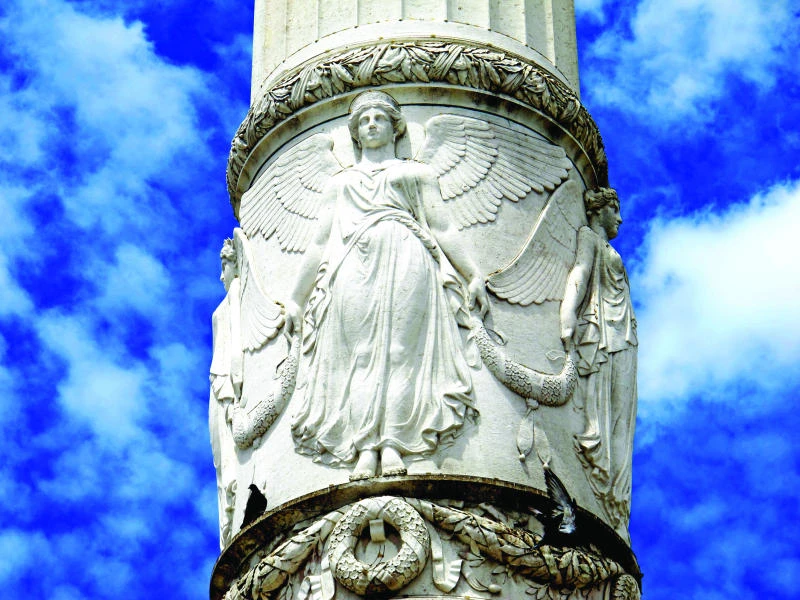
During the Second World War Portugal remained neutral and many refugees came to Lisbon fleeing the Nazis, hoping to make their way to America. Among them were the monarchs of Spain, Italy, Bulgaria and Hungary. This is commemorated by another Lisbon landmark – the Freedom Monument — at the top of Parque Eduardo VII, named after the British King Edward who visited in 1903 and whose nation remains Portugal’s oldest ally. From the top of the park, with splendid views, a popular pastime is to stroll down through the botanical gardens to the refined, tree-lined boulevard Avenida where the surrounding art nouveau buildings house the diplomatic community as well as the ghetto and the Bairro Alto district where the city lets its hair down in style.
Another aspect of Lisbon’s beauty is the cosmopolitan combination of city with beach, and a 30-minute train journey, carriages packed with vivacious daytripping locals, ends in Cascais; next stop the US.
Cascais is a charming coastal town that was once home to the Portuguese royal family. Their presence led to Portugal’s first municipality to receive a supply of electricity in 1878, the railway followed in 1889, and their enchanting chateau and palace are now open to the public. The central dock area of town has a daily fish market from where the pristine streets of the old town twist away, draped in a blanket of lavender (the national flower), orchids, sunflowers, azalea and magnolia. The town is also famous for its summer music festivals and visiting art exhibitions.
Within the ancient town walls there are beaches filled with sun-worshippers braving the icy Atlantic waters and kids diving into it from the harbor walls. Yet, as you travel westwards along the coastal road the landscape becomes immediately rugged and rocky, dropping down from high cliffs into the ocean smashing dramatically against the rocks below. At Guincho the beach is a kilometer long, set in a broad shallow bay and attracts such good waves, driven by gale force winds, that international surfing, kite surfing and windsurfing competitions are held here.
The city of Cascais is kind enough to provide bicycles free of charge and even offers solar-powered electric bikes for the older or infirm cyclist. With its soothing climate and ultra-fresh air, Cascais is a popular location to retire to, and scattered around the outlying pine forests are the magnificent villas of the rich and famous, owners including Chelsea coach José Mourinho and football legend Luis Figo. There are various high-grade golf courses in town too, as well as a small horse-racing track and bridleways, while 2km along the promenade is Estoril, home to a casino in which spy-turned-writer Ian Fleming came up with the character of James Bond.
Lisbon, with many air connections, offers a perfect spot for mixing all the attractions of a city trip with the vigor of beach life under perfect azure skies and sunsets of glowing orange.
Email: [email protected]