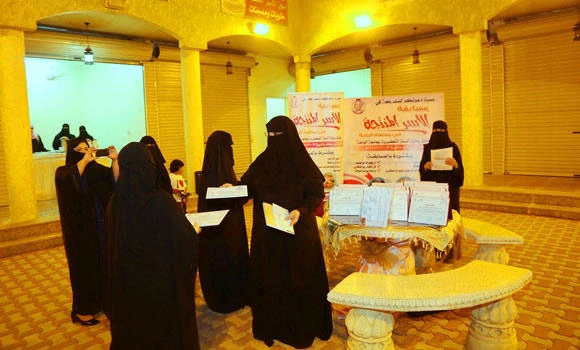
Families in Asir will take part in a new program to boost tourism in their area.
Jasser Al-Herbish, chief of the National Handicraft Program at Saudi Commission for Tourism and Antiquities (SCTA), announced a development plan for Asir’s handicrafts through Made in Asir program. The program comes within the “Asir, a touristic venue all year long” initiative that hopes to give tourism in the area a boost.
Al-Herbish said that the program included 200 families from Asir working to produce products with a registered trade mark or brand name waiting to be launched in the market soon.
The products of the new brand name will be marketed at exhibitions in the region, supported by the National Handicraft Program and targeting tourists or local visitors, or local and international exhibitions. Marketing possibilities also include electronic trade by putting the items for sale through the Internet and social media websites.
Al-Herbish added that the first stages of the National Handicraft Program include collecting information and proposals. The program invites craftsmen, craftswomen and interested designers to take part in this phase through the electronic websites of the National Handicraft Program and the Saudi Commission for Tourism and Antiquities by providing their crafts and marketing them as gifts as well as developing their products and committing to receive training.
Al-Herbish said that an agreement was reached between the SCTA and the Tourist Development Council in Asir to execute plans in support of the handicrafts sector in the area. These plans include conducting financial studies of the handicrafts market, identifying the high seasons and peak time, and best marketing locations.
The program also aims to design partnerships with the governmental institutions specialized in providing support training and support, as well as advancing cooperation between charitable societies and craftsmen who currently receive direct training.
The training programs in Asir comprise providing training for 12 craftsmen on collecting honey and teaching 12 craftswomen on making wood stools in Rijal Alma’ for the period of 10 weeks. Another part of the program indirectly addresses businessmen to host craftsmen and women at major shopping malls in Abha, Khamees Mushayit and neighboring villages. Al-Herbish stressed that the most important targeted sales sites in Asir are King Fahd Cultural Center “Muftaha village,” “Rijal Alma,” and Mahail Asir (under construction in cooperation with the Municipality of Mahail Asir).
Regarding Bllsamar scanning, he pointed that this initiative comes under the guidance of the President of the General Authority for Tourism and Antiquities, Prince Sultan bin Salman, in preparation for launching the first Righteousness and Productive Families Festival.
The scanning process includes identifying the number of artisans in the province and classifying them according to most important crafts to maintain, support and protect from extinction. “All the financial costs for these activities will be paid from the program’s budget,” Al-Herbish said.
With regards to the efforts made by the national program in Asir, Al-Herbish said that the program in the region worked to document the crafts threatened to be extinct, and broadcasted YouTube videos about the artisans. He explained that the most important craft to be preserved include Al-Qat, wicker industry, Sadu, making Asiri clothing, making stools and wooden beds as well as processing plants and aromatic herbs.
In addition to marketing productive family products project, there is another project in collaboration between the Department of Education in Asir and the National Program to train art teachers. 47 male art teachers and 67 female art teachers benefited from the project.
Apart from the role of these crafts as a national heritage, they help provide families with a living income. It’s even hard to carefully identify how much money workers in this profession make, “Undoubtedly, these families benefit widely from these artisans. It’s hard to identify the correct amount but data indicates large economic revenue,” he said adding that this is proved by the participation of 100 families at Abha Festival.
Al-Herbish reminded of the National Program’s participation in the Fourth Architectural Heritage Forum that will be held in Asir. “A private corner will be offered for the National Program whereas three speakers and ten artisans will participate in the activity apart from the gifts that will be made by the craftsmen and women,” he revealed.
The National Handicraft Program is one of the most important aspects of King Abdullah Project for Care of Cultural Heritage of the Kingdom that was adopted by the Council of Ministers to preserve the national cultural heritage and bring awareness to its economic and cultural role and advertise its uniqueness locally and internationally.
Productive families launch ‘Made in Asir’ tag