- I am coming closer to the end of the 20 fruits (mango, fig, orange, strawberry, goji, red grape, cranberry, kiwifruit, papaya, blueberry, sweet and acid cherries, red raspberry, seaberry (seabuckthorn), guava, blackberry, black currant, date, pomegranate, acai (assai), prune) Paul Gross, the “Berry Doctor,” chose to call superfruits.
- As mentioned in earlier articles, the 20 were carefully selected, because they are loaded with nutrients and phytochemicals.
Today, it is yet about another berry, blackberry. You must be wondering why so many berries are included in the “super” list. Well, because they are endowed with exceptional nutrient combinations and nutritional goodness.
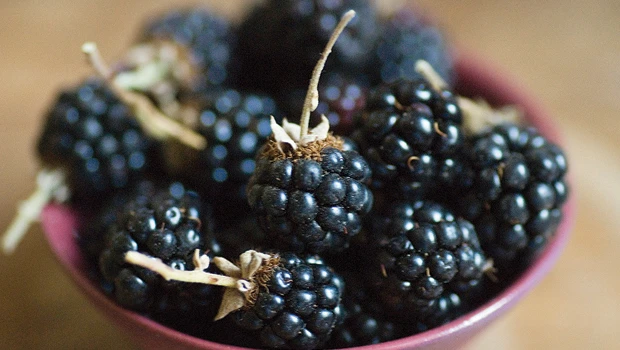
Blackberry is a cousin of red and black raspberries, which belong to the Rubus family. It is cultivated widely in northern temperate countries during summers. Like the raspberry, it is made of many drupelets, which hold seeds, rich in necessary nutrients to balance health, energy, and wellness and keep disease at bay.
Blackberry is abundant in a variety of nutrients. It contains the unusual combination of the vitamins A, C, and E plus K. Heart-healthy soluble fiber and omega-3 fat are found in the multiple seeds, which are in the drop-like bubbles. The berry is also well-endowed in essential minerals.
Blackberry holds a myriad of phytochemicals as well, which perform important functions in the body. Polyphenols in the berry comprise different types of anthocyanins like cyanidins, hydroxycinnamic acids, and ellagitannins. These protect the human body from the damage of free radicals, hence leading to health, wellness, and longevity. Anthocyanins can also counteract cancer activity through cyanidins in the pulp and ellagitannins in the many seeds, which should be thoroughly chewed in order to release their many benefits.
According to a study done in the University of British Columbia, Canada, the berry’s cyanidin glycosides were found to be potent enough to suppress the proliferation of colon cancer cells in test tubes.
Italian studies indicated that the phytochemicals protected against free radicals in human blood vessels in laboratory testing.
Phenolic acids like anthocyanins, which are produced by the berry’s intense pigment (the deepest found in all vegetation), seem to have a powerful action on disease mechanism. Anthocyanins have strong effects on inflammation, a suspected culprit behind different types of chronic illnesses like diabetes, cancer, cardiovascular disorders, and Alzheimer’s disease.
Though the superberry has taken an important place in the research field for many decades, it has not been given the attention it deserves. The unusual deep cyanidin color in blackberry and in other members of the Rubus family requires more serious research probe to unveil the secrets of the impressive activity of anthocyanins in suppressing the inflammation process.
Due to the powerful concentration of the pigment, Mexican scientists succeeded in using the color as an oral contrast medium for magnetic resonance imaging (MRI) in the investigation of the gastric and digestive tracts.
Blackberry’s wide-spread cultivation has made the fruit available to many households. It is usually enjoyed fresh as a fruit provided the hard seeds get properly crunched and well chewed to release the benefits of their nutrient-rich contents. A way to avoid the many chewy seeds is to make the berry into juice or blend it with smoothies. Eight fresh berries make a fruit helping.
Blackberries are grown in private gardens in mountainous Taif above the Holy City of Makkah. The berries are smaller and very juicy with less emphasized drupelets and their seeds are delicately crunchy. The superberries have incredible aroma, exquisite taste, and enjoyable texture. Unfortunately, they are only available during the month of June. The fruit is short-lived, expensive, and rarely found in supermarkets. They are mostly sold by street venders in plastic containers. Don’t miss them. They are just heavenly, Mmmm!
Finally, I would like to wish you all a pleasant summer. I shall resume writing, Inshallah, during the Holy Month of Ramadan in August.