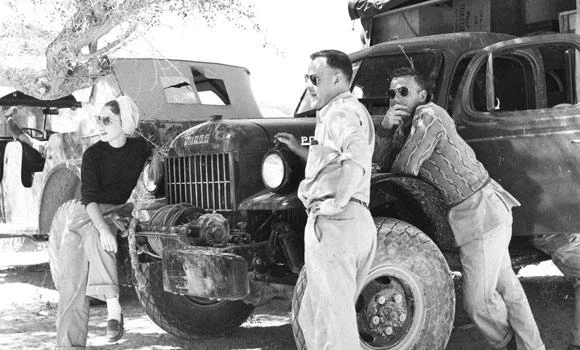
Does this story sound familiar? A young, dashing foreigner visits Arabia and becomes enamored with the region’s rich cultural history; and his passion takes him on a professional trajectory to undiscovered places in the Arabian desert.
No, it’s not T.E. Lawrence, the so-called “Lawrence of Arabia”, but his American equivalent — Wendell Phillips.
As a young paleontologist and geologist, Phillips headed one of the largest archaeological expeditions to remote South Arabia, present-day Yemen.
During his career, Phillips microfilmed over 2,000,000 pages of manuscript at the Monastery of St. Catherine in the Sinai, led the first major scientific expeditions ever to explore South Arabia, excavating the Qatabanian capital of Timna, the Timna Temple, and Hajar bin Humeid; led the Yemen expedition in Marib at the Mahram Bilqis, Moon Temple, legendary home of the Queen of Sheba in 1951 and 1952; followed by ten years of expeditions in Oman primarily concentrating in the Dhofar province.
A small trove of his discovery is currently on display at the Smithsonian’s Arthur M. Sackler Gallery.
Unearthing Arabia: The Archaeological Adventure of Wendell Phillips, is the “first multi-sensory” exhibition the Sackler has produced. The selection of excavated artifacts, 1950s-era film clips, videos, field notebooks, and vintage photographs highlights Phillips’ key finds, which are the most important collection of documented Saudi Arabian artifacts in the US, dating from the 8th century B.C. to second century A.D.
Phillips’ initial foray was approved and encouraged by the King of Yemen, Imam Ahmad bin Yahya Hamidaddin. The King’s authorization enabled him to uncover the ancient city of Timna, the capital of the once-prosperous Qataban kingdom; and Marib, the reputed capital of the legendary Queen of Sheba, who appears in religious texts sacred to all the Abrahamic faiths.
These cities once flourished 2,500 years ago along the fabled Incense Road — a trade route that stretched from India to port cities along the Mediterranean Sea. The road facilitated the movement of goods such as Arabian frankincense and myrrh, gold, precious stones, pearls, ebony, silk, Indian spices, feathers, rare woods, and animal skins.
The highlight of the exhibition, which closes June 7, 2015, includes the “Lions of Timna,” the sculptures were once featured on Yemeni currency. Also featured is an iconic translucent alabaster stele head of a young woman, with lapis lazuli eyebrows and an Egyptian hairstyle. Unearthed in the cemetery of Timna, the head was nicknamed “Miriam” by the Arab workers who discovered it.
Phillips’ team decoded the timeline of Arabian history that remains the definite narrative for archaeologists today.
Lowell Thomas, the radio commentator and author who is often credited for promoting T.E. Lawrence in the US, once referred to Phillips as “the American Lawrence of Arabia”.
Phillips knew and loved the Arabian desert like few other westerners. Of all his honors, he was proudest of the fact that he had been declared a Bedouin sheikh of the Bal-Harith tribe
— the only American so honored.
Known as the world’s richest archaeologists, Phillips derived his wealth from numerous oil leases. He was the largest individual holder of oil concessions in the world, and at the time of his death, at age 54, in 1975, his personal wealth was estimated in excess of $120 million ($471 million in today’s dollars).
“As far as I can remember, I always wanted to be an explorer,” Philips writes in his autobiography, Sheba’s Buried City. “This childhood ambition of mine was given every conceivable encouragement by my mother, who as a girl had prospected the gold dust trail by pack-mule with her father and mother throughout California’s High Sierras.”
Dr. Massumeh Farhad, chief curator and curator of Islamic Art at the Sackler Gallery, told Arab News, “Phillips was a remarkable man, he made amazing discoveries; most notably, Miriam, which is probably the most important alabaster stele ever found in the region.”
“The cultural, historical and architectural relationship between Saudi Arabia and Yemen is exemplified by the historical wealth of many of the cities that were highlighted in the Sackler Gallery’s Roads of Arabia Exhibition,” said Dr. Farhad.
—
Email: [email protected]
America’s ‘Lawrence of Arabia’