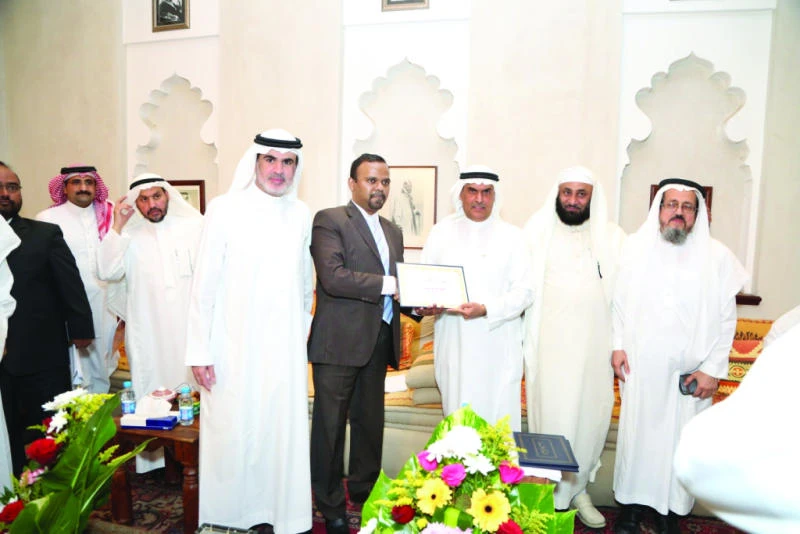
The “Make in India” campaign that aims to transform the country into a manufacturing hub offers Saudi businessmen a good opportunity to invest in India’s vital sectors such as automobiles, aviation, construction, electronic systems, IT, food processing, oil and gas and petrochemicals, said Indian Consul General B.S. Mubarak.
Addressing Saudi businessmen and entrepreneurs at Jeddah Diwaniyah, he said the campaign launched by Prime Minister Narendra Modi in September also aims at eliminating unnecessary laws and regulations, making bureaucratic proedures easier and shorter, and make government more transparent, responsive and accountable.
“The government accentuate upon the framework which include the time-bound project clearances through a single online portal which will be further aided by the eight-member team dedicated to answering investor queries within 48 hours and addressing key issues including labor laws, skill development and infrastructure,” he explained.
Foreign investments are also sought in biotechnology, defense manufacturing, electrical machinery, media and entertainment, mining, pharmaceuticals, ports, railways, renewable energy, roads and highways, space, textile garments, thermal power, tourism and hospitality.
Saudi Arabia is India’s 4th largest trading partner with bilateral trade crossing $43 billion during 2012-13, the consul general said. It is also the largest supplier of crude oil to India, accounting for one-fifth of total oil imports.
“This reflects the fact that both countries are developing a broad strategic vision where they are determined to work together closely for the welfare and benefit of their citizens while maintaining peace and stability,” he added.
In his speech, Saudi Businessman Khalid A. Al-Fouzan, chairman of Al-Fouzan Building Materials Company, appreciated the Indian community’s contributions toward boosting Saudi Arabia’s overall development. “Saudi Arabia maintains good trade relations with India and the two countries are partners in technology, science, education and business.”
Emad A. Al-Muhaidib, vice-chairman, Al-Muhaidib Group commended India for supporting the Kingdom’s causes. “Our two countries enjoy multifaceted relations reflecting the centuries old economic and socio-cultural ties. Saudis are much more interested in investing and trading with India and Indians. The 2.8 million plus Indian community in Saudi Arabia is the ‘most preferred community’ due to their expertise, sense of discipline, law abiding and peace loving nature.” He hoped that the look-east policy adopted by the Saudi government under the leadership of Custodian of the Two Holy Mosques King Abdullah would enhance Saudi-Indian relations.
Hussam Al-Kahtani, chairman of Al-Kahtani Group, praised the role of Indian manpower and expertise in education, IT, medical, construction, banking and other sectors in the Kingdom. Mohammed Al-Nafaie, chairman of ECGS, ATEICO and Digital Technology who was the first to bring IGNOU to Saudi Arabia said there is vast potential in the Indian education sector and disclosed his group’s plan to divert to India’s medical tourism as well.
Consul Commercial S.R.H. Fahmi said the government launched “Make in India” program in the view of changing economic conditions to make India a desired destination for investment and trade. Pranav Ganesh, a senior consul, said that visa issuance has been streamlined with the addition of online visa processing system. The validity has also been revised with the provision of one-year multiple business visa and five-year multiple visa for Saudi businessmen with strong credentials.
Exposing the vast potential available in the IT sector, Tata Consultancy Services program Director at K.S.A. P. Hashim said the industry has not only transformed India's image on the global platform, but also fuelled economic growth.
Mir Gazanfar Ali Zaki, executive secretary of Saudi Indian Business Network (SIBN) praised the hospitality of Jeddah Diwaniyah and highlighting the potential of Make in India, with an aim to increase bilateral trade and seek stronger cooperation between two countries.
India seeks Saudi investment in vital sectors