Prince Alwaleed bin Talal, chairman of Kingdom Holding Company, started his business when he was only 25 years old. His road was not paved with roses or flowers as some people may think. Twice he had declared himself bankrupt but he soon picked himself up and turned his failures into a great success story that made him an icon in the world of business and finance.
Prince Alwaleed depended on the English proverb, “Make hay while the sun shines,” to build his financial and media empire over 34 years with assets worth more than SR120 billion. He believes that “guts and carefully-studied risks” are the two most important factors for any success.
Following are excerpts from his interview to Okaz newspaper:
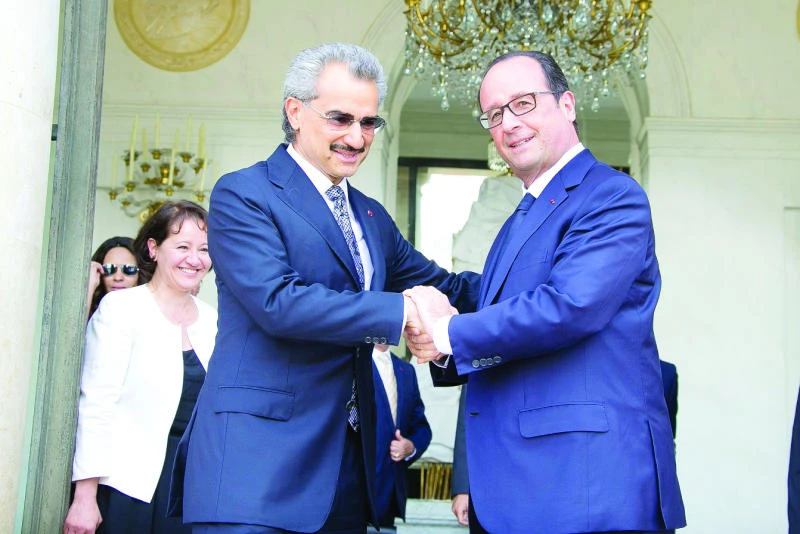
You participated recently with French President Francois Hollande in the meetings on the international sovereign funds. How did the invitation come to you? Why you personally?
The invitation came to the Kingdom Holding Company because there is no effective Saudi sovereign fund. I wished so much that the government was represented in these meetings. I have been calling for the establishment of such a fund given the turbulent world financial and economic conditions. Because no such fund existed, the invitation was extended to KHC because it is a strong local, regional and international firm. We have participated in more than 10 sovereign funds with assets of more than $3 trillion. We are proud of this participation.
Some economic experts do not believe that the Kingdom needs a sovereign fund considering the large size of its economy. They also say we have a sovereign fund represented by the Saudi Arabian Monetary Agency (SAMA). What do you think?
This is not informed talk. I think the Kingdom needs this fund now more than ever, especially with the sharp fall in oil prices. We know that the Kingdom has reserves amounting to more than SR2.6 trillion. This amount includes finances from some other government funds. The Sanabil Investment Company, which the government has established with a capital of SR20 billion, will not do much even if its proceeds are high. The returns of the government investments are not more than 1 percent. This was revealed during recent discussions in the Shoura Council with some officials in the concerned ministries. We have to activate these funds to ensure the government earns more profits. This cannot be accomplished without the sovereign fund, which will have returns of 8 to 10 percent a year, as is the case in Norway, China, Abu Dhabi, Kuwait, Singapore and other countries.
Some people claim that you are vehemently asking for the establishment of this fund so you can take over its management. What is your response to this?
Managing a budget of about $3 trillion is not an easy thing to do. Alwaleed alone or any other person will not be able to do this job single-handedly or unassisted. The matter needs a task force consisting of Saudi economic experts and statesmen whom Custodian of the Two Holy Mosques King Abdullah trusts. The fund must be managed properly and with high professionalism to ensure the Kingdom has annual returns of not less than 8 to 10 percent.
Looking at your recent message to the minister of petroleum and mineral resources in the backdrop of the fall in oil prices, one felt that you were looking with the eye of a merchant at oil as an economic commodity, not with the eye of a statesman who may have a different outlook on oil. What do you think?
Oil now is not a war weapon but rather a suicidal tool. The situation is extremely serious. The Kingdom’s budget depends 90 percent on oil. If the government does not reduce its expenditure with oil prices steadily dropping, there will be a great deficit in the general budget. If spending continued at this level, the government will be obliged to withdraw from the reserves, which will finally be depleted. After this, the government will have to resort to local and international borrowing as had happened about a decade ago. Therefore, we must diversify our sources of income and establish the sovereign fund.
What about your relationship with the ministers?
I have ties of friendship with many of them. However, I urge them all to do more for the Saudi citizen. The ministers must make the father of the nation King Abdullah their role model. The king refused many titles and said he was the Custodian of the Two Holy Mosques and the Servant of the People. Therefore, every minister should be certain that he has been appointed in his position only to serve the Saudi citizens.
Do you do believe that some ministers are arrogant and superior?
Yes, I believe that some of them are. A scene that I saw on television comes to my mind at this moment. A Saudi minister was expressing his protest to a question by a journalist on a satellite channel by blowing repulsively at the microphone. He told the questioner to “go to hell.” This is not appropriate for the image of the Kingdom or of the minister himself. On the other side, there are ministers who are down to earth and extremely nice in their dealings with other people.
How do you see the Saudi citizen?
I love the Saudi citizen and I am partial when it comes to him. I put him/her on my head. During the past five years, we have only been employing Saudi citizens in our companies. Even the people who work at my home are almost 100 percent Saudi.
Millions of people watched you on the YouTube telling a Saudi citizen that you are a Saudi citizen like him. You said to him: “I am a Saudi citizen like you. Do not call me prince.” What is the title that is more favored by you?
While I am proud of the title of “prince” and thank God for this bounty, I look at the Saudi citizen as a brother. I feel comfortable when I walk on the street and someone calls me by my first name or calls me “Abu Khaled” without any barriers.
You have investments worth billions of dollars in the media industry in the world, including the American company News Corp, Rotana channels, Al-Risalah channel and the Al-Arab News Channel, which will soon start transmitting from Bahrain, in addition to the Saudi Research and Publishing Company (SRPC). What are your real purposes behind the media investments?
The media is the fourth power. Everybody knows its strength and influence. We all remember Watergate and how two American journalists from The Washington Post were able to depose President Nixon. I strongly believe in the media and consider it a weapon for all countries. I do not, however, like the hypocritical media or the biased ones. I am all for respectful and responsible information that plays its role impartially and balances between the requirements of a country’s security and the needs of its people. The media at the same time should be committed to truthfulness, credibility and openness. This may be a difficult balance but one we are determined to strike.
Of late, you have gone for the new media. You are one of the owners of the American company Twitter and the Chinese company JD.com. How do you look at the new media? Do you consider it a feasible investment?
No doubt, the new media is important and economically feasible. Every move we make has to have clear objectives and at the same time be profitable. When we entered into Twitter, the price per share was $14. Now it has more than tripled.
Your account on Twitter had attracted more than 2.5 million followers in 15 months. You are also among the 100 most influential people in the world. How do you envisage this tool and benefit from it in your projects?
I am well aware of the importance of Twitter and its influence. Therefore, I look at it with complete seriousness and at the same time with extreme caution. If you look at my tweets, you will find that they are too little and not exceeding 126 so far. I have a consultative committee that reviews my tweets before they are put on my account.
Do you write your tweets yourself or do you have a team to do this for you?
I write my tweets myself and put them on my account. However, I believe in the importance of consultation and in getting a second opinion on some tweets. Any tweet is studied by a consultative committee, which will also choose a suitable time to post it.
Some people are of the opinion that Al-Arab News Channel will not offer anything new and will be a copy of other news channels. What do you say?
The channel will start transmission on Feb. 1, 2015. It will adopt the values of candidness, transparency and impartiality. We will give enough space for opinions and counter opinions. The channel will not be a mouthpiece for any particular party. Our commitment will only be to our Arab nation. We will not accept funding from any other foreign body even though many other famous Arab news channels do this, adversely affecting their credibility and independence.
Why have you chosen Manama for your channel even though it is not an important media city like Cairo, Dubai or Beirut?
We have carefully studied six Arab capitals but finally decided on Manama. We believe that Bahrain is most suitable to us considering the amount of freedom and political stability. This is one of the achievements of King Hamad bin Issa Al-Khalifa, with whom I have close relations of fraternity and friendship. Bahrain is also very advanced country culturally and intellectually. Bahrain is the most conducive incubator for expatriates. It is the No. 1 Arab and GCC country and the fourth in the world regarding the ability to attract foreign manpower. We should also not forget its nearness to the Kingdom and its easy accessibility through the King Fahd Causeway.
You did not specify the exact height of the Kingdom Tower but only said it would be 1,000 meters. Is this just a tactic to increase the height if a taller building suddenly appears somewhere else in the world?
I am determined to make this building the tallest in the world. It is enough that this building will put the Kingdom’s name on the world’s real estate map.
Is the construction of infrastructure for the project complete? Are you happy with the services and facilities extended by various ministries with regard to the implementation of the project?
All the ministries have responded positively. During a meeting with Minister of Municipal and Rural Affairs Prince Mansour bin Miteb, he pledged his support and made available all required facilities in accordance with the Kingdom’s regulations. As you know, it is a vital project and not restricted to the Kingdom Tower alone. It is an integrated city sprawling over an area covering 5.5 million square meters. The tower will be built on an area of 100,000 square meters and this represents only 2 percent of the project. Apart from the tower, the city will house residential buildings, hotels, schools, universities, hospitals, gardens and other facilities. On completion, the city project, with a capacity to accommodate more than 100,000 citizens, will become the nucleus of the new Jeddah city.
How do you view the projects of the Ministry of Housing?
The Ministry of Housing has not yet responded fully to the dire need of citizens for housing. The state has allocated SR250 billion to build 500,000 housing units and has made available the required plots of land and other facilities to the ministry. However the work is going at a snail’s pace and is not up to the expectations.
Could you explain the activities of the Prince Alwaleed Bin Talal Charity Housing Foundation?
The Foundation has so far built 1,562 residential units in various regions of the Kingdom. As many as 10,061 citizens have benefited from this. Within a couple of weeks, we will make announcements about the allotment of another 10,000 housing units. We will make a drastic change in our strategy and we will move from allotting villas to allocating apartments instead. This is mainly because of land related issues. Earlier, we had received land from the government. But now the state is giving priority to the Ministry of Housing in the allotment of land and the foundation is not receiving any allocations. However, we are keen to quickly allot housing units to the beneficiaries.
There is a family relationship between you and Minister of Finance Ibrahim Al-Assaf. Your son Khaled bin Waleed has married Al-Assaf’s daughter. Can we get acquainted with this kinship and the most prominent discussions and opinions between you when you meet?
Our family relations are very strong. I harbor all love and respect for the minister of finance. Also, at a practical level, I have all respect for him. There are many times when I have entered into discussions and confrontations with him because I see the nation as above every matter. Therefore, I discuss with him some subjects that I feel are in the interest of the nation, like the subject of the sovereign fund because this is a general subject and not private and the majority of economic experts support my opinion on it. But despite all the discussions our relations are still strong and the minister is an honest man who works with patriotism, truth and integrity.
How do you view the working Saudi woman?
Saudi women are capable and creative. I demand society to give them a chance in all fields. I also demand society to keep away from the culture of opposing women because this opposition is not founded on a Shariah basis. With regard to allowing Saudi women to drive cars, if we view the subject from a religious perspective we will find that it is better to allow women to drive to avoid them mixing with foreign drivers. From an economic perspective, it will reduce the burden on Saudi families. The president of McKinsey & Company, the top international consultancy company, said one million drivers would leave the Kingdom if women are allowed to drive. This means that Saudi families will save over SR1.5 billion a month, or SR18 billion annually considering a driver’s monthly salary is SR1,500. Also, allowing women to drive will reduce unemployment among women. It will give the Saudi man the opportunity to avail the services of his driver.
—
Please read full interview on www.arabnews.com
Kingdom needs to go in for sovereign fund, says Alwaleed