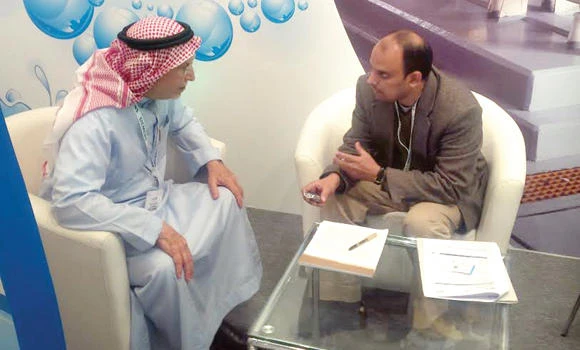
Adil Bushnak, who is among the founders of the International Desalination Association (IDA) and chairman of Moya Bushnak, was the organizer of 10th Saudi Water and Power Forum (SWPF) with the Ministry of Water and Electricity. He is credited with being one of the ideologues of the forum, which was started in 2004 to achieve sustained growth in the Kingdom’s water and power sector.
Bushnak, who also served as the first Arab president of IDA, spoke to Arab News in an exclusive interview during the 10th SWPF. He spoke about various aspects of the Kingdom’s water and power sector. He asserted that subsidy should be limited to the poor families and the rich should pay the actual cost to help government recover the expenditure.
He also urged the government to decentralize the sector with plants located nearer the district as availability of supply will reduce the cost substantially and help achieve sustained growth.
Ten years down the line, what is your assessment of the water and power sector with SWPF completing its journey for a decade (2004-2014)?
There were many set goals when we envisioned this forum and started in 2004. This year, it moved to Riyadh from Jeddah completing a decade. There is also a proposal to hold the forum in Dammam to make it truly a Saudi forum by organizing it in different regions of the Kingdom. During these years, we have achieved a lot and working on other goals, but a lot more needs to be done for achieving sustainable development through innovation.
Like water tariffs need to be revised, there is a need for change in government structure, rather than corporations to build desalination plant at the lowest possible cost and supply water and power at cheaper rates to poor families.
There is a need to work on desalination methods with decentralization to pump water at the lowest possible cost and deliver it at the lower price. We should not simply focus on seawater desalination but also on ground water desalination with decentralized plants. I am sure it will reduce production and supply cost as, so far, huge distances are covered to supply water and power. Decentralization will help cut costs.
Government should focus on using ground water and evaluate the route to a decentralized and stabilized supply of power and water for the future generation in the Kingdom. There is a need for change so that we can have sustainable tariffs. We know that somewhere down the line there is need for a paradigm shift in the sector as it is not simply water and power but food and other essentials of daily life are related to it.
Ten years from now, where do you see the Kingdom’s water and power sector?
Of course, we will see a lot of improvement in the water and power sector with the ongoing development setting benchmarks for future endeavors, but there is a need to maintain sustainability in policy innovation and successes and learn to improvise on grey areas. There are international acknowledgments to the forum and stakeholders from various parts of the world participating in it. It would be even better, if we succeed to have more Saudi footprints.
How far SWPF has helped in Saudization of the water and power sector?
Indeed, the vision and mission has helped in many ways with the exchange of ideas, which helped in grooming the local talents and increased youth participation. Yes, there are successes, but we see that there are foreign partners and investors. We are still behind in localizing technology in the water and power sector. Really, there has not been enough on this front and are still looking forward to a better and bright future. To add to this, there is huge opportunity for the private sector but there are no incentives. We need to have strategic plans to achieve sustained growth; we are just building plants. If we do not care about it, there will be a problem in achieving sustainable development.
There is huge work in progress on desalination and as an expert and man-in-charge of one of the leading companies in this sector Moya Bushnak. Do you think there is need for Saudi companies to come forward and join ongoing rapid development?
Moya Bushnak and other Saudi companies will be happy to come forward and work jointly to help reduce costs and achieve sustained growth in the water and power sector. There is huge spending on transportation of water due to limited plants, be it the largest. The government should supply water from where the demand is coming, the localized plants will help solve the issue that will require involvement of local companies. I submitted a report in writing to the Ministry of Water and Electricity, but to no avail as so far they have shown no interest.
The Kingdom is working on largest desalination plant, how do you look at it?
Why there is so much of attention to have the world's largest desalination plant in the Kingdom; instead our government should focus on using groundwater and evaluate the route to a decentralized and stabilized supply of power and water for the future generation. We are investing so much on it, while for the same amount of water and power supply we can work on a cost-effective formula with local participation.
Location-wise, plants close to the district of requirement will reduce cost of production and supply substantially, which can be utilized for other welfare programs. We do not need to build central plants as was practice decades ago. Earlier, it centralized because we were using water and power simultaneously, but it is not the case now. There is no need to do it together; we can work on water and power supply separately.
When we look at it, we have to keep in mind the economy; the economics of power is different from the economics of water. We should produce water close to where we need it.
Does the viability study support the argument validating decentralization of plants?
Yes, it supports; especially with the localization of power grade network, which can be applied for water as well. Moreover, with the work in progress on renewable energy programs aiming to reduce dependence on petroleum products to produce electrical energy and expedite process for renewable energy to decrease carbon emissions in the atmosphere will also help reduce the cost.
How does it matter for people. Is it going to affect them?
Of course. A paradigm shift in policy is required as it is not going to benefit people due to increase on prices. It will affect poor families the most. The government should ensure supply of cheaper water to low income group of families and subsidies should be limited to poor families, who can afford the high cost. I cannot believe our water tariff is one of the lowest in the world despite the fact that water scarcity is a stark reality in the region surrounded by the sea. The rich people are getting benefited the most from the subsidy at the cost of the poor family's welfare.
Our Government should generate revenue by charging the production and supply cost from the rich sections to meet the expenditure and sustained growth in the sector and restrict subsidy to the poor families only as rich people can afford to share the cost by the government. We deliver the subsidized mineral water to rich people homes also. The government should charge them the actual cost.
Q: Oil prices have gone down to the lowest in years. Do you think there is a need for making concerted efforts for alternative sources of energy like renewable and solar?
Yes, it is very much required. I think the decision-makers are aware of it and I hope in coming years. Let us say 10 years down the line, we must start producing 20-25 percent of energy requirements from such sources.
The Kingdom has signed nuclear agreements with several countries to speed up work on renewable energy projects. Don't you think an agreement with the US should be finalized on priority to give it momentum?
I hope so. But we cannot be world leaders in that and therefore we cannot rely on that. We have seen countries failing on that part. We should instead rely on a self-sustained method and work for self-reliance. We would love to see the Kingdom as a self-dependent country.
So you suggest not to rely on help from abroad?
Being a self-dependent country is significant. I am not saying no help from outside. We must learn to grow with them and take experience by sharing their expertise, but then we must start adopting a self-sustainable model. Cooperation from foreign partners is welcome. With the value-based partnership, they should benefit and we must benefit, and the world should benefit with the collective efforts. We should avoid limiting ourselves to a few countries for partnership and sharing expertise, and look for cooperation from many countries.
Self-sustainable model ‘vital to meet water and power needs in KSA’