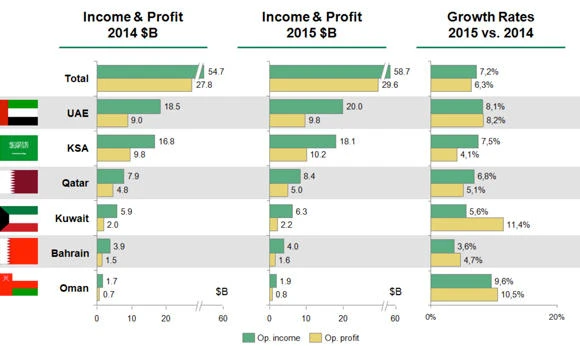
RIYADH: The banking industry in the GCC grew at a lower rate in 2015 than it did in 2014 with just a 7.2 percent increase, stemming almost exclusively from major customer segments such as retail and corporate banking, according to a new study by The Boston Consulting Group (BCG)
In parallel, in Saudi Arabia, operating revenues and profits jumped 7.5 percent and 4.1 percent, respectively.
In terms of loan-loss provisions (LLPs), in 2015, Saudi Arabia ended up with an increase of just 4.8 percent. Group LLP growth soared by five percent in 2015 compared to 2014, BCG stated in its report.
In 2015, Saudi Arabia’s retail revenue growth rate stood at five percent, versus just one percent for profits. Similarly, the median corporate revenue growth rate was five percent compared to negative one for profits.
Based on the banks’ 2015 annual results released in the first quarter of 2016, the newest study is part of BCG’s annual banking performance indices measuring the development of banking revenues (operating income) and profits for leading GCC banks.
BCG launched the first edition of the banking performance index in the GCC in April 2009, creating a customized index specifically for the regional banking markets, with 2005 revenues and profits as starting benchmarks. The index covers the largest banks in Bahrain, Kuwait, Qatar, Oman, Saudi Arabia, and in the UAE.
“The 2015 BCG index includes 45 banks from across the GCC, capturing about 80 percent of the total regional banking sector,” added Reinhold Leichtfuss, a senior partner and managing director at BCG Middle East.
Strongest growth
In 2015, Oman banks led the pack in terms of growth numbers with 9.6 percent in revenues and 10.5 percent in profits. UAE banks’ revenues grew by 8.1 percent and Kuwait banks recorded an 11.4 percent profit growth.
The spread of revenue and profit growth rates between the GCC countries was significantly smaller than that of last year, ranging from four to 11 percent. There was no negative growth on a country level, according to BCG group.
Instead, in 2015, the development of LLPs varied significantly between all the countries, resulting, in total, in a small increase of 0.6 percent.
The two biggest countries, the UAE and Saudi Arabia ended up with a small increase of two percent and 4.8 percent, respectively, whereas Bahrain banks grew LLPs by 39 percent and Oman banks by 21 percent, according to the report.
This is compensated across the GCC by a strong decline in Qatar and Kuwait.
In 2014, we had observed a decline in LLP across almost all countries. Going forward, a slight increase can be expected due to current trends in economic development.
A first sign of this is that the majority of banks in the UAE provisioned more in 2015 than they did the year before.
After a number of years with growth in operating expenses exceeding that of revenues, 2015 came out with a moderate aggregate cost growth of 6 percent, with Qatar and Kuwait banks managing almost zero and Bahrain recording a negative growth in cost of one percent.
A number of banks preempted the consequences of a low oil price environment and restricted costs and investments.
Some larger banks as well as those that had significantly increased costs in the past, managed to achieve low and, in several cases, even negative growth.
In 2015, retail banking revenues in the GCC experienced a further uptick of 8.1 percent, largely due to an increase in Qatar (16 percent), Oman (11 percent) and the UAE (10 percent).
GCC retail profits faced a decline in aggregate, largely because of a negative growth in the UAE. The growth rate in all the other countries was moderate; in fact, only banks in Qatar reached a double-digit growth rate with 13 percent.
Corporate banking revenues grew moderately by 3.3 percent while profits increased by 8 percent
In 2015, only Oman experienced double-digit growth rates in both corporate revenues and profits.
In the UAE, however, there was a slight decline in revenues while profits grew by 22 percent due to a decline in provisions.
All the other countries realized moderate revenue growth. Profit growth numbers, on the other hand, range from minus one percent in Saudi Arabia to 18 percent in Kuwait.
Superiority of strategies, business models and execution decisive for widening gaps between GCC banks.
“In 2015, the majority of GCC banks were able to achieve revenue growth. The increasing divergence when it comes to profit development is remarkable: while 11 to 17 banks still achieved double-digit growth, 11 to 15 banks witnessed negative growth overall or in customer segments. The number of banks in ‘group’ and for the ‘retail’ and ‘corporate’ segments deviate, since not all banks have a complete segment reporting yet,” Leichtfuss stated in the report.
“The midfield of banks with single-digit growth has become quite small. It is interesting to note that, in several markets, not the top banks but some of their followers achieved the highest growth rates.”
Leichtfuss explained: “According to BCG’s analysis, it is obvious that banks with superior strategies and strong business models can truly execute decisively and grow the strongest.”
Over the past decade, the leading banks have grown at double or triple the rate of the average ones. In almost all cases, such a development is based on a superior and consistently-executed strategy.
“In the coming three to five years, we consider the digitization of processes as the most important task that banks need to achieve — since this will enable advanced banks to reach the next level of customer experience as well as cost efficiency.”
Needless to say, a superior performance culture and rigorous execution will continue to be equally decisive.
It will be required, due to the fact that in 2016, oil price and environment is likely to remain challenging.
Strong business models help GCC banks to achieve profits