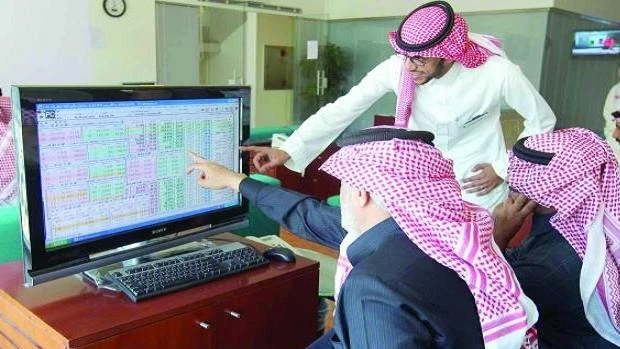
JEDDAH: Stock markets continue to go down due to decline in global oil prices, and Tadawul is no exception.
The Saudi stock market plunged again on Wednesday. Only a day before, Tuesday, it rebounded four percent.
The Tadawul All-Share Index dropped 4.99 percent to 5,459.84 points, the lowest close since March 2011. The index is already down 21 percent so far this year.
The value of Saudi traded shares exceeded SR6.5 billion on Wednesday.
“The Saudi market needed to be restructured to make it more efficient since the collapse of the market in 2006, and as a result the market reacted to extra caution in a negative way to the fall of oil prices and the slowdown of worldwide economic growth,” Sami A. Al-Nwaisir, chairman of the board, Al-Sami Holding Group, told Arab News.
However, he said: “Knowing the nature of financial market it's no surprise the market will rebound at any time.”
The petrochemical stocks battered as oil prices resumed decline on Wednesday. The petchem index fell 6.29 percent, which is 21.73 percent down so far in 2016.
Reacting to Tadawul’s fall, Asim Bukhtiar, head of research and investment advisory at Saudi Fransi Capital, said: “Market meltdown and resulting valuations are reflecting prevailing conditions and not necessarily future prospects. There are many high quality names likely to emerge substantially stronger than their competitors in respective businesses.”
But, he said: “Good news is that the correction is not coming off a bubble (meaning 2006) but rather a subdued market in H2, 2015 so a recovery is very much within the realm of possibility. And if miraculously dividends are maintained, investors will have another reason to cheer.”
US crude wallowed at its lowest since 2003 after the International Energy Agency warned the market could "drown in oversupply."
US futures plunged 5.2 percent to $ 26.97 while Brent crude lost 3.8 percent, to $ 27.67. With valuations and dividend yields now looking attractive by global standards, major Middle Eastern markets had rebounded on Tuesday. Wednesday's losses erased those gains and underlined the fragility of investor sentiment, amid uncertainty over how Gulf oil exporting economies can cope with an era of cheap oil.
The market witnessed good economic cycle of prosperity during the past year and oil is a commodity that fluctuates due to economic forces, news and market sentiment. So, this is good time for the GCC markets to revisit their economics and rationalize their spending, improve their investment prospects that they have from the cash reserved during the booming period, they should also explore other ways to reduce their dependence on oil, Reuters reported.
“The financial market is a leading economic indicator, which is very sensitive to any spontaneous news and to the geopolitical risk. At the same time, the Tadawul is extra sensitive due to the fact that it lacks market depth and breadth by number of companies that are participating in the market, which are so far only 164 companies,” Al-Nwaisir added.
Other Middle East stock markets plunged to multi-year lows again on Wednesday.
The Dubai and Abu Dhabi bourses both tumbled to 28-month lows. Dubai index plunged 4.6 percent. Abu Dhabi's bourse slumped 3.1 percent, taking its 2016 losses to 12.5 percent.
In Qatar, the index was down 3.3 percent after rocketing more than 5.0 percent on Tuesday.
Global equity markets also dropped to their lowest levels since 2013, on Wednesday.
The MSCI World equity index slumped 2.6 percent to its lowest level since July 2013. The Dow Jones Industrial Average fell 358.34 points, or 2.24 percent, to 15,657.68, the S&P 500 lost 43.99 points, or 2.34 percent, to 1,837.34 and the Nasdaq Composite dropped 110.68 points, or 2.47 percent, to 4,366.28.
There have been steeper monthly drops only four times in the MSCI World European shares touched their lowest level since October 2014, with the FTSEurofirst 300 down 3.4 percent and set for its biggest single-session loss since the China-induced selloff in August.
Oil shares in Europe are down more than 14 percent already this year and at their lowest levels since 2003. That has been a major weight on the FTSEurofirst 300, which is down nearly 12 percent in 2016 and more than 23 percent from its high in April, Reuters said.
The Nikkei share average shed 3.7 percent to its lowest close since Oct. 24, 2014.
Tadawul plunges 5%; global stocks tumble