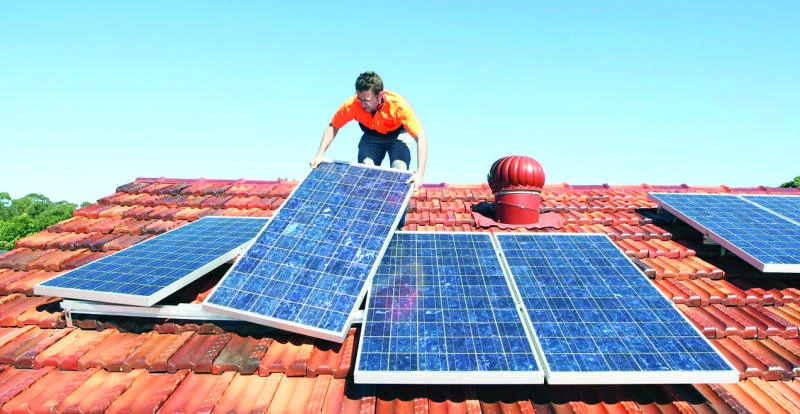
MADRID/SYDNEY: A year after Spain, the sunniest country in Europe, issued notice of a law forcing solar energy-equipped homes and offices to pay a punitive tax, architect Inaki Alonso re-installed a 250 watt solar panel on a beam over his Madrid roof terrace.
“The government wanted people to be afraid to generate their own energy, but they haven’t dared to actually pass the law,” Alonso said as he tightened screws on the panel on a sunny summer day this month. He had removed solar panels from the roof last year.
“We’re tired of being afraid,” he said.
Halfway across the globe, in the “sunshine state” of Queensland, Australia, electrical engineer David Smyth says the war waged by some governments and utilities against distributed energy, the term used for power generated by solar panels, is already lost.
“The utilities are in a death spiral,” he told Reuters by telephone while driving between a restaurant where he helped set up 120 solar panels to cut its A$60,000 ($53,000) annual power bill and a galvanizing plant which was also adding solar panels to reduce costs.
In Australia, he said, solar panels have shifted from being a heavily subsidized indulgence for environmentally-conscious households to a pragmatic option for businesses wanting certainty about what their running costs will be next year.
“Not many people are doing it because of emissions or the environment,” Smyth said. “It’s about the cost.”
Solar photovoltaic (PV) panels constitute the fastest growing renewable energy technology in the world since 2000. Global capacity has exploded from 1.5 gigawatts at the turn of the century to 136 gigawatts currently, according to the Paris-based International Energy Agency.
Meanwhile, the price of solar panels has plummeted 80 percent since 2008 thanks to generous state subsidies aimed at promoting clean energy.
It’s still less than one percent of energy capacity worldwide, but the surge in installations of rooftop solar panels is beginning to hit utilities and their business model of charging customers on the basis of consumption.
Joined by traditional energy companies, they are lobbying governments to reverse decades of subsidies to green, renewable energy such as solar and, in some cases, to tax them.
In Europe, Australia and in the US, energy companies have powerful lobbies that argue that they form a cornerstone of the economy and provide jobs to tens of thousands. Governments are forced to pay heed and in some cases they have acted.
Local Australian governments have slashed rebates for households which feed spare solar energy back into the grid, and approved massive increases to set daily connection fees. In Queensland, Australia’s most solar-powered state, one state-owned grid company just raised daily connection fees by 1,142 percent while removing per-unit consumption charges — effectively removing the incentive to switch to solar.
Spain’s decree, although never converted to law, would force solar-equipped homes and businesses to connect to the grid and pay a tax on each kilowatt consumed.
Asked when it might be approved, an industry ministry official told Reuters by e-mail: “It all depends on what the cabinet decides to do in the coming months.”
Nevertheless, the mere threat of the law was enough to ground solar panel installations to a halt in the country. Fewer panels have been installed in Spain this year than any since the early 2000s, renewable energy experts say.
“The draft law was a brilliant move by the government to keep people from going off the grid, delaying competition for the big utilities,” said Cote Romero of renewable energy advisers ECOOO. “They’ve paralyzed a whole sector without actually regulating it.”
And yet, households and businesses find solar energy appealing in an environment where utility bills are increasing.
“Current policy is encouraging people to go off the grid,” said Roger Gill, owner of Spanish solar energy company Expert Sistemas Solares.
“Most of our clients right now are small businesses, particularly in the farming and fishing industries, who are fed up and want some stability in their energy costs.”
Although the surge in solar energy may be fueled in part by environmental concerns, it is not being led by environmentalists. Apple Inc, America’s biggest company, powers its biggest data center, in Maiden, North Carolina, with the country’s largest privately-owned solar farm which it owns.
Google Inc, America’s third-largest company, gets a third of the power for its giant Mountain View, California headquarters from its own solar installation.
The record for a country installing solar PV in a year was China, in 2013, with 11.3 gigawatts or nearly a third of global installations. China wants 35 gigawatts of solar PV capacity by 2015 and 100 gigawatts, nearly the entire current world total, by 2020.
Solar’s rapid rise — along with warmer weather, more energy efficient appliances and various geopolitical factors — has pushed down demand for traditional electricity and cut into utilities’ profits across the world.
Taxes and fees: Worldwide battle between utilities and solar