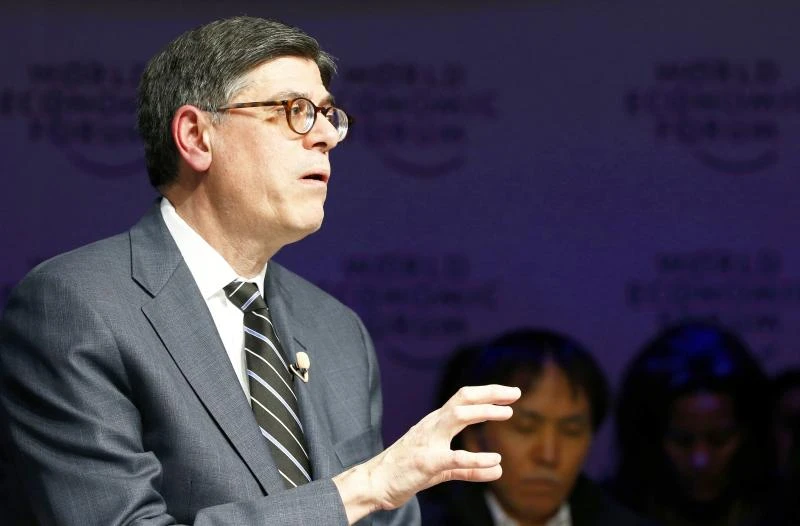
DAVOS: US Treasury chief Jack Lew says the beneficial effect of lower oil prices on consumers may not yet be fully apparent.
The plunge in oil prices has unnerved financial markets in recent weeks as investors worry it means the global economy is weakening and requiring less energy.
But in a panel in Davos, Switzerland, Lew stressed how the drop in oil prices acts like a tax cut for the majority of people and countries, which are net oil consumers.
He said consumers "have more money in their pockets" and that people are either spending or improving their household finances by saving or reducing debt. In either case, he said, that strengthens the economy in the longer term. "I don't think that money is just evaporating," he said.
***
Greek Prime Minister Alexis Tsipras says the European Union needs to come up with a comprehensive package of measures to deal with its migrant crisis — including more involvement by Europe-wide bodies in transit countries like his and a properly thought-out and paid-for relocation and resettlement plan.
Dismissing suggestions that his country has been reluctant to allow a bigger EU involvement in the eastern Greek islands, Tsipras said Thursday that Europe has to cooperate more on the many difficulties it faces, not least the refugee crisis and the economic problems afflicting the euro currency. Greece has been at the heart of both crises, and last year Tsipras signed the country's third international bailout agreement in a little more than five years.
Tsipras told a panel at the World Economic Forum in the Swiss ski resort of Davos that "we need more Europe" that is focused on building democracy, solidarity and employment.
***
Christine Lagarde is refusing to say whether she will seek a second term as the head of the International Monetary Fund after both Britain and Germany gave her their backing.
British finance chief George Osborne issued a statement Thursday saying his government nominated her to stay in the post. The German government quickly followed, with a Finance Ministry statement saying Lagarde "was a circumspect and successful crisis manager during the difficult period after the financial crisis."
Countries normally nominate their preferred candidate before the individual declares their intention to run. At a panel at Davos, Switzerland, Lagarde said she was honored but did not want to confirm whether she would agree to stand again.
The IMF has typically been run by a European official, while its sister organization, the World Bank, by an American. Developing countries have increasingly opposed this informal arrangement.
Lagarde, who is French, was in Davos to attend the World Economic Forum, a meeting of business leaders and public figures.
***
A Chinese market regulator says the country has no option but to support growth this year, using its large financial reserves if needed.
As concerns over a slowdown in the world's second-largest economy roil markets, Fang Xinghai, from China's Central Leading Group for Financial and Economic Affairs, said Thursday: "We cannot afford to let growth rate to fall too sharply, because that would ignite a lot of financial problems inside China. So we will have appropriately expansionary fiscal and financial policy this year."
At a panel in Davos, Switzerland, Ray Dalio, the chairman of Bridgewater Associates, said the biggest concern was China's currency. As it weakens, that will weigh on the global economy.
He said: "That happens at a time there is a weakness in the rest of the world."
US Treasury chief: Cheap oil will help economy