- Predictive models could improve berthing, crane allocation and cargo handling
RIYADH: Artificial intelligence is finding its way into port operations, offering new ways to manage vessel traffic, allocate resources and prevent congestion as shipping volumes rise.
When several ships arrive simultaneously, pressure builds across the port. Vessels wait offshore for available berths, cranes face competing demands, containers accumulate in storage yards and trucks queue at terminal gates. Delays in one area can quickly disrupt the entire operation, affecting the wider supply chain.
According to UN Trade and Development, disruptions are straining ports worldwide, resulting in congestion and longer waiting times. Saudi Arabia faces similar pressures as cargo volumes grow. Ports managed by the Saudi Ports Authority, known as Mawani, handled 8.3 million twenty-foot equivalent units in 2025, up 10.58 percent from 2024.
Shinkyu Park, an assistant professor of electrical and computer engineering at King Abdullah University of Science and Technology, told Arab News that from a planning and optimization perspective, “the biggest gains are likely in the interconnected decisions that planners make every day.”
These involve assigning ships to berths, determining docking sequences, allocating cranes and positioning containers for efficient retrieval. Planners must also anticipate actual vessel arrival times rather than rely on scheduled timetables.
“These tasks are difficult because they are what we call combinatorial optimization problems,” Park said.
With just 20 ships competing for berths, there are about 2.4 quintillion possible orders, he said. That calculation excludes crane availability, storage capacity and truck movements.
Park identified two ways AI could improve these operations. Machine learning can analyze existing port data to forecast vessel arrivals, handling times and congestion more accurately. This includes Automatic Identification System signals, which track ships’ positions and speeds.
The second approach, reinforcement learning, involves testing different operational strategies in realistic port simulations. Algorithms gradually learn which decisions reduce waiting times. Google DeepMind’s AlphaGo used the same technique to master the board game Go, defeating one of the world’s top players in 2016.
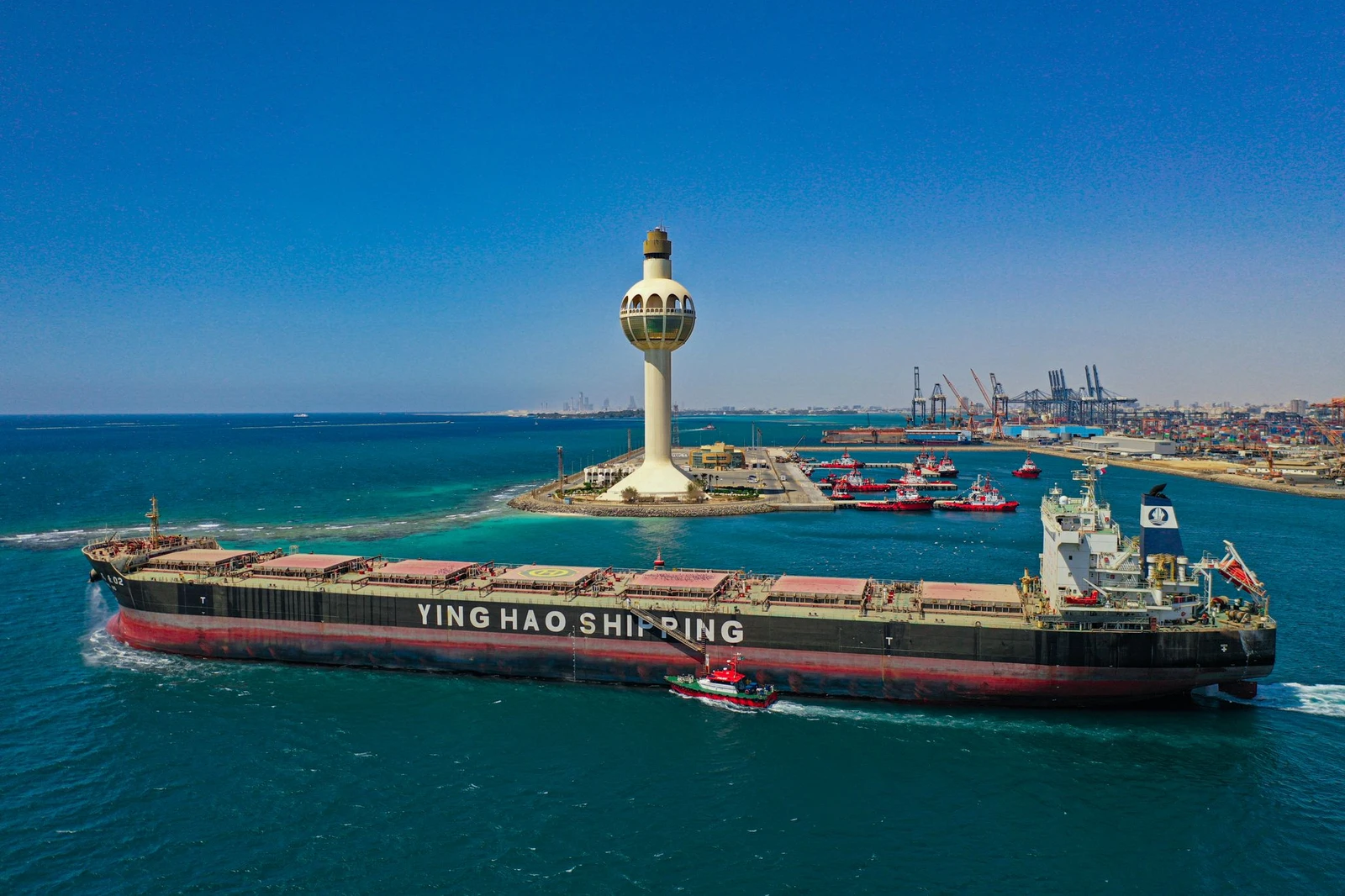
Park illustrated the potential with a hypothetical scenario. On Sunday, a model analyzing AIS data detects a ship traveling faster than usual and predicts it will arrive about 10 hours early on Tuesday. Three vessels would then compete for the same berths while the storage yard is nearly full.
The system could recommend moving a ship to a nearby berth or asking a vessel to slow down to arrive just in time. If a planner reports that a berth is under maintenance, the system could revise its recommendations within minutes.
“The planner still makes the call, but now with two days’ notice and a clear picture of the consequences,” he said.
For Mawani, which oversees ports along the Red Sea and Arabian Gulf coasts, Park said “berth allocation combined with accurate arrival prediction is likely where the most immediate value lies.”
In 2024, Mawani signed a memorandum of understanding with the Hamburg Port Authority and Hamburg Port Consulting covering digital transformation and automation, including AI applications in ports, the Saudi Press Agency reported.
Mawani and Saudi Global Ports did not respond to Arab News’ requests for comment on how AI is used in their operations.
However, Park cautioned that technology cannot replace the operational knowledge of experienced port personnel.
“AI is very good at finding a solution once a problem has been described in data or as a formal objective,” he said. “It is not good at understanding the safety criteria that experienced staff carry in their heads and that are rarely written down.”
A planner, for example, may know that a ship carrying hazardous cargo should not berth beside certain other vessels, he said.
Large language models could help bridge this gap by allowing staff to communicate instructions in plain language, which systems can translate into operational rules. Critical safety requirements, however, must remain fixed constraints, with final decisions left to human operators.
“A more accurate forecast has no value unless it leads to a better decision,” Park said.
He said ports should measure results through offshore waiting times, vessel turnaround, crane productivity, safety incidents and the frequency with which staff override AI recommendations. These should be assessed against a baseline that accounts for traffic fluctuations and seasonal changes.
“I should be honest that there is no free lunch here,” he said. The approach requires reliable data, realistic port simulations and substantial computing power, and works best alongside existing systems.
“If waiting and turnaround times fall while safety holds steady or improves, the AI is genuinely making the port more efficient,” Park said.
As Saudi ports handle growing cargo volumes, AI’s success may ultimately be measured not only by containers moved, but also by the hours of waiting eliminated.