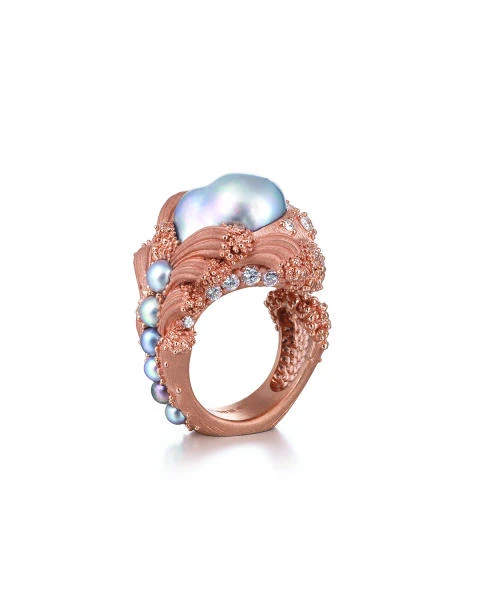
For women who love beautifully crafted ‘one-of-a-kind’ rings, Ornella Iannuzzi is establishing herself as a ‘must go to’ jewelry designer. This week, her reputation went up another notch as she swept up two highly prestigious prizes at the Goldsmiths’ Craft & Design Council Awards 2015 in London. Her exquisite ‘Uprising’ ring won two Gold Awards: the IJL Precious Jewellery Award and the Goldsmiths’ Company Award.
Arab News spoke to Iannuzzi to learn more about her journey from a young girl growing up in the French Alps to her present day achievements as an internationally sought after jewelry designer.
The fascination that Ornella Iannuzzi had with minerals and gemstones as a child has been channelled into the beautiful jewelry she designs today. The award winning artist jeweler who creates mainly one-of-a-kind high end pieces was deeply influenced by her childhood in the French Alps.
She recalled: “Mum used to take us hiking in the mountains and I used to search for minerals and gemstones. I had my little collection of crystals. Also we used to visit mineral fairs and exhibitions and I became fascinated by the sizes and colors of the stones.”
Iannuzzi is noted for her exquisitely crafted and highly individualistic rings. She spoke about the creative process.
“I take a lot of inspiration from the material I am using. I usually pick up the stone and the first thing I do is put it on my hand. If the size is suitable it usually becomes a ring. If I have two stones that are similar, I make a pair of earrings. If the stone is too big or heavy for a ring I make a pendant or a brooch. Most of the time I like to make rings. The ring is a piece of jewelry that you always have before your eyes so you can truly enjoy it personally, whereas earrings and pendants are more for the appreciation of those around you.”
Attending mineral fairs is an important part of her year.
“In Europe I go to the Mineral & Gem à Sainte-Marie-aux-Mines held in the small town of Sainte-Marie-aux-Mines in a valley in the Alsace Mountains in France, and to the Munich Mineral Show in Germany,” she explained.
High on her wishlist is to attend the Tucson Gem, Mineral & Fossil Showcase in Arizona, USA. “It’s the biggest mineral show in the world. But the fair clashes with fashion week — it’s at the beginning of February. That’s why I haven’t had time to go yet,” she said.
Her work currently leaves her with little leisure time
“I spend a lot of time working — it’s a seven day a week job really. But it’s a passion — so I don’t mind,” she commented.
She would like to find the time to travel more. Her last major overseas trip was to Ethiopia in 2010 which she found inspiring. “I did a whole collection based on opals on my return,” she said.
“There are some particularly strong pieces with opals and emeralds which are very popular in the Middle East,” she added.
She collaborated on the collection with Capet-Joaillier, Paris.
“This is the first company that I did an internship with when I was learning jewelry. I was blown away when I was doing my internship there by the quality of the craftsmanship and by what human beings can do with their hands. I have always kept this in my mind. I met up again with Capet at an event and we joked that we should collaborate and it has turned into reality. They are a really nice family business and they have a love for hand-made and new technology as well.” she said.
Asked to describe the artistic challenges in creating such finely crafted pieces she said:
“The uncut stones are quite challenging to work with. When I do the metalwork around them I really need to be careful of how the metal fits around the stone. The most difficult part is using stones in their natural shape. When you have cut stones it is just a traditional setting and there is not too much to think about, but when the stone has a particular shape and maybe is quite fragile — this is where the challenge comes. For the one off pieces I need a few months from start to finish. When I carve the wax that is the most important part because the wax is then cast in metal and if I get the wax wrong there is nothing I can do but start again. I work like a sculptor — I carve all my pieces in wax and then I have them cast in metal by the lost wax casting process. Then I have the shape back in metal and work on that again.”
—
Email: [email protected]
Ornella Iannuzzi — A gem of a jeweler