Only half a century ago, very few people knew what a coconut was, let alone knowing the taste of its fresh water or its white fruit, the fatty meaty pulp. Very few homes had coconut trees in Jeddah. Only the owners of the trees knew the value of this giving tree and its fruit. However, coconut oil was always found at the attar (local herb and spice store, once considered a pharmacist or healer). Women applied the oil to their hair before washing it to give it shine, moisture, and smoothness. It also nourished the scalp and made hair less rough and more manageable.
I remember as a child, being subjected to this weekly ritual before swimming on Fridays to protect the hair strands from the sun, wind, and salty seawater. I remember not fancying that strong smell, let alone the stickiness and the feel of the oil-smothered hair. Yet the next day, I appreciated the treatment that gave the hair an unusual gloss, a satiny texture, and an attractive appearance. The oil made the strands smooth with no apparent split ends or unevenness; prevented it from easily breaking or splitting; and protected it from weather damage.
Coconut oil repairs the hair strands and gives it a uniform silky appearance and brilliance. In India, Pakistan, and Bangladesh, women apply coconut oil all the time to their hair to give it sheen and richness and to protect it from the sun, wind, and dry climate. It also acts like a hair conditioner. Now, when I look back, I feel grateful to the special care my mother gave to my hair.
In appreciation to this special plant, I decided, today, to give respect and special attention to this exotic nut, which offers us so many benefits in different ways. I am amazed at the multiple benefits of this multifaceted plant. I shall discuss the many studies and findings demonstrating its healing effects on many health issues. Allow me to delve into the details of this generous palm tree, the coconut.
The coconut palm tree comes from the botanical family, Arecaceae, also called Palmaceae. It is a flowering tree with a slim, smooth, tall trunk, which can grow to 30 meters in height. It prospers in tropical, subtropical, and warm countries from the rainforests to the coastal shores of the deserts. The palm is crowned with a cluster of large and long green branches trimmed with many pliable green grass-like fronds. The leaves (around 3 to 4 meters long) adorn the peak of the tall elegant smooth trunk.
The flowers grow protected under the swaying branches. They eventually turn to multiple ovate green hard nuts. In Sri Lanka, coconut flowers are used as decoration in weddings for their sweet scent. In the Maldives, the coconut is the national tree.
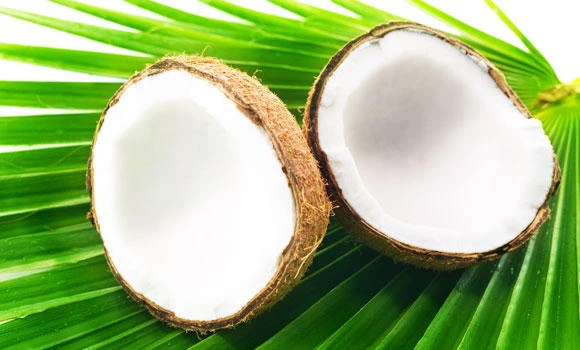
One single coconut tree may give hundreds of nuts every season. When the climate is appropriate, it gives all year round. The coconut is a smooth oval shape and has a bright green color when hanging from the top of a palm tree. The natives strip the green peel away to get to the shell, which is protected by layers of thick fiber difficult to peel. The hard brown shell protects the half-inch meaty crunchy pulp, which lines its circular interior. It is also a tough nut to crack! But the natives, who live on it, know the right soft places to pierce three holes in order to easily insert a straw and drink the refreshing and highly nutritious water. Later, I will return to describe the benefits of this serum-like water.
The white pulpy fruit, or nut, is hard, crunchy, fibrous, and rich in oil. When it is left to ripen on the tree, its water decreases and becomes concentrated. When the fruit is young and unripe, the lining fruit is thinner and creamier and can be scooped out with a spoon. It has a different texture and taste than the ripe one. It has a much milder flavor and the water is more abundant. The water of the unripe coconut is a delicacy that comes with a subtle and fine taste and offers an abundance of important minerals (potassium, surpassing that of banana, magnesium…).
The fibrous, crunchy mature white pulp is very rich in oil. It can be found shredded and dried in packets in supermarkets. It is used in Far Eastern (Indonesian…) dishes and desserts and in some Middle Eastern desserts and sweets. Coconut milk is made from the meaty pulp. The milk is often added to Indian and Thai curries and other dishes. It is found in cans in supermarkets.
Coconut oil is extracted from the mature fatty pulp. In Bab Makkah, old Jeddah, the oil can be extracted from the fresh pulp in front of you while you are waiting. The oil smells so fresh and sweet. When the white coconut particles settle, the oil becomes as clear and translucent as pure water. It should be kept in a dark glass bottle and stored in a cool place or in the fridge if you have no immediate use for it.
The Pacific Islanders have many uses for all the parts of the palm tree. In the Philippines and Indonesia, the water of the young coconut is used as remedy to break down kidney stones and ease the pain. It is also taken to treat urinary tract infections (UTI) and other urinary tract disorders.
The branches and fronds are used to thatch the roofs of their huts and the tall palm trunks are used as columns to support the roofs. The fronds are woven to make baskets and handicraft items, as they are flexible in weaving. They are also used as stuffing for mattresses. The coconut shell, which is hard and durable, is used as utensils or decorative art pieces.
The coconut you see in the market is a hairy ball of a brownish color that is because the protective thick fiber (2 inches thick) is peeled off to make it lighter and smaller in size for export. The whole fresh young coconut is green and the fiber is of an off-white tint, which becomes brown when exposed to the air.
The coconut tree and its nut have multiple uses and characteristics just like how the date palm tree of the Arabian Peninsula gives so many invaluable benefits. It stands tall and proud, yet swaying its slim trunk and frond-like branches with the gentle breeze of the coastal shores of the Pacific Islands, whereas the stern date palm stands like a solid pillar in the heat and dryness of the desert, only the branches dare to move with the wind. Both are giving and invaluable trees to the dwellers of their habitats.
Next week, I shall discuss the plethora of benefits of the coconut, the young pulp, the rich mature crunchy fruit, the nutrient-dense water, the coconut milk, and its virgin coconut oil. I will reveal the secrets of the healing and beautifying oil and the research behind it, which unveils its multiple secrets. If anything is to be called a cure-all panacea, it will be the coconut oil.
N.B.:
Individuals with medical conditions or on medication should consult their physicians when they decide to introduce anything new in their diet even if it is natural.
The previous Health Solutions articles are located at www. arabnews.com
Email: [email protected]
The exotic coconut: The ‘super nut’ (Part 1)