- Many Arabic speakers struggle to understand climate terminology, despite recognizing the words in translation.
- A 2023 study highlighted the challenges in translating climate change terminology into Arabic and the importance of audience comprehension.
- Understanding complex terms like 'decarbonization' requires more than just knowing the Arabic equivalent; context and explanation are crucial.
- Saudi Arabia is working to standardize climate-related terminology through a new bilingual dictionary aimed at improving clarity in communication.
- Familiarity with terms often comes from repeated exposure, particularly in English, rather than inherent understanding of the Arabic translations.
- Communicators and journalists must tailor explanations of scientific terms to their audience for effective understanding of climate issues.
ALKHOBAR: When Saudi resident Reem Al-Dossari was asked what “net zero” meant, she thought it described a future in which factories, cars and businesses produced no emissions at all.
The 26-year-old was less certain when she encountered its Arabic equivalent (safi al-inbi‘athat al-sifri).
“I understood the words separately, but I couldn’t explain what they meant together,” she told Arab News. “I thought the goal was to stop producing emissions completely.”
Only after hearing that net zero involves reducing greenhouse gas emissions and balancing those that remain with removals from the atmosphere did the concept become clear.
Her response raises a question about climate communication in Saudi Arabia and the wider Arab world: As environmental policies become more prominent, is the language used to explain them reaching the people they are intended to inform?
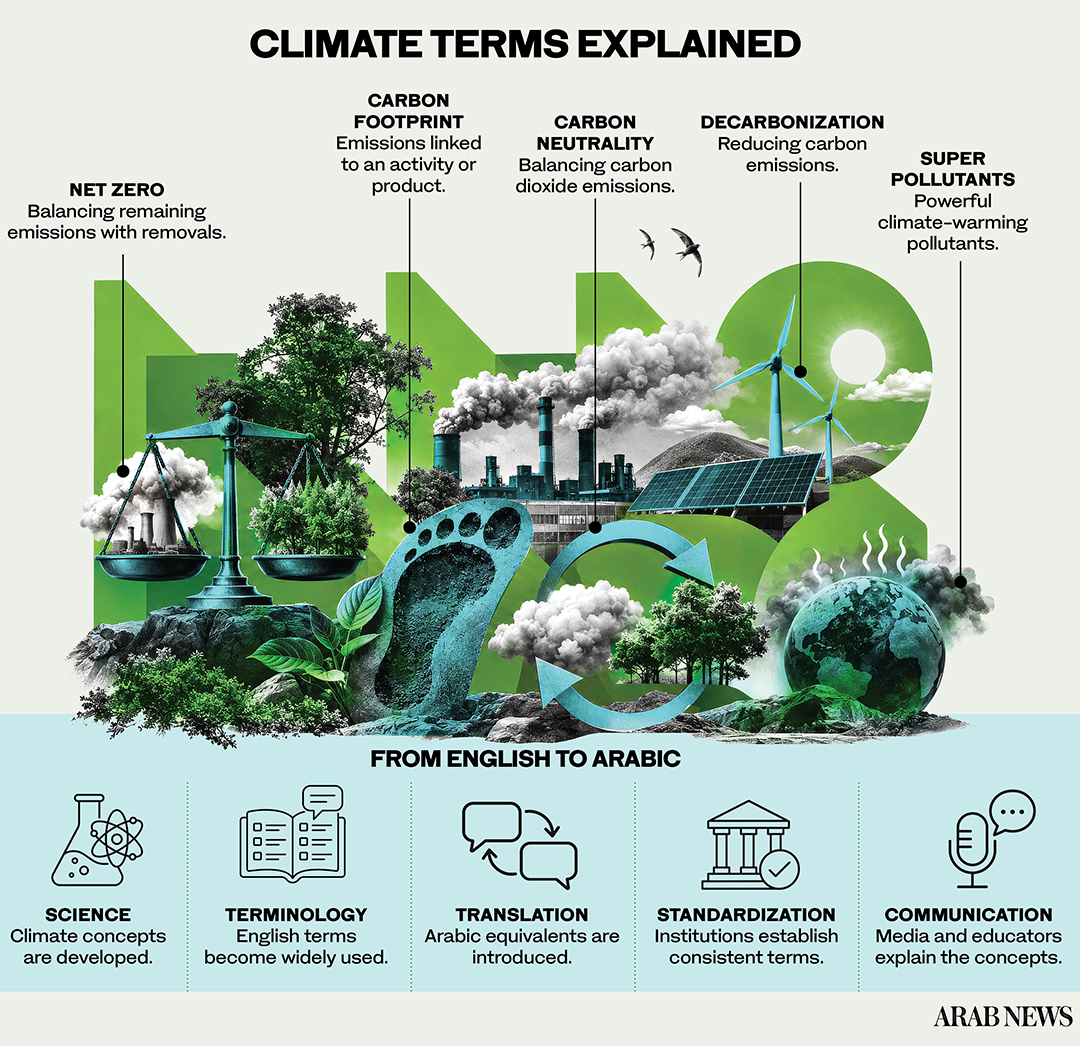
Much of the terminology surrounding climate action enters public discussion through English-language research and international agreements. Expressions such as “decarbonization,” “carbon neutrality” and “super pollutants” are translated into Arabic for government announcements, news reports and awareness campaigns, but understanding the words does not always mean understanding the science behind them.
The challenge has also attracted academic attention.
A 2023 study by Marwa Mostafa Elsayed Amin, published in the Journal of Scientific Research in Arts at Ain Shams University, examined how climate change terminology used in reports by the Intergovernmental Panel on Climate Change is transferred into Arabic.
The research explored linguistic approaches including derivation, borrowing, compounding and metaphor, as well as questions surrounding terminology standardization.
While the study examined how scientific terms are formed and translated, it did not establish how well general audiences understand them.
For Noura Al-Harbi, an English-language teacher specializing in linguistics, the distinction between recognizing a word and understanding its meaning is central to the problem.
“We sometimes assume that once a term has an Arabic equivalent, the communication problem has been solved,” she told Arab News. “But people can understand every word in a sentence and still struggle with the idea those words are describing.”
One example is “decarbonization,” commonly translated as (izalat al-karbon).
In climate policy, the term generally refers to reducing carbon dioxide emissions from sectors such as energy, transport and industry, rather than physically removing carbon from an object.
“If I tell someone that a factory is working toward decarbonization, the phrase alone doesn’t explain what the factory is doing,” Al-Harbi said.
“But if I explain that it is changing its energy sources or production methods to release less carbon dioxide, the idea becomes much more concrete.”
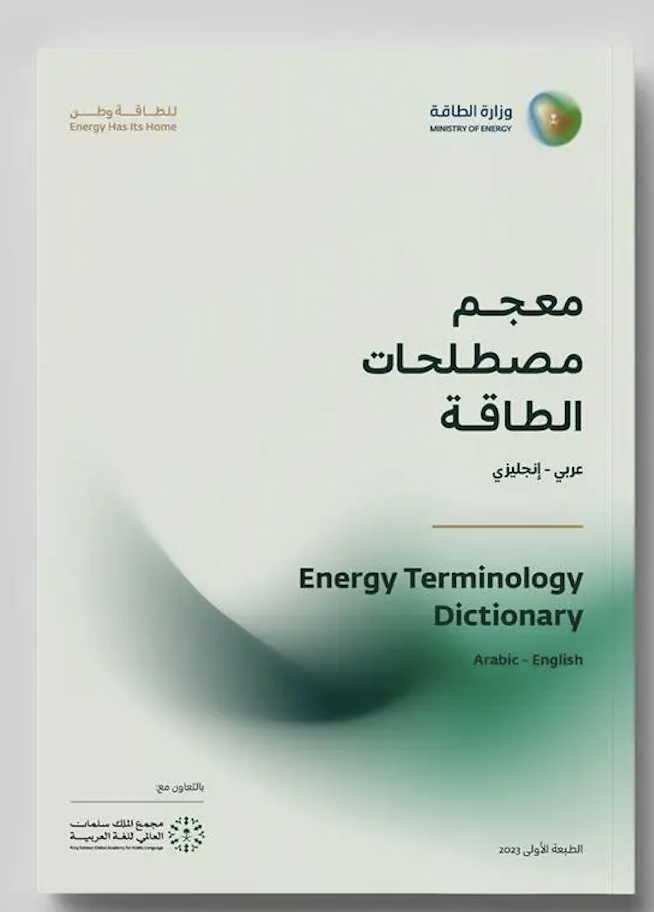
Saudi Arabia has taken steps to develop and standardize specialized terminology.
In June 2024, the Ministry of Energy and King Salman Global Academy for Arabic Language launched a bilingual dictionary containing more than 1,500 energy-related terms across eight fields, including sustainability and renewable energy.
According to the Saudi Press Agency, the project involved technical translation and linguistic review aimed at establishing consistent terminology across the sector.
The National Center for Meteorology has also addressed the importance of communicating scientific information clearly.
At an October 2024 workshop organized with the Arab League, discussions examined meteorological terminology in media reporting and the need to simplify technical information without compromising accuracy.
Such initiatives help establish a common scientific vocabulary, although standardizing a term and ensuring that readers understand it remain separate challenges.
For Khalid Al-Qahtani, a 32-year-old Dammam resident, familiarity with a climate expression depended partly on the language in which he encountered it.
He recognized “carbon footprint” from English-language news and social media but hesitated when shown (al-basmah al-karboniyyah).
“I’ve heard the English expression enough times to know it has something to do with how much pollution we produce,” he said. “I didn’t immediately connect it with the Arabic term.”
A carbon footprint refers to greenhouse gas emissions associated with a person, product, activity or organization.
Al-Qahtani said the Arabic expression became clearer once he learned that both terms described the same concept.
Al-Harbi said familiarity with terminology often depends on repeated exposure rather than the language itself.
“People don’t necessarily understand a term better because it’s in English,” she said. “They may simply have encountered it more often, particularly if they follow international news or English-language content online.”
Other expressions present difficulties because their wording offers few clues about the scientific concept.
“Super pollutants,” for example, describes powerful climate-warming pollutants including methane, black carbon and hydrofluorocarbons.
These pollutants can contribute substantially to warming, particularly over shorter periods, but the Arabic expression (al-mulawwithat al-fa’iqah) does not explain what distinguishes them from other forms of pollution.
Al-Harbi said examples drawn from familiar activities could help readers make the connection.
“Someone might not know what methane is, but they can understand that gas released from decomposing waste contributes to warming,” she said. “You don’t have to remove the scientific term. You have to give people a reason to understand it.”
Even closely related expressions can create confusion.
Net zero and carbon neutrality are sometimes used interchangeably, although their scope can differ depending on the emissions covered and how reductions and removals are accounted for.
That distinction can be difficult to preserve when scientific reports are condensed into headlines or translated for general audiences.
For 24-year-old Saudi university graduate Sara Al-Otaibi, “carbon neutrality” initially suggested that carbon dioxide was no longer harmful.
“I thought neutral meant it didn’t have an effect anymore,” she told Arab News. “I didn’t understand that it was about balancing emissions.”
After hearing an explanation of how emissions can be reduced and remaining carbon dioxide balanced through removals, she said the concept became easier to follow.
The responses of the three residents do not establish how widely climate terminology is understood in Saudi Arabia. They do, however, offer individual examples of how readers might interpret unfamiliar scientific language.
Al-Harbi said the responsibility for communicating such concepts extends beyond translators to the institutions and journalists using them.
“Accuracy matters, but so does knowing who you’re speaking to,” she said. “A scientific term might be appropriate in a research paper, while a news article may need an additional sentence to explain what it means.”
As climate terminology becomes part of everyday discussions in Saudi Arabia, that additional explanation can make the difference between recognizing a term and understanding the issue behind it.
For Al-Dossari, the Arabic translation was not the problem. Nor was the English expression.
“I just needed someone to explain what it actually meant,” she said.