JEDDAH: Media outlets need to “rethink” how they cover the news in the wake of the divisive US election, a World Economic Forum (WEF) panel in Dubai heard this week.
A discussion on "The Next Media Revolution" at the Annual Meeting of the Global Future Councils discussed how the media’s “top-down” approach is no longer relevant in the social-media age.
Out of the 100 biggest newspapers in the US, 57 endorsed Hillary Clinton while only two backed Donald Trump, according to the American Presidency Project at the University of California.
But many media outlets were not listening to their audiences — with many members of the public instead turning to more extreme right-wing news sites, the WEF panel heard.
Dr. Claire Wardle, Director of Research at the Tow Center for Digital Journalism at Columbia University, said that the election result shows that mainstream media should no longer act like the “gatekeepers” of the news.
“This election will cause a real rethinking of the news… I think it’s been too top-down and we haven’t been listening to audiences,” she told the panel in Dubai.
“Journalists, editors and news organizations have had this idea that ‘we know best and we will tell our readers what they need to know’. And actually social media now allows people to talk amongst themselves. And there was this perception that media were ignoring whole swathes of the US population that were angry and hurt and felt they were being ignored.”
Given this, many US media consumers turned to the likes of Fox News, the Breitbart News Network and “right-wing blogger sites”, Wardle said.
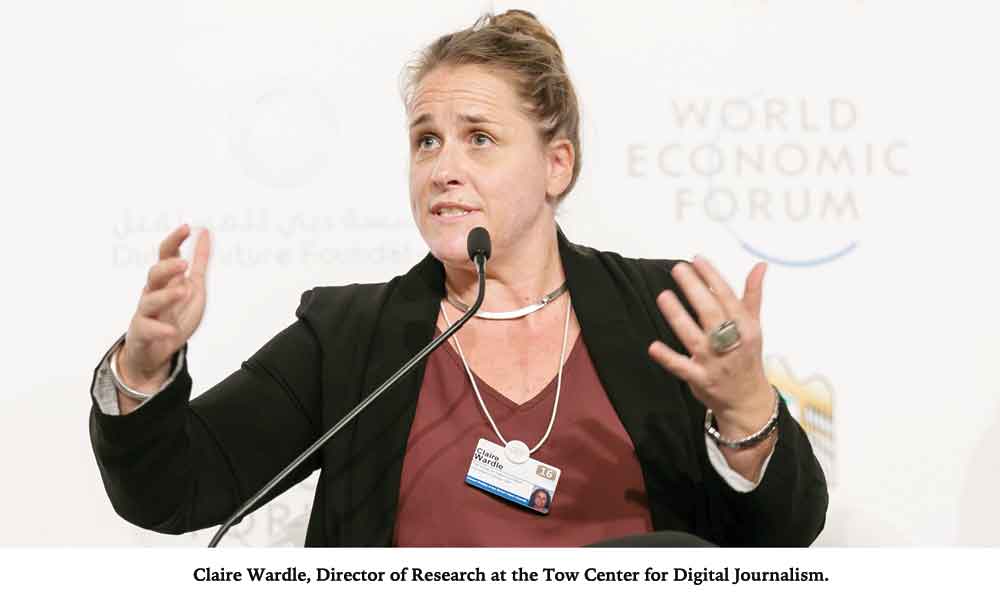
“Fewer people sit down at 7 o’ clock and watch a news bulletin. They’re spending more time in their bubbles, and that’s what I’m really really concerned about,” she added.
Earlier in the discussion, Wardle warned that the current number of news organisations in the world “cannot be sustained”, bringing the danger that the media will become more centralized.
Fellow panel member Mona Al Marri, Director-General of the Government of Dubai’s Media Office, said that the revolution in the media means that everyone is now a journalist. “The reality is that [citizen journalists] are taking over… Anyone can video stream on Snapchat, or Twitter, or Facebook Live,” she said.
Noura Al Kaabi — UAE Minister of Federal National Council Affairs, Chairwoman of Abu Dhabi’s Media Zone Authority and twofour54 — agreed that there had been a “shift” in the media and how we consume it over the last ten years.
But she said the role of journalism will remain as a career. “I believe it is a very important job, journalism, and getting the news right,” she said.
Aaron H. Sherinian, Chief Communication and Marketing Officer of the United Nations Foundation, agreed that the mainstream media needed to listen to its audience more.
“There’s this idea that we have two ears, and one mouth, and we should be using it in proportion,” he told the panel.
“Maybe there’s a reminder for media… we’ve got to listen. And in America, people were not listening enough.”