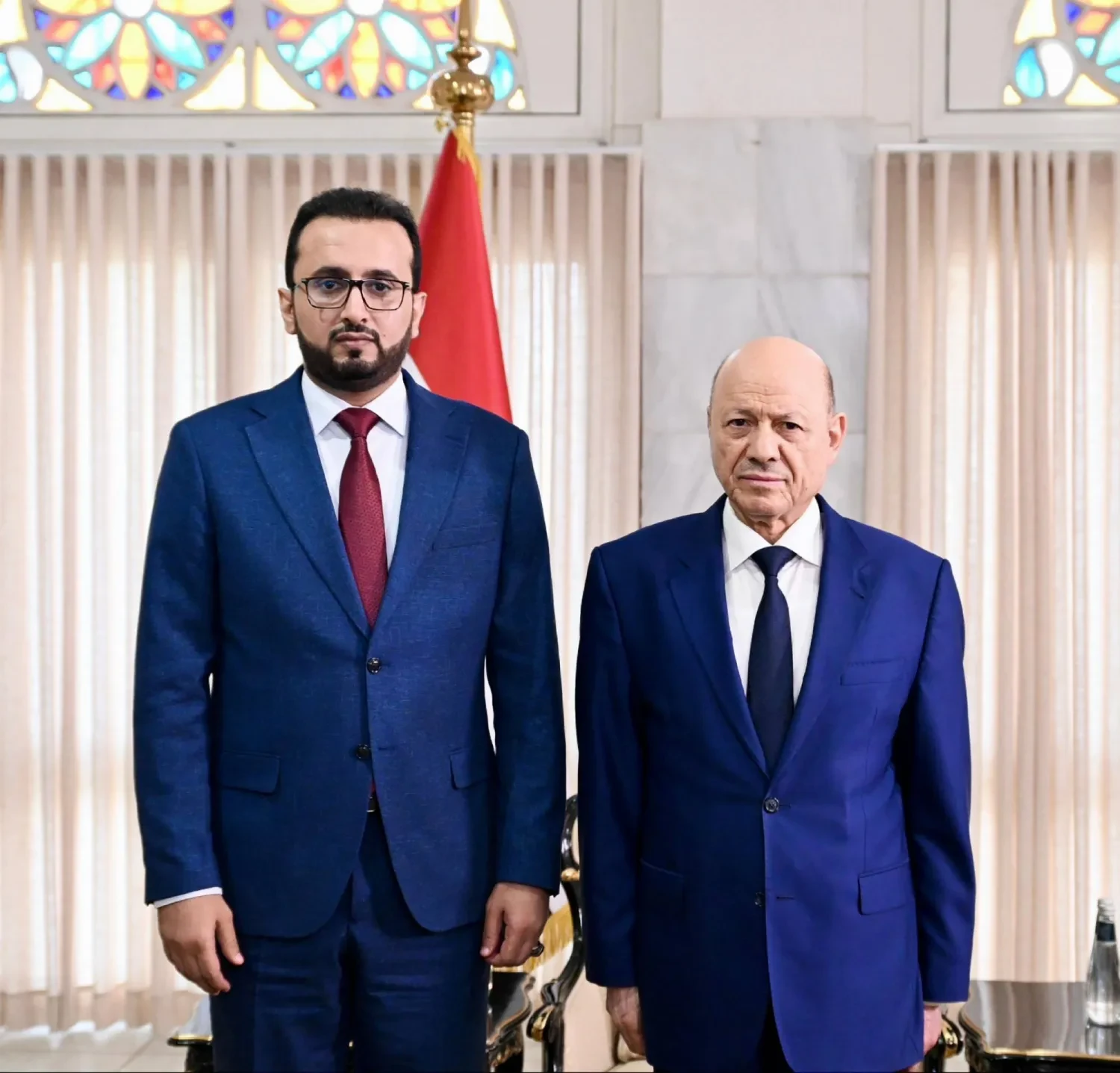
Yemen's Minister of Information Salem Thabit Al-Awlaki said the biggest challenge facing his ministry is restoring the influence of state media, stressing that rebuilding public trust requires news outlets that address people's concerns, communicate honestly and avoid presenting an idealized picture of a reality the public knows firsthand.
In his first interview since assuming the portfolio, Al-Awlaki told Asharq Al-Awsat that the ministry would focus in the coming period on strengthening its operations from the interim capital, Aden, improving the performance of state media institutions and enhancing coordination among government agencies to ensure information reaches journalists and the public more quickly and consistently.
He said covering Operation Yemen Dawn was a fundamental responsibility, emphasizing that media organizations must exercise discipline and responsibility under such circumstances. Coverage, he explained, should keep pace with developments on the ground without prematurely disclosing sensitive information, report facts without exaggeration and maintain public trust by avoiding inflated claims and unrealistic predictions.
Al-Awlaki also warned against what he described as Houthi attempts to rewrite the history of Yemen's conflict through misleading narratives, saying countering them requires presenting facts and evidence and demonstrating the nature of the Houthi project through its actions and consequences.
Information Before Rumors
The minister warned that delays in releasing official information allow rumors to spread and create impressions that can be difficult to correct.
He said some government institutions still handle information through slow procedures or take too long to explain developments, even as the media operates around the clock.
Al-Awlaki said the ministry would prioritize better coordination among government agencies, strengthen the role of official spokespersons and establish more effective mechanisms for sharing information, ensuring that journalists and citizens have clear, reliable sources to consult when events occur.
He explained that maintaining a consistent government message does not mean requiring every media outlet to use identical language. Rather, it means ensuring that the state's positions are clear, its information is consistent and its institutions do not issue conflicting accounts of the same event.
The minister also stressed the importance of transparency with the public, saying that when certain details remain unverified, authorities should acknowledge this openly rather than leave people facing conflicting accounts or present incomplete information as established fact.
He recognized that military and security circumstances may sometimes require withholding certain details to protect personnel and operations. However, he said such considerations should not justify a lack of official clarification about information that can safely be disclosed.
Restoring Public Trust
Al-Awlaki said the relationship between audiences and the media has changed significantly. Citizens can now access multiple sources through their phones, compare reports and quickly identify inconsistencies.
As a result, he said, information no longer commands public trust simply because it comes from an official media outlet.
He argued that credibility, quality content and attention to people's everyday concerns are what encourage audiences to follow and trust a news organization.
"If we talk about the government's achievements, citizens also have the right to know what has failed, why it failed and what is being done to address it," he said.
The minister stressed that government media should represent state institutions and their policies while fulfilling their professional responsibility to report facts, discuss public issues and provide room for responsible criticism.
He said rebuilding trust requires clear editorial standards, giving qualified journalists the freedom to perform their duties, distinguishing news from opinion and upholding accuracy, balance, the right of reply and the correction of errors.
"I cannot imagine the public placing its trust in media that ignores its problems or presents an idealized picture of a reality people know for themselves," he said.
"People want media that deals with them honestly and respects their intelligence."
Covering Operation Yemen Dawn
Al-Awlaki said Operation Yemen Dawn forms part of the national campaign to end the Houthi rebellion and restore state institutions, making its coverage a central responsibility of the Ministry of Information.
He explained that the ministry would coordinate with the relevant military and security authorities to improve media coverage in line with developments on the ground and strengthen public understanding of the campaign's objectives and broader implications.
The minister emphasized that reporting during military operations requires considerable discipline and responsibility. The pursuit of breaking news, he said, must not lead journalists to publish information that could endanger troops, reveal their movements or compromise operational security.
At the same time, he cautioned that a lack of official information should not leave the field open to rumors and psychological warfare.
"We need media that keeps pace with developments on the ground without getting ahead of them by revealing sensitive information, reports facts without sensationalism and preserves public trust without exaggeration or reckless predictions," he said.
Al-Awlaki added that coverage should highlight the sacrifices of fighters, draw attention to the suffering of civilians in Houthi-controlled areas, expose violations and strengthen engagement with Arab and international media to communicate what is happening.
He said the success of media coverage should not be measured by the volume of reports or the intensity of its rhetoric, but by its ability to provide reliable information, strengthen cohesion on the home front and reach audiences both inside and outside Yemen.
Countering the Houthi Narrative With Facts
Al-Awlaki warned against what he described as Houthi attempts to rewrite the history of the conflict and portray the group as a movement defending national sovereignty against foreign powers.
He argued that this narrative overlooks the origins of the conflict, the course of the armed rebellion and subsequent military expansion, culminating in the group's seizure of Sanaa in 2014 and the undermining of state institutions.
He said countering this account requires more than repeatedly stating the government's political position. It demands presenting facts and evidence and demonstrating the nature of the Houthi project through its practices and consequences.
The minister highlighted the need to address the siege of Taiz, attacks on civilians, the detention of humanitarian and United Nations personnel, threats to international shipping and the humanitarian, economic and social suffering resulting from the group's policies.
Al-Awlaki also emphasized the importance of distinguishing between domestic and international audiences.
Yemeni citizens, he explained, need reporting that connects their daily suffering with the underlying causes of the crisis. Reaching international audiences, meanwhile, requires communicating in their languages through documented information, testimonies, reports and independently verifiable material.
He acknowledged that the government had sometimes devoted more attention to responding to Houthi propaganda than to presenting its own account in a sustained and organized manner.
"We have a just cause and many facts that the world needs to hear. But having a just cause alone is not enough to convince others if we fail to present it properly, document it and communicate it effectively," he said.
Strengthening Fact-Checking
The minister warned against conflating criticism with disinformation or treating every opinion that differs from the government's position as part of a campaign targeting the state.
He stressed that journalists have the right to criticize the government's performance and institutions, while citizens are entitled to express their views, even when those views are harsh or contradict official positions.
Efforts to combat rumors, he said, must not become a pretext for restricting these rights.
Al-Awlaki drew a distinction between journalists who unintentionally publish inaccurate information that can be corrected and those who deliberately fabricate facts or manipulate content to deceive the public.
He said deliberate disinformation should be addressed through legal procedures that respect rights and freedoms.
The ministry, he explained, would focus on strengthening fact-checking mechanisms, making information available through official sources, promptly correcting inaccurate reports and working with the journalistic community to develop professional methods of identifying disinformation without compromising press freedom.
"Respecting press freedom serves the state itself, because professional journalism helps expose mistakes early, creates room for public debate and gives institutions an opportunity to correct their performance," he said.
Facilitating Journalists' Work
Al-Awlaki said journalists often have to make considerable efforts to obtain even basic information from government institutions, sometimes without receiving any response to their inquiries.
Yet media outlets are subsequently blamed when they publish incomplete reports, he observed.
He said the ministry would work with government agencies to improve communication with journalists, strengthen the role of media offices and official spokespersons, and develop clear procedures for responding to inquiries to ensure timely access to information.
The minister also acknowledged the longstanding financial and professional difficulties facing media workers.
Some journalists, he said, are living under harsh conditions, while media institutions suffer from shortages of resources and equipment.
He explained that the ministry would begin identifying and prioritizing these problems, following up with the relevant authorities on outstanding payments and entitlements, improving working conditions and seeking to expand training and professional development opportunities.
Al-Awlaki reaffirmed the ministry's commitment to journalists who have faced violations because of their work, as well as to issues involving press freedom and professional protection.
He stressed that the ministry should maintain close relationships with journalists working across state, private, community and independent media, based on cooperation and mutual respect while preserving the independence of media institutions.
The ministry would pursue these matters seriously and transparently, he said, while recognizing that some solutions would require decisions and resources beyond its authority.