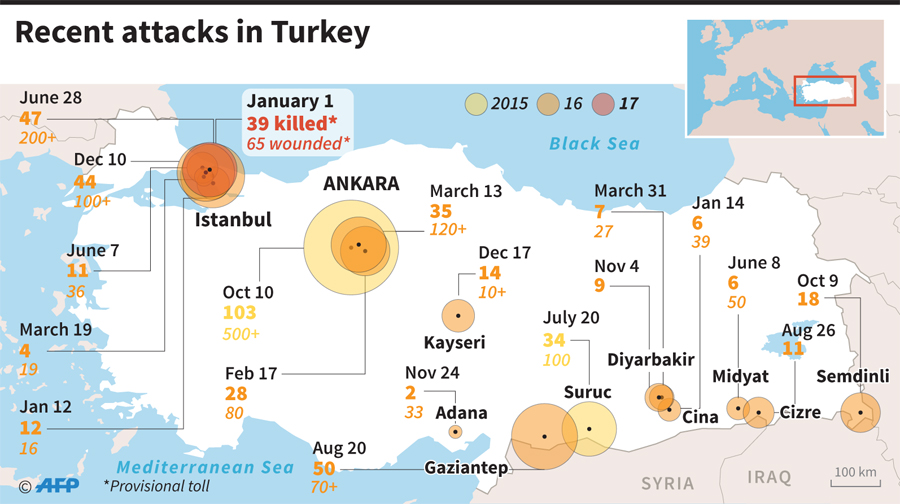
ISTANBUL, Turkey: More than a dozen Arab nationals were among the dead after a bloody terror attack at a Turkish nightclub in the early hours of New Year’s Day.
A major manhunt was launched after a gunman opened fire at the packed Reina nightclub on the Bosphorus in Istanbul, killing at least 39 people.
Nationals of Saudi Arabia, Morocco, Lebanon, Libya, Israel, a Turkish-Belgian dual citizen and a Franco-Tunisian woman were among those killed, officials told Reuters.
Officials quoted by Turkish media said at least 24 foreign nationals were among the victims, including seven Saudis, two Tunisians, a Syrian, an Iraqi and Libyan.
Three Lebanese citizens were killed and four others wounded, Lebanon’s foreign ministry said, according to Reuters.
A statement issued by the Saudi Consulate in Istanbul confirmed that a number of Saudi citizens were among the victims, although it did not confirm the number of dead. Officials from the consulate visited wounded Saudis in hospitals.
Saudi Arabia on Sunday condemned the terrorist attack and reiterated its solidarity with Turkey in the fight against terrorism, a statement issued by the Saudi Foreign Minister said. According to eyewitnesses, at about 1:15 a.m., an attacker in Santa costume, armed with a Kalashnikov rifle, killed a police officer and a civilian standing outside the Reina club, before entering the venue and opening fire. The club was hosting about 600 people for the New Year celebrations.
Some people escaped from the bloodshed by jumping into the icy waters of Bosphorus in the ensuing panic.
The attacker, who allegedly changed clothing inside the club, was still on the run later on New Year’s Day. An investigation is still ongoing by the security officials.
In a written statement released on an official website, Turkish President Recep Tayyip Erdogan said the attack aimed at creating chaos in the country by deliberately targeting peace and civilians.
No one has yet claimed responsibility for the mass shooting, but many have suggested the involvement of Daesh. Over the past two weeks, the Ortakoy district, where Reina and many other nightclubs are located, was scene to tight security measures after security warnings by US embassy in Turkey. Abu Bakr Al-Baghdadi, the so-called leader of Daesh, made several threats in his recent speeches, calling for attacks against Turkey.
Turkey’s top religious affairs body, the Diyanet, released a statement following the attack, saying “there is no difference whether this barbarous action would be done in a bazaar or a place of worship or in an entertainment place. Terror can never be accepted no matter by who or against whom it is committed.”
Haldun Yalcinkaya, a former lieutenant colonel at the Turkish Military Academy and currently heading the international relations department of Ankara’s TOBB Economics and Technology University, said that such an attack — most probably perpetrated by Daesh or another radicalized terror organization — was likely influenced by Turkey’s increased footprint in the Syrian conflict.
“It is inevitable and statistically proven that a civil war like the one in Syria can spill over to the neighboring countries when it has ethnically and religiously dimensions,” Yalcinkaya told Arab News.
Turkey is currently fighting Daesh in Syria as part of the international coalition.
Turkey has recently converged its policy on Syria with Russia and signed a cease-fire agreement with Russia and Iran. Turkey’s shifting policy in Syria brings it at odds with jihadi terror organizations, which tended to spare Turkey in the past.
In the past, Daesh mostly attacked civilians in Turkey at the country’s most popular places, damaging the country’s economy and tourism appeal.
According to Yalcinkaya, the hostility between the PKK and YPG groups and Daesh in Syria is being reflected on Turkish soil, and the latest terrorist attack in Istanbul amounts to the passing of a threshold in the extent of violence.
Although there is a similarity between Reina nightclub attack and the one at the Bataclan theater in Paris in November 2015, Yalcinkaya notes that there is also a key difference between the reactions of the two countries.
“After the Paris attack, France declared the state of emergency, but it also decreased its presence in Syria, which lessened the terrorist attacks in its territories,” he said.
Yalcinkaya also said that, considering the attacker killed so many people in cold blood, they could be someone who has experience in warzones, and cannot be solely the act of a sleeping cell in Turkey.
Turkish Armed Forces declared their fight against terrorism would continue with determination after this attack.
The White House immediately expressed condolences and offered help to Turkish authorities in defeating terrorism. The European Commission also released a statement about the attack, saying that Turkish government can count on the EU’s support in repelling terrorism.
Last week a banner was seen on numerous walls in Istanbul and sparked harsh debate about the limits of freedoms in the country: “We are Muslims. No to Christmas & New Year’s Eve celebrations.”
Selin Nasi, an Istanbul-based expert on international relations, does not think the recent controversy over the New Year celebrations had a direct impact on the terror attack.
“An attack was highly anticipated and the security was on alert all across the country, particularly in the last couple of weeks. What is of more importance is that we need to face the extent of security deficit in our country. Something is wrong and neither solidarity nor mourning alone fixes our problems,” Nasi told Arab News.
According to Nasi, the polarization over the frustration among the secular segments in the society, tending to interpret the Reina terror attack as an outcome incited by the discriminatory rhetoric against those who celebrate Christmas and the New Year, simply benefit terror organizations.
“In fact, it is a typical (Daesh) strategy to specifically pick targets that would deepen the existing fault lines within the country; i.e. Kurds vs Turks, seculars vs. pious. We should not fall into this trap,” she added. “If the government declares a mourning after this brutal terror attack, it would send a strong message to those who claim that it has a discriminatory stance so far.”
According to Nasi, the more Daesh is pushed into the corner, the harder it will respond by stepping up international terror attacks to distract attention and make up for its defeats on the ground.
“By having left its traditional foreign policy of neutrality in the Syrian Conflict, Turkey has become a warfront. Even though it was launched with humanitarian concerns, radical groups abused Turkey’s open borders policy,” she added. “I’m afraid Turkey is likely to become a target of not only (Daesh) but also of other opposition groups as well in the future.”