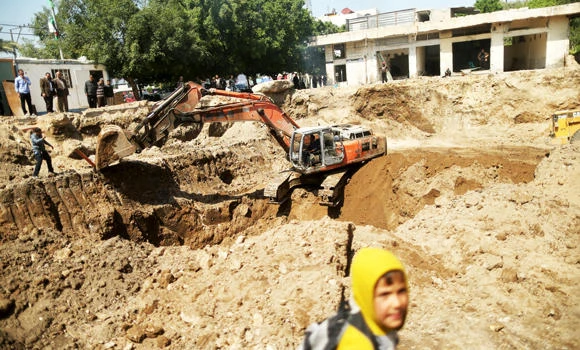
GAZA: Construction workers in Gaza have discovered ancient ruins that archaeologists say may be part of a Byzantine church dating from around 1,500 years ago, the Palestinian tourism and antiquities ministry said on Monday.
The findings include segments of marble pillars with ornate Corinthian capitals, one nearly three meters long, and a 90 cm foundation stone bearing a Greek symbol for Christ. Fifteen pieces have been uncovered, with excavations continuing. “Our first thought is that the site is a cathedral or a church from the Byzantine period,” said Jamal Abu Rida, the general director of the Antiquities Ministry.
“During that era, there was a great interest among the Byzantine rulers to build churches in the Gaza Strip.”
Gaza was a prosperous seaport during the Roman period, with a diverse population of Greeks, Romans, Jews, Egyptians and Persians. Pagan temples were destroyed in the late 4th and early 5th centuries AD and there was widespread church-building.
That continued until the Muslim general Amr ibn Al-As conquered Gaza in 637 AD, after which most of the population adopted Islam and Christian places of worship were abandoned.
“I dare say the place is of historical value,” said Abu Rida, estimating the ruins to date from somewhere between 395 and the late 600s AD.
Dozens of onlookers watched on Monday as a bulldozer and a digger continued to shift earth in Palestine Square, a busy shopping district in downtown Gaza. Bystanders used their phones to take pictures and video of the archaeological pieces laid out next to the digging site.
The discovery was first made on Saturday, as construction workers prepared the ground for a shopping center. The antiquities ministry was called in and immediately uncovered three large pieces. Then a dozen more were found. Abu Rida said the preparation for a shopping center may have to be halted should excavations lead to the discovery of more pieces. Construction workers showed no sign of stopping on Monday, with diggers shifting huge mounds of earth.
Builders find remnants from Byzantine period in Gaza