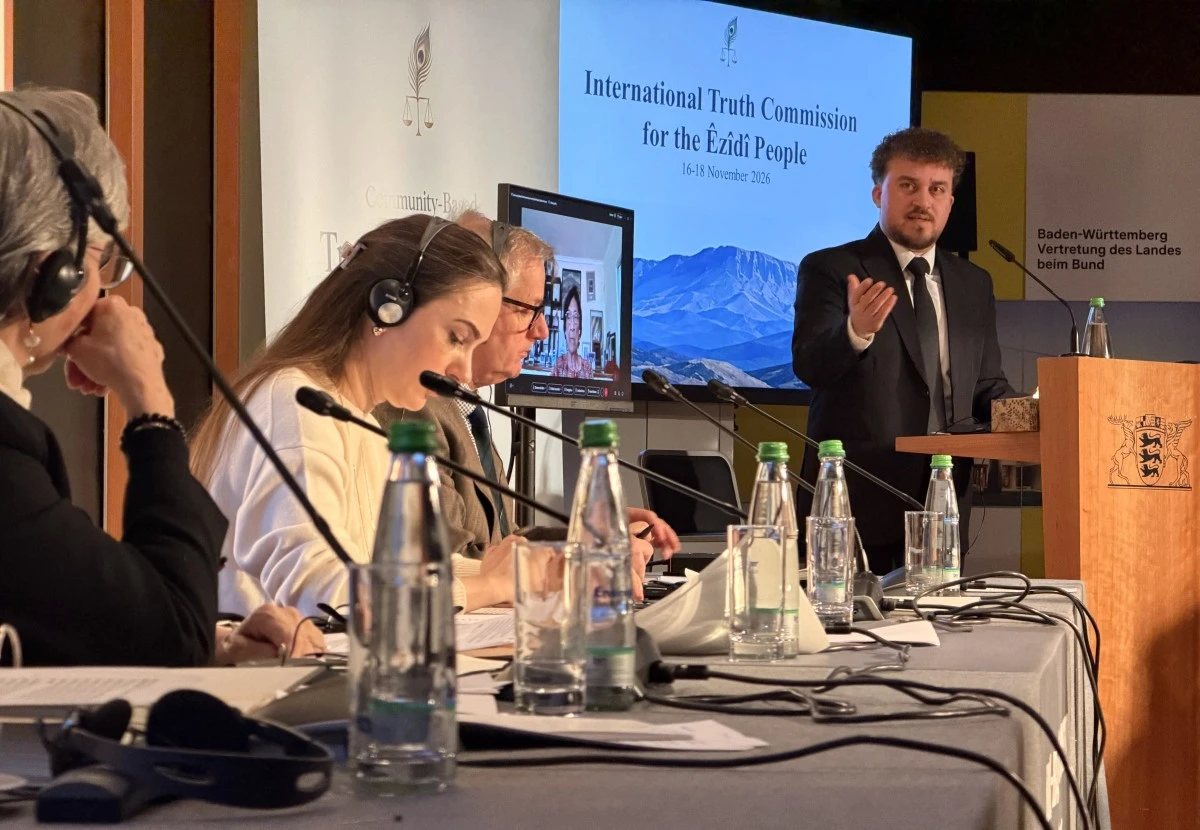
- Ardawan Abdi, a survivor of the Yazidi genocide, testified about being imprisoned and witnessing horrific abuses at 14 years old during a truth commission in Berlin
- The commission, featuring around 30 Yazidi survivors, aims to address the lack of accountability for atrocities committed against the Yazidi community since 2014
BERLIN: Ardawan Abdi was just 14 when Daesh militants seized the ancestral homeland of his Yazidi people in northern Iraq’s Sinjar Mountains and locked him up for seven months.
“In that time, I saw everything, from blood to death,” he told AFP in Berlin on Monday on the sidelines of a first-of-its-kind “truth commission” for survivors of the Yazidi genocide that started in 2014.
“We were beaten, we were abused, and women were sold, raped, repeatedly abused,” Abdi said. “And I had to experience all of that as a 14- to 15-year-old.”
Abdi is one of around 30 survivors from the religious minority who are due to give evidence at the three-day event.
Their testimony of murder, torture, rape and forced marriage is to be evaluated by seven commissioners, including Nobel Peace Prize winner Navi Pillay and lawmakers from Germany and the United Kingdom.
“There has been no meaningful accountability for the atrocities committed in the past 12 years,” head commissioner Helena Kennedy told the opening of the event, billed by organizers as a “community-based truth commission.”
“The rape and enslavement of (Yazidi) women and girls is one of the great shames of the last couple of decades,” she told AFP.
- ‘I cannot forget’ -
More than a decade on from the atrocities, in which an estimated 5,000 Yazidis were murdered and around 6,400 enslaved, many survivors are yet to tell their stories.
The commission in Germany — a country which has granted refuge to an estimated 230,000 followers of the pre-Islamic faith — offered an opportunity for some to testify for the first time.
Najlaa Matto recounted how Daesh fighters attacked her home village of Kocho in Iraq on August 15, 2014, murdering her father and brother.
“They killed the men because they refused to convert,” she told the panel. “I cannot forget what (Daesh) did to me.”
Matto was taken to the Iraqi city of Mosul, where she was “inspected, sold and given away” to a Daesh militant.
After attempting to escape, she said, she was subjected to rape and sold to another Daesh fighter, spending four months “close to starvation” before being freed.
Matto, 39, said she hopes to face her captors in court one day. “That is my justice,” she added.
Another witness, Sanaa Alnemeat, warned that the genocide against her people is “still ongoing,” highlighting the fate of over 2,000 Yazidis who remain missing.
- ‘Do not look away!’ -
UN investigators and several Western countries have recognized the horrors committed against the Yazidi people as a genocide, but the prosecution of those responsible has proceeded unevenly.
Many of those interned in Iraq have been convicted for other crimes, such as membership of a terrorist organization.
While a handful of Daesh members have faced genocide charges in Germany, Belgium, France and other European countries in recent years, systematic action at the international level has so far been limited.
The United Nations in 2017 set up the UN Investigative Team to Promote Accountability for Crimes Committed by Daesh (UNITAD) but wound it down in 2024 on the request of the Iraqi government.
Organizers hope the new truth commission can galvanize efforts to provide justice for the Yazidis.
“We’re going to be calling for a proper tribunal to be created,” Kennedy told AFP. “And the United Nations really has to rise to this occasion.”
Abdi, the survivor, also recounted how, after being bought out of Daesh captivity by his uncle alongside most of his family, he was able to reach safety in Germany under a special admission program for Yazidis in 2015.
“We want to ensure that what happened to us Yazidis in 2014, namely a genocide, does not happen again and that justice is carried out,” Abdi told AFP.
“That means, internationally, that wherever the perpetrators are, they are brought before the courts, convicted, and made to serve their sentences.”
“My demands are directed at the European Commission,” he said. “Do not look away!”