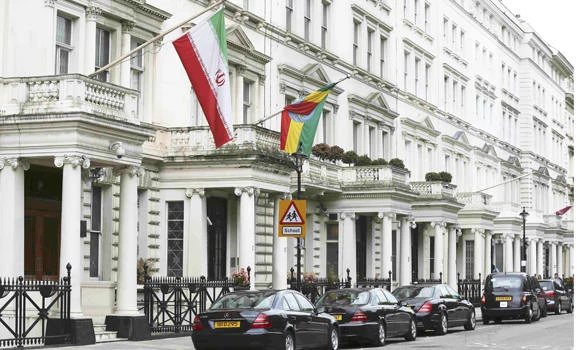
TEHRAN/LONDON: Iran will in the coming days reopen its embassy in London “at the same time” as Britain reopens its mission in Tehran, an Iranian foreign ministry official said on Thursday.
The official earlier said Britain would reopen its embassy during a visit to Iran by Foreign Secretary Philip Hammond due to start on Sunday.
Britain closed its embassy four years ago after protesters ransacked the elegant ambassadorial residence and burned the British flag.
The move to restore full diplomatic relations marks a thawing of ties with Iran since it reached a nuclear deal with the United States, China, Russia, Germany, France and Britain.
“The foreign secretary (Philip Hammond) will travel to Iran to reopen our embassy there,” a British diplomatic source told Reuters on Thursday.
After more than a decade of casting the Islamic Republic as a rogue power seeking to sow turmoil through the Middle East, Britain has sought to improve ties with Iran, whose natural gas reserves are larger even than Russia’s.
Hammond will travel to Iran this weekend for the formal opening of the embassy on Sunday. He will take a small group of business leaders, including representatives from Royal Dutch Shell and other companies, with him on the trip, according to the source.
The British minister will have meetings with Iranian President Hassan Rouhani, Ali Akbar Velayati, who is a senior adviser to Iranian Supreme Leader Ayatollah Ali Khamenei, and with Foreign Minister Mohammad Javad Zarif.
With the business delegation, Hammond will meet the Iranian ministers of industries and business, petroleum and transport.
With the prospect of an end to sanctions, foreign businesses are already jockeying for business in Iran, a nation of 80 million whose economy has withered. Officials have even laid on bus tours for visiting executives looking to refurbish Iran’s creaking oil refineries.
Embassy ransacked
While the nuclear deal is seen by its backers as an opportunity for improved relations between Iran and the West, hard-liners in Washington and Tehran have opposed it, as has Israel.
Until a new ambassador is announced, the embassy will be led by Ajay Sharma, until now the non-resident chargé d’affaires.
There are worries that the building may not be electronically secure. Four years ago, the protesters removed laptop computers, phones and other equipment.
Iranian protesters stormed two British diplomatic compounds in Tehran in November 2011, smashing windows, torching a car and burning the British flag in protest against nuclear-related sanctions imposed by London, long-regarded as the “Old Fox” in Iran for its perceived malign influence in regional affairs.
There had been regular protests outside the British embassy over the years since the 1979 Islamic revolution that toppled the US-backed shah, but none were as violent as the 2011 storming.
At the time, Prime Minister David Cameron called the attacks “outrageous and indefensible” and scolded the Iranian government for failing to defend British staff and protect the imposing building, which had been a treasure trove of valuable paintings and historic memorabilia.
Protesters smashed the large stone lion and unicorn on the gates at the ambassadorial residence, where in 1943 a dinner was held for Winston Churchill, Joseph Stalin and Franklin D. Roosevelt — the first meeting between the leaders of Britain, Russia and the United States to discuss their strategy for winning World War II.
Protesters looted the embassy and smashed some treasures. A portrait of Queen Victoria was torn in two, the head was cut out of a portrait of Edward VII and a picture of Queen Elizabeth was stolen. A pub in the embassy, the Parrot, was also ransacked.
Britain responded by shutting Iran’s embassy in London and expelling its diplomats. For the last two years, Tehran has been represented by a non-resident charge d’affaires.
Britain and the United States have long been viewed with considerable suspicion in Tehran.
There has been no US embassy there since it was sacked in the early days of the Islamic Revolution in 1979 by students who feared a repeat of a 1953 coup when the CIA orchestrated the overthrow of Prime Minister Mohammad Mossadegh.
Churchill himself was a main proponent of the toppling of Mossadegh, who had nationalized the Anglo-American Oil Company.
Thawing of ties: UK, Iran set to reopen embassies