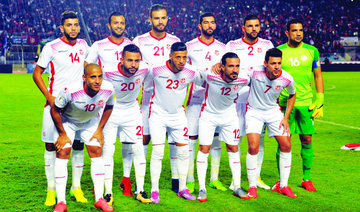
For the first time ever, four Arab countries will be heading to the World Cup.
Today, Saudi Arabia, Egypt, Tunisia and Morocco will discover who they will be up against next summer when the draw for Russia 2018 takes place in Moscow.
It’s almost certain all four will end up facing missions improbable, if not impossible.
Out of the four, Egypt look to be, marginally, in the best shape.
Though the Pharaohs will be at their first World Cup in 28 years — since when all three other have made appearances — they look to possess a formidable squad with many of the senior players plying their trade in some of Europe’s major leagues
Crucially for Egypt, losing finalists at the 2017 Africa Cup of Nations, they find themselves in Pot 3. This means that as arguably one of the better non-European squads of the two lower pots, there is strong possibility of a first World Cup win and potential progress to the knockout stages.
A dream scenario for Hector Cuper’s men would be a group with Russia or Poland, Peru and Panama. And with Liverpool’s Mohamed Salah currently one of the hottest properties in European football, Egypt’s red army of supporters will be believe anything is possible.
Tunisia, also in Pot 3, are in a similar situation to Egypt and will be looking for their first ever progression from the group stage having been absent from the World Cup since 2006.
Coach Nabil Maaloul has fostered a focused, unified squad since taking over from Henryk Kasperczak earlier this year. And with captain Ayman Abdennour, Youssef Msakni and Wahbi Khazri among their ranks, their supporters will be hoping that a kind draw could see this generation better the nations heroic performances at the 1978 World Cup in Argentina, when they beat Mexico before losing to Poland and drawing with West Germany.
For Saudi Arabia and Morocco, in the fourth and final pot, things will undoubtedly be tougher and both will not so much be hoping for an easy group, more praying to avoid a group of death.
The Green Falcons performed admirably in the qualifiers to advance automatically from a group that included the last two Asian champions, Australia (2015) and Japan (2011), as well as UAE team that had finished third at the 2015 AFC Asian Cup.
However, since the euphoria of the decisive 1-0 win over Japan in September, things have not gone according to plan.
Bert van Marwijk, the Dutchman who masterminded the qualification campaign and revamped Saudi football in the process, walked away after failing to sign a new contract that demanded he spend more time in the kingdom and away from his family.
His departure was followed by the appointment of then UAE coach Edgardo Bauza; the Argentine lasted just five friendlies (two wins and three defeats) before being deemed not up to the task by the Saudi Arabian Football Federation.
Now, the biggest obstacles to a strong performance in Russia appears to come from the lack of stability that that currently surrounds the squad.
It remains to be seen exactly what the new man in the hotseat, the Argentine Juan Antonio Pizzi, can achieve in the six or seven months before the start of the tournament.
He will at least be hoping that tomorrow’s draw does not throw up a group that includes Germany, Uruguay and Sweden. They could even end up with Brazil, Spain and Sweden.
Morocco, will fear similar worst-case scenarios, but have much to be optimistic about too.
After failing to win their opening two matches in the CAF Third Round group stage, qualification to the World Cup was only confirmed on the final match day with an outstanding away win against the Ivory Coast.
Much of the credit must go to French coach Herve Renard, who has done a remarkably solid job with a group of players excelling at home and abroad.
The feel-good factor surrounding Moroccan football following World Cup qualification was pumped up even more after Wydad Casablanca recently defeated Al-Ahly of Egypt to win the CAF Champions League.
And around Europe, Hakim Ziyech (Ajax), Soufiane Boufal (Southampton), and Achraf Hakimi (Real Madrid) have caught the eye this season.
There is also the possibility of intriguing all-Arab clashes if Saudi Arabia are drawn in the same group as Tunisia and Egypt.
With the exception of Morocco in 1986 and Saudi in 1994, Arab nations have failed to qualify to the knockout stages of the World Cup.
Qualification to the finals was in the past often deemed a triumph in itself. Times have changed, and so have expectations.
Today’s draw will determine just how much the four nations can dare to dream.