Lebanese hospitals struggle with tide of COVID-19 patients

Lebanese hospitals struggle with tide of COVID-19 patients
1 / 3
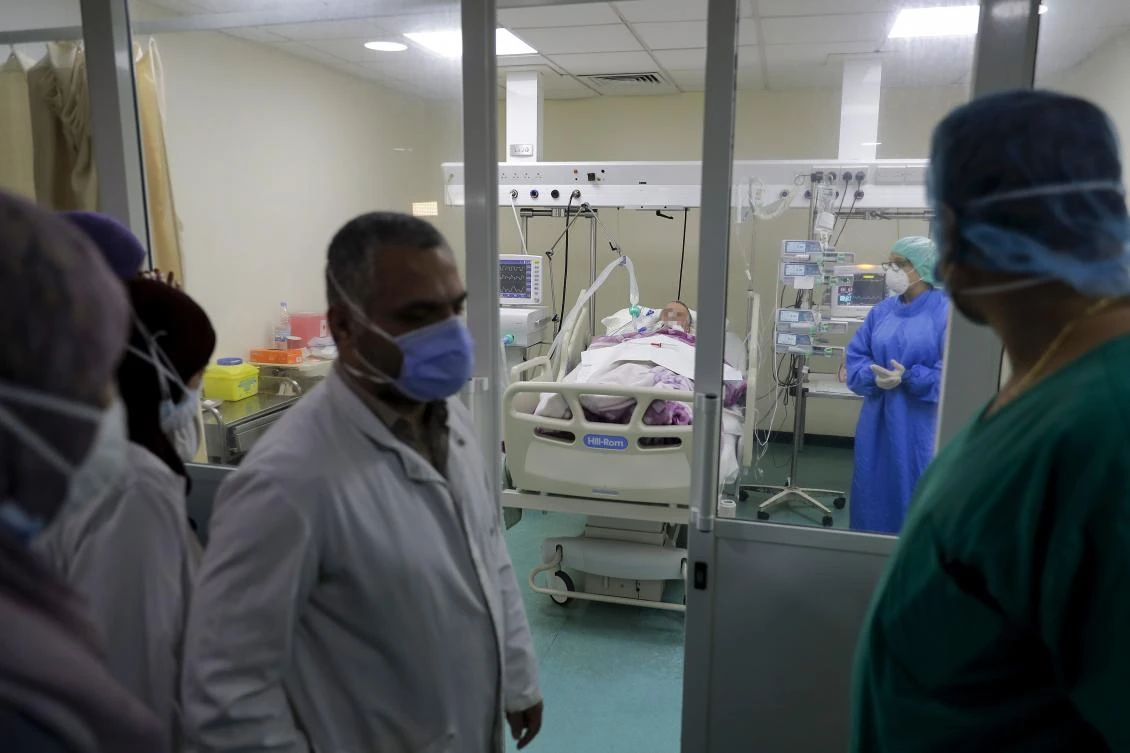
Doctors perform rounds in the intensive care unit of the Rafic Hariri University Hospital in Beirut on November 13, 2020. (AFP)
Lebanese hospitals struggle with tide of COVID-19 patients
2 / 3
A nurse takes care of a COVID-19 patient in the Intensive care unit of the Rafic Hariri University Hospital in the Beirut on November 13, 2020. (AFP)
Lebanese hospitals struggle with tide of COVID-19 patients
3 / 3
A COVID-19 patient speaks to a member of the medical team at intensive care unit of the Rafic Hariri University Hospital in Beirut on November 13, 2020. (AFP)
Short Url
Updated 14 November 2020

Lebanese hospitals struggle with tide of COVID-19 patients

Lebanese hospitals struggle with tide of COVID-19 patients
  • One 91-year-old spent 10 days on a trolley in the COVID-19 section at a hospital in Beirut
  • There are more than 44,000 COVID-19 patients in Lebanon, 307 of whom are in critical condition

BEIRUT: As Lebanon entered into complete lockdown for two weeks from Saturday its hospitals are struggling to cope with the number of new COVID-19 patients, which is now around 2000 every day.
One 91-year-old, Zuhair Salem Al-Husseini, spent 10 days on a trolley in the section designated for COVID-19 patients at Makassed Islamic Charitable Society Hospital in Beirut because all the beds there were occupied, his daughter Heba told Arab News.
Al- Husseini spent two days in the emergency department, to complete his treatment at home because there were no isolation rooms. But his children took him back to the hospital as his condition deteriorated and he was treated with remdesivir.
He said that he did not know where he caught the infection because he rarely leaves home. “About 20 days ago, I felt I needed to vomit and I had a very high temperature. From that moment, my journey with fighting the coronavirus began.”
His daughter Heba said that after her father was discharged from hospital he did not receive any special treatment to follow at home.
Al-Husseini said: “I have never been to a doctor all my life, and I do not suffer from any disease. I am a smoker and I used to smoke two or three cigarettes with a cup of coffee before I caught the disease. When I learned about my infection, I was not afraid. I accepted it calmly and said I want to survive and encouraged myself.”
His 80-year-old wife did not contract the virus even though she accompanied the patient during his illness.
There are more than 44,000 COVID-19 patients in Lebanon, 307 of whom are in critical condition, according to Ministry of Health statistics. The total number of cases since last February has exceeded 100,000 cases.
The Minister of Health in the caretaker government, Hamad Hassan, promised that “the two-week-lockdown will witness an intensification of testing campaigns for early detection of those infected with the virus because this diagnosis leads to the immediate isolation of cases at home to relieve the pressure on hospitals.”
Dr. Firas Al-Abyad, director of the Hariri Governmental University Hospital, announced that “the hospital’s beds are full and the hospital can no longer receive any new cases.”
He said that “6 cases arrived on Saturday morning at the hospital emergency room, including 4 in critical condition, and they were kept in the emergency department because there were no vacant beds in the treatment department.”
Al-Abyad said that “the recording of 21 deaths on Friday raised the total number of corona deaths in the past five days to 73.” He anticipated that “Lebanon will record the highest weekly death rate resulting from Corona since the beginning of the pandemic.”
Turkey, Iraq draw closer over terror threat

Updated 18 December 2020

Turkey, Iraq draw closer over terror threat

Turkey, Iraq draw closer over terror threat
  • Experts drew attention to the shared security concerns between the two

ANKARA: Turkish President Recep Tayyip Erdogan hosted Iraqi Prime Minister Mustafa Al-Kadhimi on Thursday at the presidential palace.  
The sudden visit of top Iraqi officials to Turkey led to speculation about the challenges ahead in the region that brought the two countries together.  
Experts however drew attention to the shared security concerns between the two over the influence of autonomy-seeking Kurdish Kurdistan Workers’ Party (PKK) militants as the main driver of this top-level meeting.
According to Samuel Ramani, a Middle East analyst at the University of Oxford, a key subject during the meeting will be Turkey’s cross-border raids on the PKK in Iraq, which Baghdad views as a violation of its sovereignty but Turkey claims they are essential for its national security.  
“Turkish state-aligned media has emphasized that Turkey will frame itself as trying to help Iraq fight the PKK,” he told Arab News.  
Turkey prioritizes wiping out the PKK from Sinjar province of Iraq as a critical move for securing “the future of Iraq” because the terror group is more and more using Sinjar as a new headquarters to be an alternative to the Qandil mountains in northern Iraq.  
The Turkish military has been occasionally striking the hideouts of the PKK inside Iraq in parallel with its fight against PKK-affiliated Syrian Kurdish YPG forces to restrict Kurdish plans to control more territories in the region and prevent its own Kurdish population from being inspired by self-governance ambitions.  
On Tuesday, Iraqi Kurdish peshmergas and PKK/YPG militants clashed when the latter tried to illegally enter Iraqi Kurdistan from Syria and attacked the local Peshmerga base with heavy weapons.
“The YPG cannot be allowed to exploit foreign assistance to launch attacks on our territory. Any repeat would be seriously damaging to the regional security,” Masrour Barzani, prime minister of the Kurdistan Regional Government, said in a statement.  
Ramani thinks that the ongoing Syrian civil war will also top the bilateral agenda during the Iraqi premier’s visit to Ankara, as Iraq has aspirations for a bigger diplomatic role in the region.  
Turkey however long criticized Iraq for giving shelter to the PKK especially during unilateral Turkish incursions into Iraqi Kurdistan have drawn anger from Baghdad and Iraqi Kurdistan’s regional government.  
“As Turkey, we will give any support we can to fully clear the country from this terrorist organization,” Turkish Foreign Minister Mevlut Cavusoglu told a joint press conference with his Iraqi counterpart, Fuad Hussein.  
The resumption of visa-free travel for Iraqis to Turkey has been also a key part of the negotiations.
“Iraq wants visa-free travel, while Turkey has been wary about the security situation since Daesh rose,” Ramani said.  
The rise of Daesh led Turkish authorities to halt a visa-free regime with Iraq. Last month, 22 Daesh terror suspects, all Iraqi nationals, were arrested in Turkey.  
“An agreement on visa-free travel would be a symbolic step toward a stronger Iraq-Turkey partnership, notwithstanding recent frustrations in Baghdad about the Turkish military conduct,” Ramani said.  
Turkish and Iraqi foreign ministers have decided to form a committee to prepare a roadmap for the resumption of visa-free travel.  
Against the high expectations of the Iraqi side, no mention was made about the signature of the much-awaited protocol regulating fair water-sharing between the two countries from the Tigris River as Iraq still suffers greatly from the scarcity of Tigris water – a three-decade-long bilateral disagreement.   
Both sides are still negotiating the sharing of the Tigris river’s waters. Turkey also dispatched a special envoy to Baghdad last year for tackling water-sharing tensions with Iraq. The allocation of a monthly water quote to Iraq from the Tigris River is on the table.  
On the other hand, the trade relationship between the two countries is almost unidirectional as Turkey still keeps the lion’s share in $15 billion worth of bilateral trade.