Breaking the mold: Landless Afghans turn to fungi farming

Breaking the mold: Landless Afghans turn to fungi farming
1 / 4
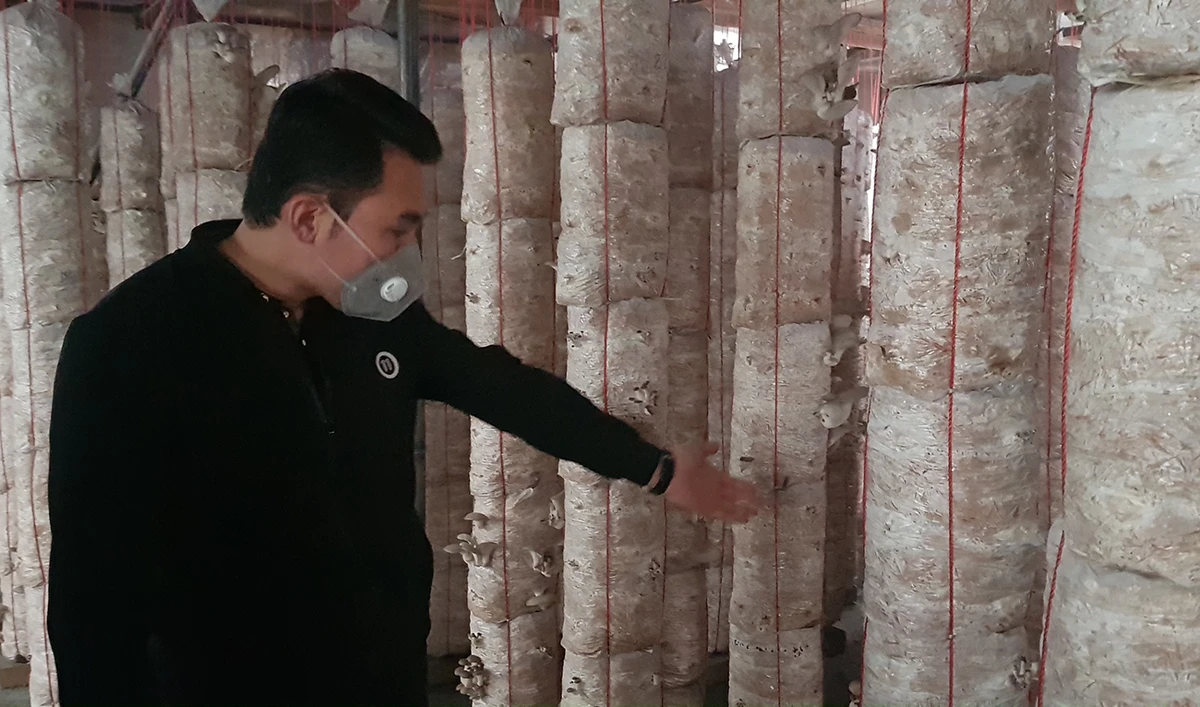
Rasool Rezaie picks mushrooms from a room he uses as his little farm for the cultivation of the plant in the outskirts of Kabul on March 13, 2021. (AN photo by Sayed Salahuddin)
Breaking the mold: Landless Afghans turn to fungi farming
2 / 4
Rasool Rezaie picks mushrooms from a room he uses as his little farm for the cultivation of the plant in the outskirts of Kabul on March 13, 2021. (AN photo by Sayed Salahuddin)
Breaking the mold: Landless Afghans turn to fungi farming
3 / 4
Rasool Rezaie picks mushrooms from a room he uses as his little farm for the cultivation of the plant in the outskirts of Kabul on March 13, 2021. (AN photo by Sayed Salahuddin)
Breaking the mold: Landless Afghans turn to fungi farming
4 / 4
Rasool Rezaie picks mushrooms from a room he uses as his little farm for the cultivation of the plant in the outskirts of Kabul on March 13, 2021. (AN photo by Sayed Salahuddin)
Short Url
Updated 21 March 2021

Breaking the mold: Landless Afghans turn to fungi farming

Breaking the mold: Landless Afghans turn to fungi farming
  • Legion of growers are cultivating highly nutritious mushrooms in their homes as a source of livelihood

KABUL: It has been three years since Jamila Khoshbo began farming oyster mushrooms in a section of her tiny house in the Dasht-e-Barchi neighborhood of southeastern Kabul.

The 48-year-old Afghan mother-of-four said that she learned how to cultivate the fungi from the local radio and “decided to try it since it requires much less space, water and money to grow.”

“I have been in this business since 2019. All you need is a space of four by five meters, and clean wheat straw with chlorine. Keep the mushrooms in plastic bags vertically on posts in humid conditions for several weeks and they will be ready to eat or sell,” Khoshbo told Arab News.

Today, she earns nearly $200 a month — more than the salary of a government employee — by selling to grocers in the area.

Khoshbo is one of a growing number of landless women who are growing highly nutritious mushrooms in their kitchens or backyards rather than working in the male-dominated farming sector.

Since the Taliban’s ouster in 2001, Afghan women have regained the right to education, to vote and to work outside their homes.

Still, it is not an easy place to be a woman, with forced marriages, domestic violence and maternal mortality prevalent across the country, particularly in rural areas.

However, access to public life has improved, especially in the capital Kabul, where most women work, and more than a quarter of the parliament is female.

Also, with drought and an acute water shortage affecting several areas of this mainly agricultural nation, growing mushrooms has offered a new lease of life to traditional farmers who prefer cultivating the fungi to other fruits and vegetables since it is cheap and “low maintenance.”

“It needs little water and is a very good, small-scale and clean business which requires two to three people to operate,” Rasool Rezaie, a 28-year-old resident of the Ghazni province in central Afghanistan, told Arab News.

Rezaie learned to grow mushrooms during a stay in Russia in 2012, when he had moved there to escape the insecurity and unemployment plaguing Afghanistan.

He returned to his homeland in 2016 and began selling computers. But “business was not good at all,” he said.

Two years ago, he set up a “mushroom farm” in Kabul.

“I was passing the Ministry of Agriculture one day and saw an official teaching a group of people how to grow mushrooms. Suddenly, I recalled my experience in Russia and set up this business,” Rezaie told Arab News.

His initial farm was small and produced 50 kg of mushrooms, but he has expanded the business to “bigger rooms” and now cultivates nearly 1,000 kg, earning $500 per month.

The cash flow is important for Rezaie, who is the family’s sole bread earner and takes care of his siblings following their parents’ death.

“I sell the mushrooms in the local market and teach new farmers, too,” he said, providing a textbook example of crowdsourced domestic farming by using limited resources.

“It’s easy to learn. I explain the process to interested customers, discuss what sort of tools they need and how to keep the buds at a certain temperature, etc. If someone else can benefit from growing mushrooms, why not?” he said.

Officials agree, with Mohammad Aman Aman, head of the agriculture ministry’s forestry department, telling Arab News that Afghanistan’s “conditions” were ideal for farming the fungi.

“Growing mushrooms is highly effective in this country because they do not need a lot of land or water. We have made proposals to the presidential palace to promote the growth of mushrooms,” he said.

Aman said that while the oyster variety is the most popular choice among farmers, plans are in place to cultivate truffles and morels — the more expensive assortments — as well.

“We export a small number of truffles produced here to India. So our push is to promote the idea of its growth because it is far more beneficial financially,” he said.

Afghans have for generations consumed wild mushrooms, which sprout in the mountainous north and northeastern regions of the country during spring.

The traditional condiment is added to soups and qorma — a meat-based dish infused with herbs, spices and dry fruits — but is increasingly sought after in restaurants selling pizzas.

In recent years, there has been a surge in mushroom consumption in urban and rural areas, according to traders.

“We buy it from farmers for less than $2 for a kilogram and sell it for double that sometimes. Business is good,” Rasool Dad, a hawker in Kabul, told Arab News.

Rezaie said that he hoped that Afghans’ newfound love for mushrooms could be a catalyst for change in other areas, too, such as altering the country’s image as the global producer of opium.

According to UN estimates, nearly 163,000 ha of land were used for poppy cultivation in 2019.

“If we can produce truffle and morels in large quantities, then farmers will gradually abandon the cultivation of poppy here because these two varieties are costly abroad,” he said.

Eager Ethiopia plays host to crisis-wracked African Union

Eager Ethiopia plays host to crisis-wracked African Union
Updated 6 sec ago

Eager Ethiopia plays host to crisis-wracked African Union

Eager Ethiopia plays host to crisis-wracked African Union
ADDIS ABABA: Just three months ago, foreigners were fleeing Ethiopia in droves, responding to alarming security warnings from mostly Western embassies about a possible rebel advance on the capital.
This week, traffic is moving in the opposite direction, as delegations from across Africa fly in for the latest summit of the African Union this weekend — an event the government has described as “a heavy blow to those who were professing the doomsday here.”
Well over a year into a conflict ravaging the country’s north, Ethiopia appears eager to host a meeting that will focus on other crises, and the AU has several on offer.
From coups to climate change to the coronavirus, the two-decade-old bloc is confronting a number of challenges which look set to weigh on its 55 member states for years to come.
It also faces the prospect of a debate over its relationship with Israel that analysts warn could become highly polarizing during the two-day gathering that begins on Saturday.
The result is a fraught agenda that may distract from Ethiopia’s troubles while allowing Addis Ababa, home to AU headquarters, to present itself as a strong, stable host for its neighbors.
“I think it can certainly be seen as a political win for Ethiopia,” said Imogen Hooper, African Union analyst at the International Crisis Group (ICG), a conflict-prevention organization.
Abiy’s government “has been lobbying heavily for this to take place in person, because it does give a sense of normalization.”


The summit follows a spate of recent coups on the continent, the latest occurring less than two weeks ago in Burkina Faso.
On Tuesday night, Guinea-Bissau President Umaro Sissoco Embalo survived a gun attack that both the AU and the West African bloc ECOWAS denounced as a coup attempt.
The following day, addressing a meeting of foreign ministers preceding this weekend’s summit for heads of state, African Union Commission chair Moussa Faki Mahamat condemned a “worrying resurgence of military coups.”
The AU’s 15-member security body has suspended Burkina Faso, Mali, Guinea and Sudan over their unconstitutional changes in power.
But it has not suspended Chad, where a military council took over following the death of longtime President Idriss Deby Itno on the battlefield last April.
“The AU’s inconsistent response to the slew of unconstitutional changes of government has been particularly damaging,” ICG said in a briefing this week.
At the summit , leaders should discuss how to be more proactive in addressing factors that give rise to coups, including terrorism-related instability and frustration over constitutional revisions that extend leaders’ time in power, said Solomon Dersso, founder of the AU-focused Africa Amani think tank.
“It is only when crisis hits that we say, ‘Gosh, how come this country is falling apart like this so quickly?’” Solomon said.


On Saturday, South African President Cyril Ramaphosa is slated to provide an update on Africa’s response to the pandemic, nearly two years after the continent’s first Covid-19 case was detected in Egypt.
As of January 26, only 11 percent of Africa’s more than 1 billion people had been fully vaccinated, according to the Africa Centers for Disease Control and Prevention.
That is a far cry from the body’s target of 70 percent by the end of the year.
African leaders have long spoken out against the hoarding of vaccines by rich countries, a theme likely to be repeated.
A draft agenda seen by AFP also includes a discussion of Faki’s decision last year to accept Israel’s accreditation at the AU.
Accredited non-African states are able to attend some conferences, access non-confidential AU documents and present statements at meetings that concern them.
Faki’s move drew quick, vocal protest from powerful members including South Africa and Algeria, which argued that it flew in the face of AU statements supporting the Palestinian Territories.
Analysts say a vote on the issue could yield an unprecedented split in the bloc.


Amid all this, it is doubtful the war in Ethiopia, pitting Abiy’s government against the Tigray People’s Liberation Front (TPLF) rebel group, will get much attention.
Foreign envoys are pushing hard for a cease-fire and expanded aid access to conflict-hit areas.
But Abiy’s government has dismissed criticism from the US and other Western powers as smacking of neo-imperialism.
If signs recently posted outside the Addis Ababa airport are any indication, Abiy seems poised to use this year’s AU summit to shore up his pan-African bona fides.
“African solutions to African problems,” reads one. “The future of Mother Africa is bright,” reads another.
And a third: “To pull together is to avoid being pulled apart.”
rcb/np/yad

President Xi Jinping, China’s ‘chairman of everything’

President Xi Jinping, China’s ‘chairman of everything’
Updated 03 February 2022

President Xi Jinping, China’s ‘chairman of everything’

President Xi Jinping, China’s ‘chairman of everything’
  • Xi’s rise coincides with increased assertiveness abroad following three decades of China keeping its head down to focus on economic development
  • Many of the changes from Xi's “national rejuvenation” program are deemed hostile to ethnic minorities, pro-democracy and other activists  

BEIJING: The last time the Olympics came to China, he oversaw the whole endeavor. Now the Games are back, and this time Xi Jinping is running the entire nation.
The Chinese president, hosting a Winter Olympics beleaguered by complaints about human rights abuses, has upended tradition to restore strongman rule in China and tighten Communist Party control over the economy and society.
Xi was in charge of the 2008 Summer Olympics in Beijing that served as a “coming-out party” for China as an economic and political force. A second-generation member of the party elite, Xi became general secretary of the party in 2012. He took the ceremonial title of president the next year.
Xi spent his first five-year term atop the party making himself China’s strongest leader at least since Deng Xiaoping in the 1980s. Xi was dubbed “chairman of everything” after he put himself in charge of economic, propaganda and other major functions. That reversed a consensus for the ruling inner circle to avoid power struggles by sharing decision-making.
The party is crushing pro-democracy and other activism and tightening control over business and society. It has expanded surveillance of China’s 1.4 billion people and control of business, culture, education and religion. A “social credit” system tracks every person and company and punishes infractions from pollution to littering.

Born in Beijing in 1953, Xi enjoyed a privileged youth as the second son of Xi Zhongxun, a former vice premier and guerrilla commander in the civil war that brought Mao Zedong’s communist rebels to power in 1949.

Xi’s rise coincides with increased assertiveness abroad following three decades of China keeping its head down to focus on economic development.
Xi wants China to be “the greatest country on Earth, widely admired and therefore followed,” said Steve Tsang, a Chinese politics specialist at the School of Oriental and African Studies in London.
“The world where China is top dog is a world where authoritarianism is safe,” Tsang said. Democracies will ”need to know their place.”
Born in Beijing in 1953, Xi enjoyed a privileged youth as the second son of Xi Zhongxun, a former vice premier and guerrilla commander in the civil war that brought Mao Zedong’s communist rebels to power in 1949. At 15, Xi Jinping was sent to rural Shaanxi province in 1969 as part of Mao’s campaign to have educated urban young people learn from peasants. Xi was caught trying to sneak back to the Chinese capital and returned to Shaanxi to dig irrigation ditches.
“Knives are sharpened on the stone. People are refined through hardship,” Xi told a Chinese magazine in 2001. “Whenever I later encountered trouble, I’d just think of how hard it had been to get things done back then and nothing would then seem difficult.”
Beijing is pushing for a bigger role in managing trade and global affairs to match its status as the second-biggest economy. It has antagonized Japan, India and other neighbors by trying to intimidate Taiwan — the island democracy that the ruling party says belongs to China — and by pressing claims to disputed sections of the South and East China Seas and the Himalayas.
The party has ended limits on foreign ownership in its auto industry and made other market-opening changes. But it has declared state-owned companies that dominate oil, banking and other industries the “core of the economy.”
Beijing is pressuring private sector successes such as Alibaba Group, the world’s biggest e-commerce company, to divert billions of dollars into nationalistic initiatives including making China a “technology power” and reducing reliance on the United States, Japan and other suppliers by developing processor chips and other products.
That, combined with US and European curbs on Chinese access to technology due to security fears, is fueling anxiety global industry might decouple or split into markets with incompatible auto, telecom and other products. That would raise costs and slow innovation.
Xi, 68, looks certain to break with tradition again by pursuing a third term as party leader at a congress in October or November. He had the constitution’s limit of two terms on his presidency repealed in 2018. That reversed arrangements put in place in the 1990s for party factions to share decision-making and hand over power to younger leaders once every decade.
Even before Xi took power, party officials complained that group leadership was too cumbersome and allowed lower-level leaders to ignore or obstruct initiatives. Officials defend Xi’s efforts to stay in power by saying he needs to ensure reforms are carried out.

Activists complain Beijing is trying to erase minority cultures, but officials say the camps are for job training and to combat radicalism. They reject reports of force abortions and other abuses.

Xi led an anti-corruption crackdown whose most prominent targets were members of other factions or supported rival leadership candidates. The campaign was popular with the public but led to complaints that officials refused to make big decisions for fear of attracting attention.
Xi has called for a “national rejuvenation” based on tighter party control over education, culture and religion. Many of the changes are hostile to ethnic minorities, gays and lesbians, pro-democracy and other activists and independent-minded artists and writers. Social media groups for gay university students have been shut down. Men deemed insufficiently masculine were banned from TV.
An estimated 1 million Uyghurs and members of other mostly Muslim minority groups have been confined in camps in the Xinjiang region in the northwest. Activists complain Beijing is trying to erase minority cultures, but officials say the camps are for job training and to combat radicalism. They reject reports of force abortions and other abuses.
Xi oversaw the 2015 detention of more than 200 lawyers and legal aides who helped activists and members of the public challenge official abuses.
After the coronavirus emerged in 2019, Xi’s government suppressed information and punished doctors who tried to warn the public. That prompted accusations Beijing allowed the disease to spread more widely and left other countries unprepared.
Beijing extended its crackdown to Hong Kong following 2019 protests that began over a proposed extradition law and expanded to include demands for greater democracy.
A national security law was imposed on Hong Kong in 2020, prompting complaints that Beijing was eroding the autonomy that had been promised when the former British colony returned to China in 1997 — and ruining its status as a trade and financial center.
Pro-democracy figures have been imprisoned. They include Jimmy Lai, the 73-year-old former publisher of the Apple Daily newspaper, which shut down under government pressure, and organizers of candlelight memorials of the party’s deadly 1989 crackdown on a pro-democracy movement.
A big potential stumbling block to achieving Xi’s ambitions is the struggling economy. Growth is slumping after Beijing tightened controls on use of debt in its real estate industry, one of its biggest economic engines. That adds to the drag from politically motivated initiatives, including tech development and orders to manufacturers to use Chinese suppliers of components and raw materials, even if that costs more.
“Xi himself weakens the economy rather than strengthening it,” Tsang said. “If you mess up the economy, he’s not going to make China the dominant power in the world.”


Burkina Faso junta lifts nationwide curfew in force since coup

Burkina Faso junta lifts nationwide curfew in force since coup
Updated 03 February 2022

Burkina Faso junta lifts nationwide curfew in force since coup

Burkina Faso junta lifts nationwide curfew in force since coup
  • Mutinous soldiers imposed the restrictions on January 24 after seizing power from President Roch Marc Christian Kabore 

OUAGADOUGOU: Burkina Faso’s junta lifted Wednesday a nationwide curfew they imposed after seizing power in a coup last month, the military announced.
The restrictions were imposed on January 24 after mutinous soldiers arrested President Roch Marc Christian Kabore following a revolt at several army barracks in the capital over the handling of jihadist attacks in the Sahel nation.
“The President of the Patriotic Movement for Preservation and Restoration, President of Faso, Head of State, updates... the total lifting of the curfew measure as of this day, February 2,” Col. Paul-Henri Sandaogo said in a press release.
The nation’s nightlife will not completely resume as “popular celebrations and festive events are prohibited after midnight from Monday to Thursday and after 2 am from Friday to Sunday,” the junta said in a televised statement.
The coup leaders said the measure was taken “in view of the security context and in solidarity with the victims of insecurity.”
Initially imposed from 9 p.m. to 5 pm, the national curfew was later reduced to midnight to 4 am before being lifted entirely.
Like neighboring Mali and Niger, Burkina Faso has been caught up in a spiral of violence since 2015, attributed to jihadist groups affiliated to Al-Qaeda and the Daesh militant group.
The violence has killed more than 2,000 people and forced at least 1.5 million to flee their homes.
Sandaogo also reshuffled the country’s military leadership, a change sought by soldiers in the January mutiny.
Former sports minister Colonel-Major David Kabre was appointed chief of the general staff of the armed forces, with Col. Adam Nere becoming chief of staff of the army.


17 dead in Argentina after taking laced cocaine

Police organize packages containing drugs seized during a raid in Taller Puerta 8 shantytown in Buenos Aires province on Feb. 2, 2022. (AFP PHOTO / TELAM / Eliana Obregon)
Updated 03 February 2022

17 dead in Argentina after taking laced cocaine

Police organize packages containing drugs seized during a raid in Taller Puerta 8 shantytown in Buenos Aires province on Feb. 2, 2022. (AFP PHOTO / TELAM / Eliana Obregon)
  • Early reports said victims suffered convulsions and sudden heart attacks
  • Officials said they are working quickly to determine what the cocaine was mixed with

BUENOS AIRES: At least 17 people died and 56 more were hospitalized in a northwestern suburb of Buenos Aires after consuming cocaine cut with a toxic substance, possibly opioids, authorities said Wednesday.
Officials said they are working quickly to determine what the cocaine was mixed with, but warned those who have bought the drug over the last 24 hours to dispose of it.
Sergio Berni, the security chief for Buenos Aires province, told the television channel Telefe authorities were trying to locate the toxic substance “to remove it from circulation.”
About 10 people were arrested after police raided a house in the poor Tres de Febrero neighborhood where they believe the cocaine was sold.
Packets of cocaine similar to those described by the victims’ families were seized.
The drugs were taken to a laboratory in La Plata, the capital of Buenos Aires province, for analysis.
Authorities issued an urgent warning early Wednesday after three separate hospitals reported several deaths and serious cases of poisoning. Later in the day, eight hospitals were treating patients.
Several of those being treated told doctors they had taken cocaine together.
Early reports said victims suffered convulsions and sudden heart attacks.
Health authorities said at least four of the victims were men aged between 32 and 45.
“There is a key ingredient that is attacking the central nervous system,” Berni said.
His office said late in the day that emergency services were reporting new patients in “critical condition” being brought to hospital.

Berni explained that “every dealer that buys cocaine cuts it. Some do it with non-toxic substances such as starch. Others put hallucinogens in it, and if there is no form of control, this kind of thing happens.”
He said that on this occasion, however, the drug was cut with a harmful substance as part of a “war between drug traffickers.”
The San Martin public prosecutor, Marcelo Lapargo, told Radio Mitre that authorities’ main concern “is to be able to communicate, so that those who are in possession of this poison know that they should not consume it.”
Investigators fear the toll could rise, with some people who bought the cocaine unable to reach a care center in time.
Lapargo said that this case was “absolutely exceptional.” He also said that the idea of a battle between drug traffickers was “conjecture” at this point.
Police clashed briefly with residents in a part of Tres de Febrero who were protesting the arrest of local young people in the drug raid.


German vaccine commission to recommend fourth COVID-19 shot

German vaccine commission to recommend fourth COVID-19 shot
Updated 03 February 2022

German vaccine commission to recommend fourth COVID-19 shot

German vaccine commission to recommend fourth COVID-19 shot

BERLIN: Germany’s expert panel on vaccine use (STIKO) is preparing to recommend a fourth COVID-19 vaccine dose, the committee’s head, Thomas Mertens, told media group Funke on Thursday.
“We have data from Israel that shows a fourth dose significantly improves protection from a severe case of illness,” Mertens told Funke. “The STIKO will make the recommendation soon,” he added.
The panel would recommend booster shots only with vaccines that are already available, Mertens added.
On vaccines that have been adapted to work against the omicron coronavirus variant, STIKO would have to wait for clinical data from Moderna and Pfizer-BioNTech, the media group cited Mertens as saying.
Some countries have already started offering additional booster doses, but a recent study from Israel showed that while a fourth dose of an mRNA vaccine boosted antibodies, the level was not high enough to prevent omicron infection.