Seoul says fired warning shots after North Korean troops crossed border

Seoul says fired warning shots after North Korean troops crossed border
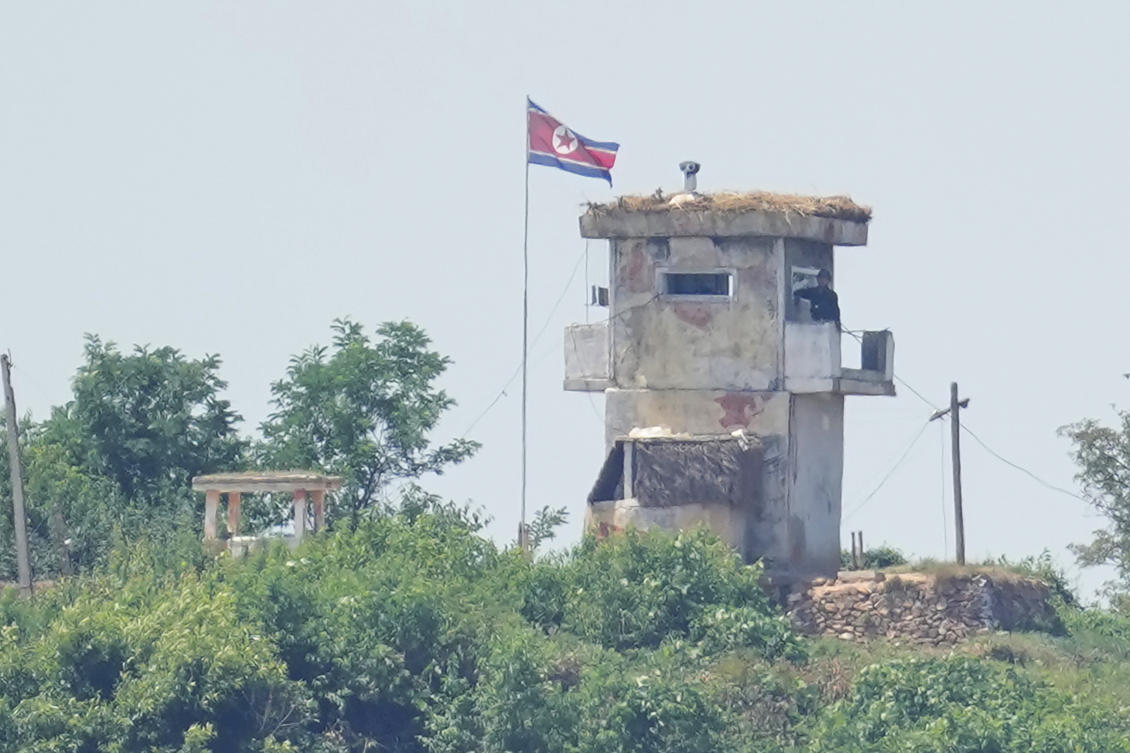
Above, a soldier stands at a North Korean military guard post flying a national flag, as seen from Paju in South Korea on June 26, 2024. (AP file photo)
Short Url
Updated 23 August 2025
Follow

Seoul says fired warning shots after North Korean troops crossed border

Seoul says fired warning shots after North Korean troops crossed border
  • South Korea’s Joint Chiefs of Staff calls event a ‘premeditated and deliberate provocation’
  • The last border confrontation between the arch-rivals was in early April

SEOUL: South Korea fired warning shots at North Korean soldiers that briefly crossed the heavily fortified border earlier this week, Seoul said Saturday after Pyongyang accused it of risking “uncontrollable” tensions.
South Korea’s new leader Lee Jae Myung has sought warmer ties with the nuclear-armed North and vowed to build “military trust,” but Pyongyang has said it has no interest in improving relations with Seoul.
Seoul’s military said several North Korean soldiers crossed the border Tuesday while working in the heavily mined Demilitarized Zone (DMZ) separating the two Koreas.
The incursion prompted “our military to fire warning shots,” Seoul’s Joint Chiefs of Staff said in a statement, adding “the North Korean soldiers then moved north” of the de facto border.
Pyongyang’s state media said earlier Saturday that the incident occurred as North Korean soldiers worked to permanently seal the frontier dividing the peninsula, citing a statement by Army Lt. Gen. Ko Jong Chol.
Calling the event a “premeditated and deliberate provocation,” Ko said Seoul’s military used a machine gun to fire more than 10 warning shots toward the North’s troops, according to the official Korean Central News Agency.
“This is a very serious prelude that would inevitably drive the situation in the southern border area where a huge number of forces are stationing in confrontation with each other to the uncontrollable phase,” Ko said.
The last border confrontation between the arch-rivals was in early April when South Korea’s military fired warning shots after around 10 North Korean soldiers briefly crossed the frontier.
North Korea’s military announced last October it was moving to totally shut off the southern border, saying it had sent a message to US forces to “prevent any misjudgment and accidental conflict.”
Shortly after, it blew up sections of the unused but deeply symbolic roads and railroad tracks that connect the North to the South.
Ko warned that North Korea’s army would retaliate against any interference with its efforts to permanently seal the border.
“If the act of restraining or obstructing the project unrelated to the military character persists, our army will regard it as deliberate military provocation and take corresponding countermeasure,” he said.
Under Lee’s more hawkish predecessor, relations between the two Koreas had sunk to one of their lowest points in years.
After Lee’s election in June, he pledged to pursue dialogue with the nuclear-armed North without preconditions, saying last week his government “will take consistent measures to substantially reduce tensions and restore trust.”
Even so, South Korea and the United States began annual joint exercises on Monday aimed at preparing for potential threats from the North.
Lee described the drills as “defensive” and said they were “not intended to heighten tensions.”
North Korea – which attacked its neighbor in 1950, triggering the Korean War – has long been infuriated by such exercises between the US and the South, decrying them as rehearsals for invasion.
Hong Min, a senior analyst at the Korea Institute for National Unification, said Pyongyang was again accusing Seoul of pursuing a “dual approach” with its latest outburst – calling for dialogue while in its view raising military tensions.
Pyongyang’s leader Kim called earlier this week for the “rapid expansion” of the North’s nuclear weapons capability, citing the ongoing US-South Korean military exercises that he claimed could “ignite a war.”
His powerful sister has since said Seoul “cannot be a diplomatic partner” of the North, and that Lee “is not the sort of man who will change the course of history.”
Former UK minister in U-turn over Israel’s killing of Palestinian nurse

Former UK minister in U-turn over Israel’s killing of Palestinian nurse
Updated 5 sec ago
Follow

Former UK minister in U-turn over Israel’s killing of Palestinian nurse

Former UK minister in U-turn over Israel’s killing of Palestinian nurse
  • Alistair Burt says govt was wrong to trust Israeli probe over 2018 killing of Razan Al-Najjar
  • Popular 20-year-old nurse was shot dead amid protests on the Gaza border, prompting global outrage

LONDON: A former Conservative minister in the UK has admitted a change of heart over the killing of a prominent young Palestinian nurse and accused the Israeli government of murdering her, The Independent reported.

The government of Prime Minister Benjamin Netanyahu was also accused by Alistair Burt of carrying out fake inquiries into the death of Razan Al-Najjar in 2018.

The young nurse, who was killed aged 20, was popularly dubbed the “Angel of Mercy.”

She was shot dead by Israeli forces while coming to the aid of a wounded demonstrator on Gaza’s border with Israel in 2018, prompting international condemnation.

Burt, who at the time served as Middle East minister in the Conservative government led by Theresa May, said the UK was wrong not to “call out” Israel after Al-Najjar’s killing.

After the killing, Burt refused to criticize Israel and urged the Israel Defense Forces to investigate the death.

Yet a UN probe found “reasonable grounds” to believe that Al-Najjar had been deliberately targeted by Israeli security forces responding to the demonstrations, despite posing no threat.

The UK minister had also blamed Palestinians for the violence and argued that “extremist elements exploited the protests for their own violent purposes.”

However, Burt now regrets his “grim” reaction to the killing, and says he is now certain Al-Najjar was “clearly targeted and murdered” by Israel.

The UK had been wrong to trust Israeli government denials and promises to investigate the killing, he added, describing the internal probes as bogus.

“I know exactly what I did. I know why I did it. And it’s grim. I have thought about this a lot. The strongest memory I have was the shooting of the young paramedic Razan Al-Najjar. She was clearly targeted and murdered by the Israelis,” he said.

“We relied on the Israeli response that they know all about every shot that was fired by the IDF. My suspicion then — since confirmed — is that these investigations were effectively useless and used as a cover by the Israelis for the killing and covering up such as this.

“I and the UK should have been more bold in calling this out.”

The former minister’s U-turn is described in a new book on Britain’s ties to the war in Gaza, “Complicit, Britain’s Role In The Destruction of Gaza,” by journalist Peter Oborne.

Burt’s change of heart is emblematic of a wider shift in Western attitudes toward Israel in the wake of the Gaza war.

The IDF cleared itself of wrongdoing after Al-Najjar’s death, but was accused of conducting a smear campaign against the young nurse after releasing a film in which she appeared to describe herself as a “human shield.”

But it later emerged that the video had been manipulated, and the nurse had instead called herself a “human shield to save the injured.”

Before her death, Al-Najjar had become an icon among Palestinians in the occupied territories and beyond. Thousands of Gazans attended her funeral.