The 189 Palestinian journalists killed in the war in Gaza endured hunger and grief
The 189 Palestinian journalists killed in the war in Gaza endured hunger and grief

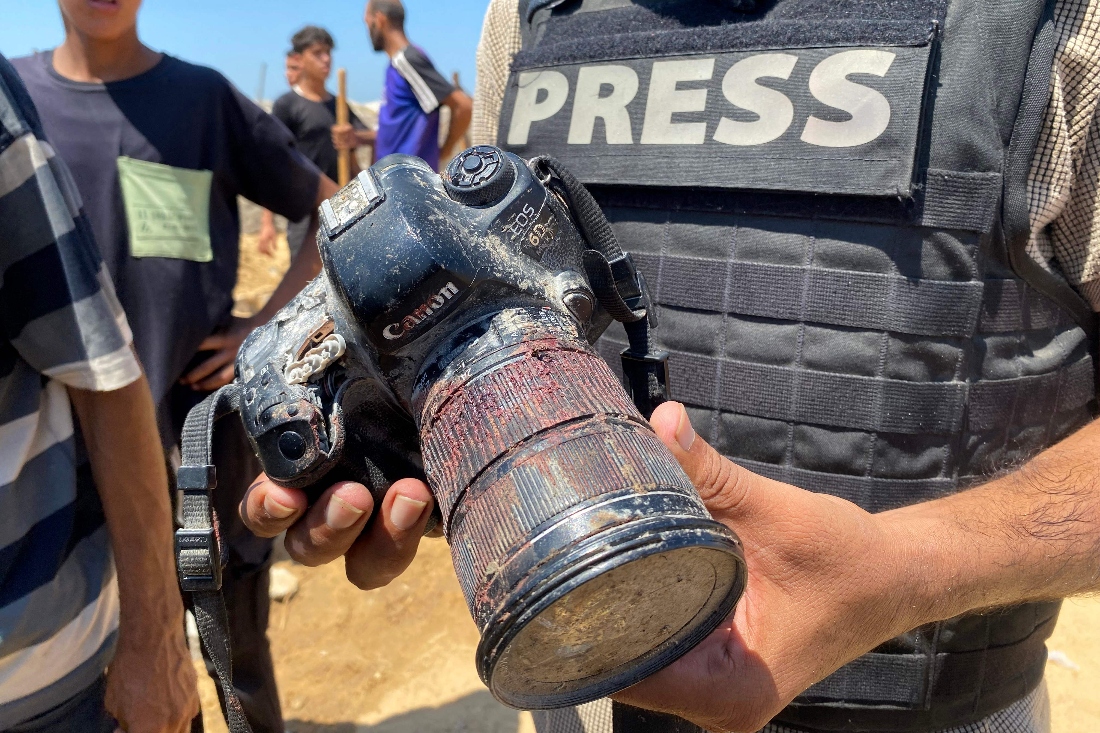
A journalist holds the blood-covered camera belonging to Palestinian photojournalist Mariam Dagga, a journalist who freelanced for AP since the start of the war and who was killed in an Israeli strike on Nasser hospital in Khan Yunis in the southern Gaza Strip, during her funeral. (AFP)
Short Url
Updated 26 August 2025
Follow

The 189 Palestinian journalists killed in the war in Gaza endured hunger and grief
The 189 Palestinian journalists killed in the war in Gaza endured hunger and grief

Since the war began in Gaza, 189 Palestinian journalists have been killed, according to the New York-based Committee to Protect Journalists. They include men and women, freelancers and staffers, veterans with years in the field and young reporters on some of their first assignments. Some were killed with their families at home, others were in vehicles marked “PRESS,” or in tents near hospitals, or out covering the violence. Many endured the same conditions as those they covered — hunger, displacement, and grief.
Among them:
— Mariam Dagga, 33. A visual journalist and a 33-year-old mother, she was known for human-centered reporting from southern Gaza, including at Nasser Hospital, where she was killed in an Israeli strike in August 2025. During the war, she worked for The Associated Press and Independent Arabia. The strike that killed her also claimed the lives of rescuers and four other journalists.
— Anas Al-Sharif, 28. The father of two was killed in an Israeli strike on a tent outside Shifa hospital in August 2025, days after he wept on air while reporting on starvation deaths in Gaza. The strike — which also killed five other journalists — prompted an outpouring of condemnation from press freedom groups and foreign officials.
— Hamza Dahdouh, 27. The son of Al Jazeera’s Gaza City bureau chief, he was killed in a January 2024 drone strike after leaving a reporting assignment at the site of an earlier strike in southern Gaza. He was the fifth member of his family to be killed.
— Ayat Khadoura, 27. The Al Quds University graduate shed light on the hardships families faced in the first weeks of the war. She became known for reporting on bombs striking her northern Gaza neighborhood, including one video in which she said Israeli forces had ordered residents to evacuate moments before a strike hit her home and killed her in November 2023.
— Hossam Shabat, 23. A freelancer from northern Gaza, he was killed while reporting for Al Jazeera in March 2025. Before the war, he told a Beirut-based advocacy group he hoped to start a media company or work in his family’s restaurants.
— Fatima Hassouna, 25. The photojournalist was killed in an April 2025 Israeli airstrike a day after a documentary about her efforts to film daily life amid war in Gaza was accepted at a Cannes Film Festival program promoting independent films.
Israel has accused some of the journalists killed of involvement with militant groups, including Hamas and Islamic Jihad — charges that journalists and their outlets have dismissed as baseless. Israel’s military did not respond to an Associated Press request for comment about the CPJ data.
Figures and methodologies may differ among groups that track journalist deaths. CPJ said it “independently investigates and verifies the circumstances behind each death,” including to verify journalists’ lack of involvement in militant activities.


White House restricts reporters’ access to part of press office

White House restricts reporters’ access to part of press office
Updated 01 November 2025
Follow

White House restricts reporters’ access to part of press office

White House restricts reporters’ access to part of press office
  • Journalists are now barred if they do not have prior approval to access the area known as Upper Press, near the president's office
  • he policy comes amid wider restrictions on journalists by the Trump administration, including new rules at the Pentagon 

WEST PALM BEACH: US President Donald Trump’s administration on Friday barred reporters from accessing part of the White House press office without an appointment, citing the need to protect “sensitive material.”
Journalists are now barred if they do not have prior approval to access the area known as Upper Press — which is where Press Secretary Karoline Leavitt’s office is located and is near the Oval Office.
Reporters have until now been able to freely visit the area, often wandering up to try to speak to Leavitt or senior press officers to seek information or confirm stories.
Media are still allowed to access the area known as “Lower Press,” next to the famed White House briefing room, where more junior press officers have their desks, the memo said.
The policy comes amid wider restrictions on journalists by the Trump administration, including new rules at the Pentagon that major outlets including AFP refused to sign earlier this month.
The change at the White House was announced by the National Security Council in a memorandum titled “protecting sensitive material from unauthorized disclosure in Upper Press.”
“This memorandum directs the prohibition of press passholders from accessing... ‘Upper Press,’ which is situated adjacent to the Oval Office, without an appointment,” said the memo, addressed to Leavitt and White house Communications Director Steven Cheung.
“This policy will ensure adherence to best practices pertaining to access to sensitive material.”
It said the change was necessary because White House press officers were now routinely dealing with sensitive materials following “recent structural changes to the National Security Council.”
Trump has gutted the once powerful NSC, putting it under the control of Secretary of State Marco Rubio, after former National Security Adviser Mike Waltz was reassigned in May following a scandal over the use of the Signal app to plan strikes on Yemen.
Trump’s administration has made a major shake-up to access rules for journalists since his return to power in January.
Many mainstream outlets have seen their access to areas like the Oval Office and Air Force One reduced, while right-wing, Trump-friendly outlets have been given more prominence.
The White House also banned the Associated Press news agency from key areas where Trump speaks after it refused to recognize his order changing the name of the Gulf of Mexico to the Gulf of America.