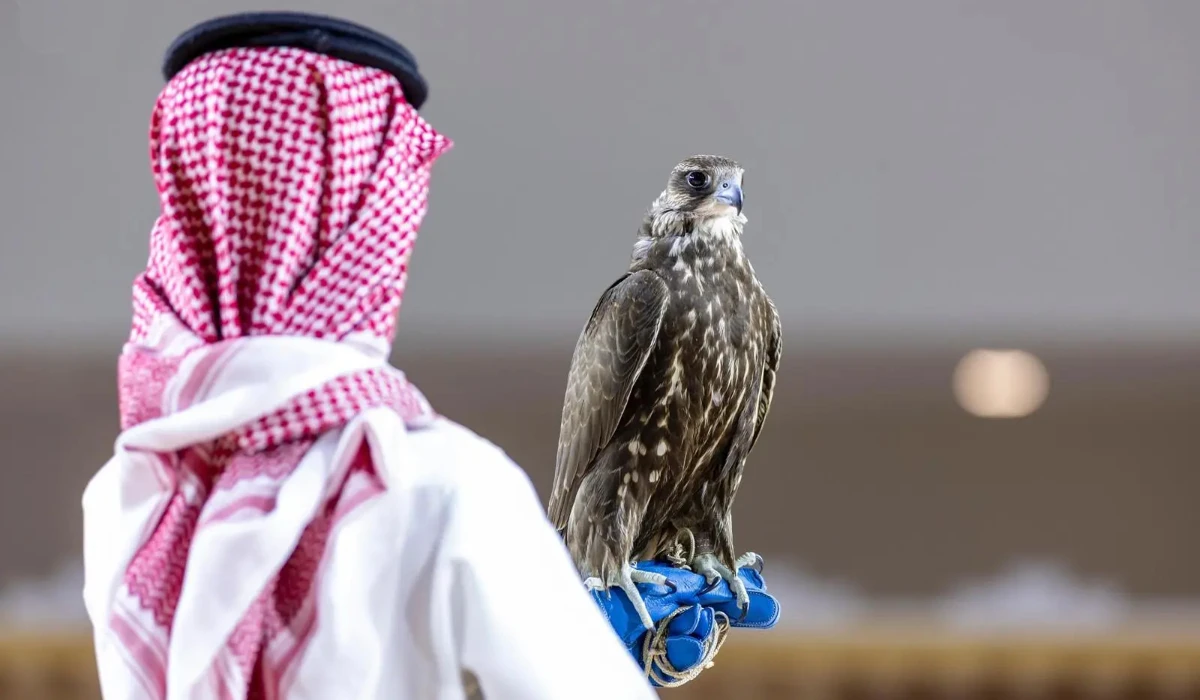
Mongolian falcon sells for SR650,000

The auction of Mongolian falcons continued as part of the exhibition, where two falcons were sold for a total of SR778,000. (SPA)
Short Url
Updated 07 October 2025
Follow

Mongolian falcon sells for SR650,000

The auction of Mongolian falcons continued as part of the exhibition, where two falcons were sold for a total of SR778,000. (SPA
  • The first, a hur farkh (juvenile falcon), opened bidding at SR70,000 and was sold for SR128,000

RIYADH: The most expensive Mongolian falcon to date was sold Monday at the International Saudi Falcons and Hunting Exhibition 2025 for SR650,000 ($173,276) following intense bidding. 

The auction of Mongolian falcons continued as part of the exhibition, where two falcons were sold for a total of SR778,000.

The first, a hur farkh (juvenile falcon), opened bidding at SR70,000 and was sold for SR128,000. The second, a hur qarnas (mature falcon) started at SR100,000 and was sold for SR650,000, making it the most expensive Mongolian falcon ever sold.

For the first time in its history, the International Saudi Falcons and Hunting Exhibition dedicated a special zone to Mongolian falcons, which hold a distinguished status among falconers in the Kingdom and the region for their exceptional quality.

The zone showcases elite falcon breeds from Mongolia in East Asia, particularly the Mongolian hur falcon, known for its large size, long wingspan, and strong endurance.

Its colors range from white to dark brown, and these traits give the Mongolian falcon an advantage in falconry, thanks to its resilience to harsh conditions and quick responsiveness to training, making it one of the most sought-after species among both amateurs and professionals.



Saudi researchers develop AI system for camel herders

Saudi researchers develop AI system for camel herders
Updated 14 November 2025
Follow

Saudi researchers develop AI system for camel herders

Saudi researchers develop AI system for camel herders
  • AI-powered drone system can recognize and track camels from the air 
  • Prof. Basem Shihada and his team at KAUST developed the low-cost system

RIYADH: A research team at King Abdullah University of Science and Technology has created a low-cost, AI-powered drone system that can recognize and track camels from the air.

The system promises an affordable option for camel herders to continue one of Saudi Arabia’s oldest labors and for scientists to learn more about camel migration patterns and habits, according to a KAUST press release.

Created by Professor Basem Shihada and his labmates, the system uses inexpensive commercial drones and cameras to enable camel herders to track their camels in real time without relying on expensive GPS collars or satellite connections.

The team used a single drone-mounted camera to capture aerial footage of small camel herds in Saudi Arabia, then trained their AI model using machine learning. The model revealed new insights into the animals’ behaviors.

“We found their migration patterns were not random but showed identifiable patterns,” said KAUST scientist Chun Pong Lau, who was also involved in the project.

The release added that camels, especially elders, showed coordinated grazing migration, covering long distances throughout the day, but always returned to their herder by sunset. They also showed high sensitivity to the drone’s sound, which is why the KAUST scientists kept the drone at least 120 meters above the ground.

For centuries, camels have been central to Arabian life by providing transport, food and a cultural link to the desert. Today, they contribute more than SR2 billion ($534 million) annually to the Saudi economy through industries such as food, textiles and tourism.

However, herding remains a challenge, with camels roaming up to 50 km a day across isolated terrain. This mobility often leads to road accidents, overgrazing and loss of livestock.

As a next step, Shihada and his colleagues plan to collect video of larger camel herds of more heterogeneous sizes and colors to train their AI system for higher performance.