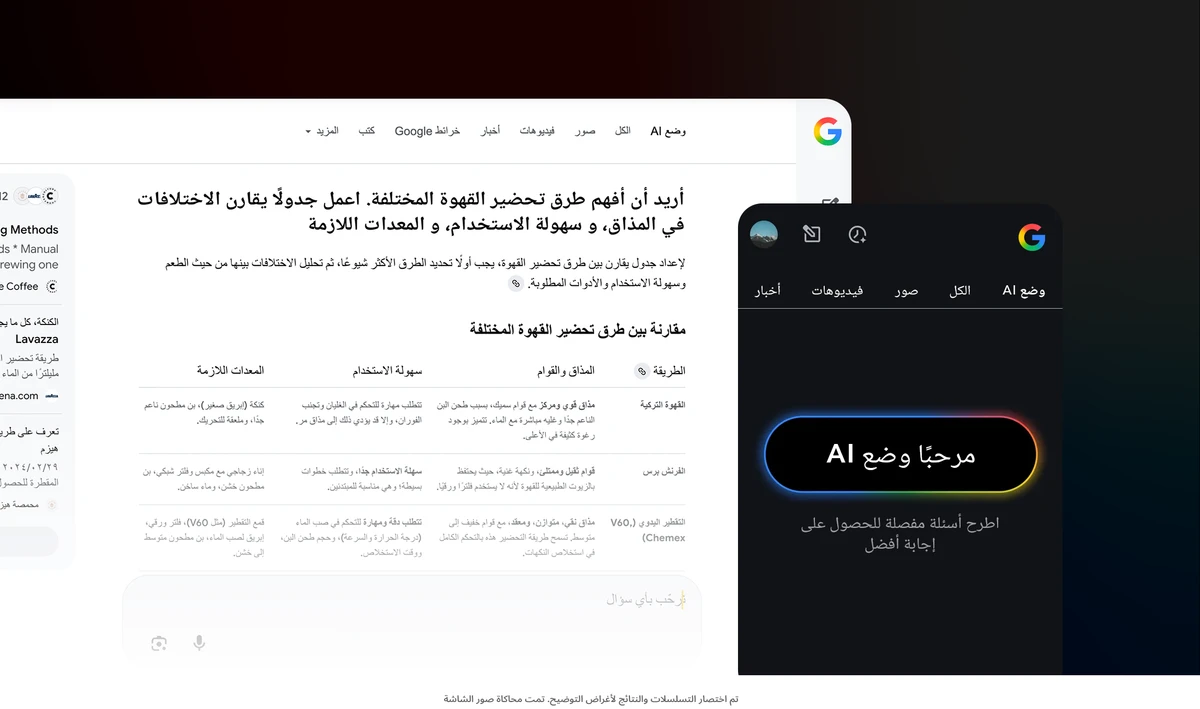
Google expands AI Mode to Arabic and 35 other languages

The update follows the feature’s launch in English in the MENA region this August. (Supplied)
Short Url
Updated 08 October 2025
Follow

Google expands AI Mode to Arabic and 35 other languages

Google expands AI Mode to Arabic and 35 other languages
  • New feature allows users to submit questions via text, voice, offering advanced reasoning, multimodal search

LONDON: Google has rolled out its AI Mode feature in Google Search to 36 new languages, including Modern Standard Arabic, reaching over 200 countries and territories.

Powered by Google’s Gemini 2.5 model, AI Mode offers users advanced reasoning, multimodal search, and the ability to explore topics in depth using follow-up questions and contextual links.

The tool builds on Google’s AI Overviews — the company’s existing artificial intelligence feature at the top part of Google Search results — and allows users to submit questions via text, voice, or images.

“When people use AI Mode to search for a topic, our systems aim to surface relevant links, including news pages, and connect people with a breadth of content and perspectives from across the web, on a wide range of queries,” Najeeb Jarrar, Google’s regional product and marketing director for the Middle East and Africa, said in a statement to Arab News.

“We aim to show an AI-powered response as much as possible, but in cases where we don’t have high confidence, you will see a set of web search results.”

The update follows the feature’s launch in English in the MENA region this August.

Google reports that users in markets where AI Mode is live are now submitting queries two or three times as long as traditional search inputs, reflecting a shift in how people seek information online.

However, the rollout has also prompted debate among experts, many of whom caution that AI-driven search may significantly reduce website traffic by providing direct answers instead of routing users to external pages.

Some studies have found that Google’s AI Overviews have reduced traffic to original websites by as much as 30 to 70 percent, depending on the query.

However, Google, along with other major AI firms, argues the new model is driving “more queries and higher quality clicks.”

The company’s AI Mode uses a “query fan-out” technique, running multiple background searches and aggregating them into a single, cohesive response meant to offer greater breadth and depth than standard search results.

The company said it will continue to add features and capabilities to AI Mode and plans future integration into the main Search experience.

AI Mode appears as a tab on Google Search results, as well as on the Google app for Android and iOS.


YouTube to roll out AI video generation model Veo 3 on Shorts in MENA

YouTube to roll out AI video generation model Veo 3 on Shorts in MENA
Updated 07 November 2025
Follow

YouTube to roll out AI video generation model Veo 3 on Shorts in MENA

YouTube to roll out AI video generation model Veo 3 on Shorts in MENA
  • Veo 3 on Shorts can create high-definition videos in English, but platform said it is looking to expand to more languages and creators
  • According to YouTube’s own figures, 61 percent of Saudi YouTube Shorts users reported that they do not use Instagram Reels

LONDON: YouTube announced on Thursday that it will begin rolling out Veo 3, Google’s most advanced AI video generation model, on YouTube Shorts — free of charge to selected countries in the MENA region — over the coming weeks.

The announcement came during YouTube’s flagship advertiser event, Brandcast, marking the platform’s renewed push into AI as it seeks to solidify its regional presence against competitors TikTok and Meta’s Instagram.

“YouTube has been the launchpad for the creator economy across MENA for over a decade,” said Tarek Amin, YouTube’s regional director for the Middle East, Turkiye & Africa.

“By combining the authentic trust of our creators with powerful AI models like Veo 3, we are offering brands in the region an unmatched ability to drive culture and commerce with audiences they can’t find anywhere else,” he said.

YouTube marked its 20th anniversary since the upload of the historic video, “Me at the zoo,” on April 23, 2005, and has been operating in MENA for more than a decade.

The platform boasts high penetration rates — 94 percent in the UAE and 89 percent in Saudi Arabia — making it the dominant video-sharing platform in the region.

According to YouTube’s data, which it described as “significant and unique,” 61 percent of Saudi YouTube Shorts users and 54 percent of UAE users reported that they do not use Instagram Reels.

YouTube reiterated its commitment to regional growth, stating that the introduction of new features reflects its dedication to creators in MENA.

Among these is Veo 3 on Shorts, which can create high-definition videos. Initially, it will be English-first but plans exist to expand to more languages and creators in the future.

The Google-owned platform also plans to broaden the reach of its auto-dubbing feature, currently available to about 51,000 Egyptian creators translating Egyptian Arabic to English — an AI-powered translation tool enabling creators to reach global audiences.

Additionally, YouTube will launch its “Creator Partnerships Hub and Open Call” in 2026 across MENA to help brands streamline collaborations with creators and identify the best fit for their campaigns.

Key consumer trends were also highlighted, including a notable shift in viewer behavior.

A Kantar survey revealed that viewers in Saudi Arabia and the UAE rank YouTube as their top platform for researching, vetting or making decisions about brands, products or services — outperforming Facebook, Instagram, TikTok, X (Twitter) and Snapchat.

Sixty percent of surveyed Gen Z viewers in Saudi Arabia and the UAE indicated that they prefer watching video product reviews over reading written content or listening to audio reviews.

“We’re building the future of streaming, commerce and entertainment on YouTube,” Amin said. “MENA is a global force in content creation, and we are just getting started.”