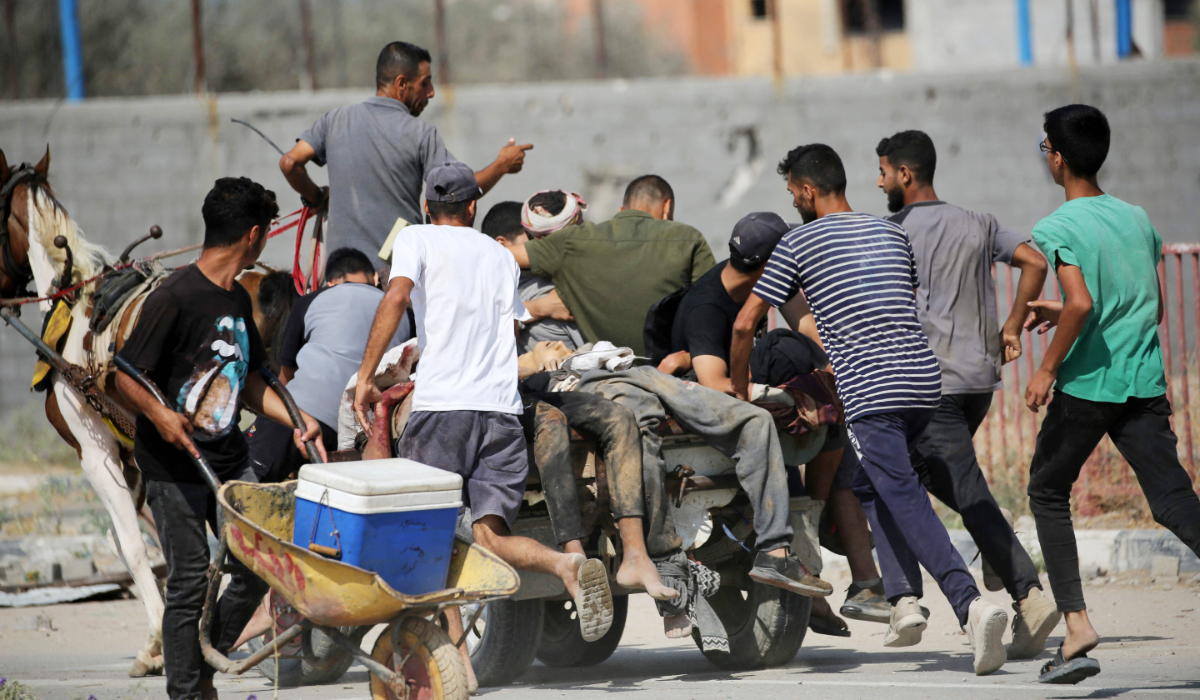
- The Gaza Health Ministry says more than 2,500 people were killed and hundreds more wounded seeking aid, either on route to GHF sites or when Israeli troops fired as crowds massed waiting for UN aid trucks entering Gaza
- Israeli troops pulled out of part of Netzarim on Friday under the terms of the ceasefire deal and are due to withdraw from parts of Rafah later
JERUSALEM: Food distribution sites run by the controversial US and Israel backed Gaza Humanitarian Foundation are being shut down under the terms of the ceasefire deal, an Egyptian official and another official in the region told The Associated Press on Sunday.
Multiple Palestinian witnesses said three of GHF’s distribution sites had been abandoned, in the southern area of Rafah and in the Netzarim area of central Gaza. Palestinians, aid workers and health officials have said the system forced aid-seekers to risk their lives to reach the sites by passing Israeli troops who opened fire to control crowds, killing hundreds. The Israeli military says it only fired warning shots.
Hoda Goda, a Palestinian woman, said the site she often went to in Rafah was vacant and Palestinians tore down structures, taking wood and metal fences. Video circulating online showed people walking away with scrap metal from the site in the Netzarim area of central Gaza. Israeli troops pulled out of part of Netzarim on Friday under the terms of the ceasefire deal and are due to withdraw from parts of Rafah later.
A third official, with knowledge of the situation, said the current plan was to rely on other aid agencies to supply Gaza. All three officials spoke on condition of anonymity because they were not authorized to discuss the deal’s provisions.
A GHF spokesperson said there will be “tactical changes” to its operations and “temporary closures” of some sites over the next few days during the transfer of the hostages to Israel.
“There is no change to our long-term plan,” the official said on condition of anonymity in accordance with the organization’s rules.
UN aid ramping up
The United Nations, which had opposed the GHF distribution, was gearing up to bring increased aid into the devastated territory after the ceasefire came into effect Friday. It said it has about 170,000 metric tons of food, medicine and other humanitarian aid ready to enter once Israel gives the green light.
The Israeli military body in charge of humanitarian aid in Gaza, COGAT, said the amount of aid entering the Palestinian territory was expected to increase to around 600 trucks per day, as stipulated in the agreement.
The UN humanitarian chief Fletcher told the AP that trucks of aid began going into Gaza on Sunday, including cooking gas for the first time in months, but not yet at the scale they hope for in the days and weeks ahead.
He said the UN has a plan for the next two months to restore basic medical and other services, bring in thousands of tons of food and nutritional supplies, fuel and remove rubble.
“Much of Gaza is a wasteland,” Fletcher said. “But I’m absolutely determined that we will not fail. ... We will strain every sinew to deliver for the people of Gaza.” He said the UN has the networks, the expertise and the experience to beat the famine that has taken hold in Gaza City.
US officials have not said they expect GHF to halt all its operations in Gaza, but they have also said there are no current plans to continue funding for it. These officials, speaking on condition of anonymity because the situation is still in flux, said there could still be a role for GHF, or an organization like it, if and when a ceasefire is solidified and if UN and other agencies are not able to handle the demand for assistance or prevent it from reaching Hamas.
COGAT said it was unclear on GHF’s future in Gaza. It had no immediate comment on whether its role was coming to an end.
A controversial system
GHF began operating in late May, after Israel had shut off all food to Gaza for months, pushing the population toward famine. Israel intended for the private contractor group to replace the UN food distribution system, claiming Hamas was diverting large amounts of aid. The UN denied the claims.
The UN had opposed the creation of GHF, saying the system gave Israel control over food distribution and could force the displacement of Palestinians. Throughout the war, the UN led a massive humanitarian effort with other aid groups, distributing food, medicine, fuel and other supplies at hundreds of centers around Gaza.
The four GHF distribution sites were located in Israeli military-controlled zones. Palestinians desperate for food had to walk for miles daily to reach the site past Israeli troop positions. Witnesses said Israeli troops fired heavy barrages to keep crowds from moving before the sites’ opening or from leaving designated roads. Once at the sites, thousands of aid-seekers scrambled in a mad rush to get to food boxes,.
The Gaza Health Ministry says more than 2,500 people were killed and hundreds more wounded seeking aid, either on route to GHF sites or when Israeli troops fired as crowds massed waiting for UN aid trucks entering Gaza. In either case, Israel said it fired warning shots.
GHF says there has been no violence in the aid sites themselves but acknowledged the potential dangers people face when traveling to them on foot. It said last week it had distributed the equivalent of 185 million meals in Gaza since it began operations.