IMF raises Saudi growth forecast to 4% for 2025 and 2026 

IMF raises Saudi growth forecast to 4% for 2025 and 2026 
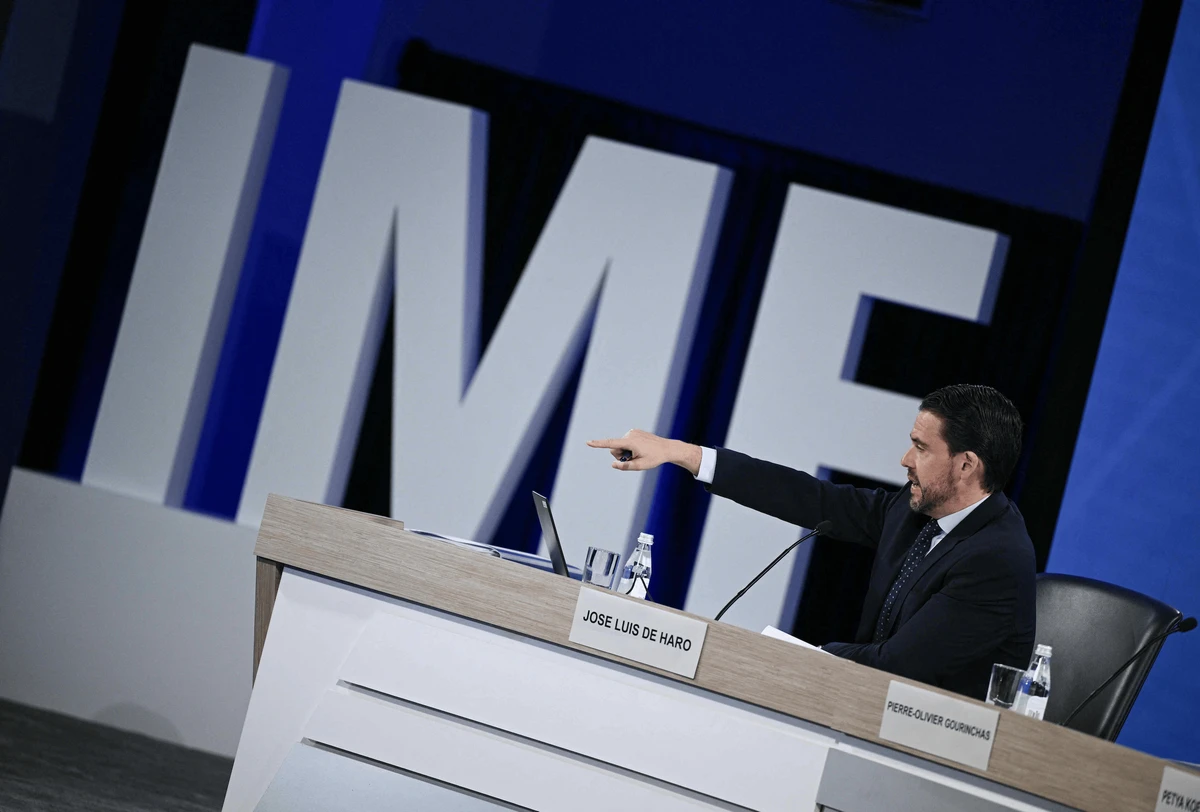
International Monetary Fund Chief Communications Officer Jose Luis De Haro, speaks during the “World Economic Outlook” press briefing during the IMF/World Bank annual meetings in Washington, DC on Oct. 14, 2025. AFP
Short Url
Updated 14 October 2025
Follow

IMF raises Saudi growth forecast to 4% for 2025 and 2026 

IMF raises Saudi growth forecast to 4% for 2025 and 2026 

RIYADH: The International Monetary Fund has raised Saudi Arabia’s economic growth forecast to 4 percent for both 2025 and 2026. 

In its October World Economic Outlook, the IMF upgraded the Kingdom’s 2025 projection from the 3.6 percent it forecast in July, along with an estimate of 3.9 percent for 2026.

The IMF’s updated forecast is broadly in line with projections from other institutions. The World Bank this month said the Saudi economy will expand 3.2 percent in 2025, accelerating to 4.3 percent in 2026 and 4.4 percent in 2027. In September, the Organization for Economic Cooperation and Development also raised its 2026 growth estimate for the Kingdom to 3.9 percent from 2.5 percent. 

Globally, the IMF expects the world economy to grow by 3.2 percent in 2025 and 3.1 percent in 2026. 

In its latest report, the institution said: “Growth in the Middle East and Central Asia is projected to accelerate, from 2.6 percent in 2024 to 3.5 percent in 2025 and to 3.8 percent in 2026.” 

The IMF said the forecast largely reflects developments in Gulf Cooperation Council countries, in particular Saudi Arabia.

The report also noted that Saudi Arabia is expected to maintain an annual inflation rate of 2.1 percent in 2025 and 2 percent in 2026. 

Regional outlook 

The Middle East and North Africa region is expected to post economic growth of 3.3 percent in 2025, rising to 3.7 percent in 2026. 

The IMF projected that the UAE economy will expand by 4.8 percent in 2025 and 5 percent in 2026. 

Qatar is forecast to grow 2.9 percent this year before accelerating to 6.1 percent in 2026. 

Following a slowdown in 2024, Kuwait’s economy is set to rebound in 2025, with growth projected at 2.6 percent. 

The IMF added that both Oman and Bahrain are expected to grow by 2.9 percent in 2025. 

Global outlook 

The IMF attributed the stronger global outlook to several factors, noting that growth is now projected at 3.2 percent this year and 3.1 percent next year. 

The fund said prospects have improved “thanks to the agility of the private sector, which front-loaded imports in the first half of the year and speedily reorganized supply chains to redirect trade flows.” 

It also cited the negotiation of new trade deals between various countries and the US, along with restraint from much of the world, which has largely kept the trading system open. 

Among advanced economies, the US is projected to grow 2 percent in 2025 and 2.1 percent in 2026, while the UK is expected to expand 1.3 percent in both years. 

In emerging markets, India leads with growth of 6.6 percent in 2025 and 6.2 percent in 2026, while the Chinese economy is forecast to expand 4.8 percent and 4.2 percent, respectively.
Saudi Arabia, Canada explore ways to enhance cooperation in technology, innovation 

Saudi Arabia, Canada explore ways to enhance cooperation in technology, innovation 
Updated 04 November 2025
Follow

Saudi Arabia, Canada explore ways to enhance cooperation in technology, innovation 

Saudi Arabia, Canada explore ways to enhance cooperation in technology, innovation 

RIYADH: Saudi Arabia’s technology and innovation partnership with Canada is set to receive a boost after senior ministers met to explore new avenues of cooperation and strengthen trade ties. 

Saudi Minister of Investment Khalid Al-Falih said in a post on X that he met with Canada’s Minister of Artificial Intelligence and Digital Innovation Evan Solomon to discuss ways to strengthen relations between the countries and to build partnerships that contribute to mutual economic growth, particularly in priority investment sectors. 

This comes as trade between the two nations continues to expand. In February, Saudi Arabia exported SR641 million ($170 million) to Canada, marking an 86.6 percent increase from SR344 million in February 2024, according to data from the Observatory of Economic Complexity.

It also follows an agreement in January 2024 for both countries to re-exchange trade delegations to enhance economic relations and boost trade and investment flows. 

In a subsequent post on X, Al-Falih stated: “The dialogue took place between me and Anita Anand, the Canadian Minister of Foreign Affairs, in the presence of the Saudi ambassador to Canada, Amal Yahya Al-Moallimi.” 

He added: “We discussed supporting and strengthening relations between our two countries, and facilitating investment exchange, in order to achieve more fruitful cooperation in the most important sectors, which will bring success to both peoples.” 

Artificial intelligence has become a central pillar of Saudi Arabia’s post-oil economic strategy, with the Kingdom leveraging advanced technologies to drive data-led industries and automation. 

Now at the halfway point of Vision 2030, the country is accelerating efforts to position itself as a global technology leader, balancing innovation with sustainability goals. 
Key initiatives — including the Project Transcendence program, valued at around $100 billion — aim to further establish Saudi Arabia as a global hub for AI innovation. 

Over the past five years, Saudi Arabia has made significant progress toward establishing itself as a regional artificial-intelligence hub. PwC projects that AI could contribute about $235 billion — or 12.4 percent — to the Kingdom’s gross domestic product by 2030.